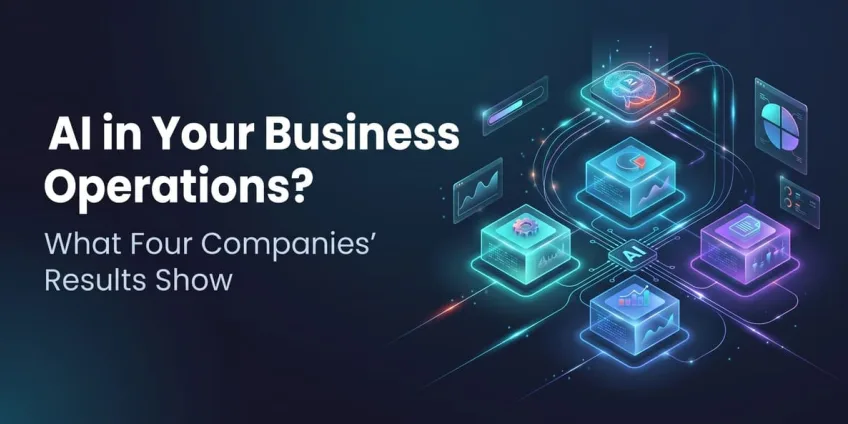
How Much Should AI Run Your Business Operations? What Four Companies' Results Show
Business optimizationPublished on by Alex Korniienko • 9 min read read
- Why AI in business operations rarely reaches the P&L
- Rules, models and authority: four levels of control
- When the system decides alone: UPS route optimization
- When AI answers and hands off: Air India's virtual agent
- When AI drafts and a person sends: Octopus Energy's service emails
- When AI replaces a team: what Klarna's reversal shows
- How to choose the level of control for each operation
- What the build involves beyond the model
- AI in business operations: FAQ
- Start with the level of control, not the model
Klarna's AI assistant handled two-thirds of the company's customer service chats in its first month, in early 2024. Klarna said that equalled the work of 700 full-time agents. In 2025, its CEO admitted the push had lowered quality, and the company started hiring people back. The assistant stayed, though, and by late 2025 Klarna credited it with the work of 853 agents.
Results from AI in business operations depend less on the model than on how much authority the system gets. Give a machine full control over a narrow, measurable task and it can run for years. Give it a whole team's judgment, and errors show up in customer complaints first. Four public records from UPS, Air India, Octopus Energy, and Klarna sit at four different levels of that authority.
The records below show what each level looks like in practice, with figures from each company's own reports or a published case study. Later sections turn those records into a table for choosing a level per operation and list what the build needs beyond the model.
Why AI in business operations rarely reaches the P&L
Access to AI is no longer the constraint. McKinsey's 2026 State of AI survey of 1,719 respondents found that nearly nine in ten organizations use AI in at least one business function and 44% are scaling it across the enterprise. Only 37% attribute any EBIT impact to it, about the same share as a year earlier. Roughly 6% qualify as high performers, meaning AI drives at least 5% of their EBIT and they call its impact significant.
The high performers share one habit that matters for operations. Nearly three-quarters of them redesign workflows from the ground up when they deploy AI, against about a quarter of everyone else. The figures come from the McKinsey State of AI 2026 report. Redesigning a workflow means deciding who makes each call: a rule, a model or a person. A project that skips that step adds a model to a process designed for people and leaves the question of authority open.
Gartner's June 2025 forecast points the same way. More than 40% of agentic AI projects will be cancelled by the end of 2027, because of escalating costs, unclear business value or inadequate risk controls. Gartner also estimated that only about 130 of the thousands of vendors selling "agentic AI" offer real agentic products. That is the risk for agentic AI in business operations: an agent with no defined authority has no defined value either. For the wider data on where process automation pays and where it stalls, see our breakdown of AI business process optimization pros and cons.
Rules, models and authority: four levels of control
Automation and AI are often used as synonyms, but they handle different things. Rule-based automation executes a decision someone already made: if an invoice matches the purchase order, approve it. AI makes a judgment where no rule fits, such as reading a customer's question and choosing an answer. For an operations lead, the practical question is how much of that judgment the system may act on without a person.
Four levels cover most real deployments, from route planning to customer service. The first is full autonomy inside a narrow task, where the system decides alone. Next is AI that answers on its own but hands anything unusual to a person. A third level keeps AI in a drafting role, with a person approving each output. The fourth replaces the role outright.
Each company below sits clearly on one of these levels. Its results show what that level demands of the surrounding process, not just the technology.
When the system decides alone: UPS route optimization
ORION is UPS's route optimization system: it calculates the order in which a driver makes the day's stops. The task is narrow, with one objective (fewer miles for the same deliveries), constraints known in advance and a result anyone can read on an odometer. UPS tested the system between 2010 and 2012 before the wider rollout. In a 2015 announcement, the company reported a reduction of 6 to 8 miles per route.
UPS expected the full US rollout to save about 100 million miles, 10 million gallons of fuel and more than $300 million a year. The company had earlier valued cutting one mile per driver per day at up to $50 million annually. None of this needed generative AI. That arithmetic explains why full autonomy worked here: each error is small, visible in the next day's data and cheap to correct.
Level one suits operations where the objective fits in one number. Route length, reorder points and staffing against forecast demand share that profile. Once the objective needs a human reading of context, such as a customer's tone, the same autonomy becomes a risk.
When AI answers and hands off: Air India's virtual agent
Air India launched its generative AI agent, AI.g, in May 2023 on Azure OpenAI models, with retrieval over the airline's own policy documents. By February 2026, Microsoft's case study on Air India reported around 40,000 customer queries a day across more than 1,300 topics. AI.g had handled more than 13 million conversations with a 97% success rate, according to the airline.
The design choice that matters is the exit. When AI.g detects that a customer needs more help, it escalates to the contact center instead of improvising. In 2024, chief digital and technology officer Satya Ramaswamy told Campaign Asia that the airline tracks the share of queries passed to people, then about 7%. By 2026, Microsoft's case study put that share at about 3%. His team automatically groups wrong answers, then reviews them by hand to find and fix the cause.
Air India also didn't force the channel. Roughly half of its customers pick AI.g first, and the other half still prefer a human agent, which the airline accepts. Level two works when answers come from documents the company controls and a person is one step away. Customer-facing generative AI in business operations can reach this level without betting the whole service on the model.
When AI drafts and a person sends: Octopus Energy's service emails
Octopus Energy, the UK's largest energy supplier, runs customer service on Kraken, the platform it built in-house. Kraken's Octopus Energy case study (checked November 2026) reports that 60% of customer communications are first drafted by AI for agents. It also reports that 89% of AI-drafted outbound content goes out unchanged. The AI writes for the agent, not for the customer, so a person stays accountable for every message.
That 89% figure deserves a second look. Agents still change roughly one draft in nine, which is the share a fully autonomous system would have sent as written. Kraken also cites a 40% lower cost to serve. But the company ties that figure to putting every customer query in one platform. Reading it as an AI result would overstate what the drafting tool did.
Level three trades some speed for a review step, and it pays only when reviewers have time to read. If agents start approving drafts without reading them, the company is running level four without admitting it. Tracking the unchanged-send rate over time is the simplest way to see that drift.
When AI replaces a team: what Klarna's reversal shows
Klarna went furthest. Its February 2024 announcement said the assistant worked in 35 languages and cut average resolution time from 11 minutes to 2. Klarna also estimated a $40 million profit improvement for that year. Customer satisfaction, the company said, matched human agents. Recruitment was frozen while the assistant absorbed the work.
By May 2025, CEO Sebastian Siemiatkowski was telling Bloomberg that the cost focus had produced lower quality. Klarna began recruiting human customer service staff again, and its communications head described the new split as AI for speed and people for empathy. A month later, Gartner predicted that half of the companies planning large AI-driven cuts to customer service staff would drop those plans by 2027.
Still, the reversal was partial, and that is the useful part. On its third-quarter 2025 earnings call, Klarna said the assistant now did the work of 853 full-time agents and had saved $60 million. What changed was the level: AI keeps the routine volume, and customers can reach a person for the rest. Klarna moved from level four back to level two. Level four has to be earned at the levels below it.
How to choose the level of control for each operation
The four records suggest a simple test. Raise the level of control only as far as the task allows: how narrow the objective is, how fast an error becomes visible and who catches it. The table maps each level to typical operations and to what has to be true before you use it.
| Level of control | Typical operations | Must be true first | What fails if it isn't |
| 1. System decides alone (UPS) | Route planning, reorder points, staffing against forecast | One measurable objective, cheap errors, historical data | Small errors repeat at scale before anyone notices |
| 2. AI answers, people take exceptions (Air India) | High-volume customer questions, order status, policy lookups | Current source documents, a working escalation path, a tracked escalation rate | Customers loop with the bot or get outdated policy answers |
| 3. AI drafts, a person approves (Octopus Energy) | Service emails, invoice coding, reconciliation exceptions, payouts | Reviewers with time and authority, a tracked unchanged-send rate | Rubber-stamp approvals, or reviewers become the bottleneck |
| 4. AI replaces the role (Klarna, 2024) | Rarely justified as a starting point | Proven results at levels 2 and 3, a human fallback kept | Quality drops, then the cost of rehiring |
Nothing in the four records argues for skipping levels. Air India reached 97% automation with an exit to people built in from the start. Klarna ended up with the same arrangement after trying without it. Start most customer-facing work at level two or three, and move up only when the numbers from the lower level hold for months.
Running the test works best one operation at a time. Pick a process and write down its current cost per case, error rate and cycle time before anything changes. Set the level, then review the same numbers after a full business cycle. Raise the level only if those numbers held.
What the build involves beyond the model
Every level above the first needs engineering around the model. The usual parts are connections to the systems that hold the data and rules that decide when to escalate. Add a queue for review and approval, plus monitoring that shows when a run failed. Teams scoping AI for business operations often budget for the model and discover the rest during the build.
Two projects our developers worked on show what level three looks like in code. Roman M. built document-processing pipelines for invoices and purchase orders on a workflow rule engine, with configurable business rules and role-based review and approval stages. Denis M. built a back-office reconciliation system that matches transactions from payment providers and internal ledgers against orders and invoices. Mismatches such as missing captures, partial refunds and duplicate charges go to review queues with evidence attached, and payouts pass through approval workflows with thresholds and audit logs. For three more builds and what stayed with people, see our workflow automation case studies.
In both systems, code does the matching and flags the exceptions, while a person signs off on anything that moves money. That split keeps accountability with people and gives the machine the repetitive work. For this kind of build, look for automation developers who have wired rule engines and review queues into existing systems. Add AI engineers who work with LLMs and document extraction for the steps where a model reads documents or drafts replies.
AI in business operations: FAQ
- Which business operations should a company automate first? Start with high-volume back-office work with a clear before-and-after number, such as invoice matching, reconciliation, or document intake. MIT's NANDA initiative (2025) found the clearest returns in back-office automation, even though more than half of generative AI budgets went to sales and marketing tools. Back-office processes repeat thousands of times, follow known rules, and make results easy to measure.
- RPA or AI agents: which fits a rule-based process better? For a rule-based process, RPA is usually the better fit, because the decision is already defined and only needs executing. AI agents add value where inputs vary and judgment is needed, such as free-text emails or unfamiliar documents. Gartner (2025) noted that many use cases sold as agentic do not need an agentic implementation. A stable, rule-bound process rarely justifies the extra cost and risk.
- What is agent washing? Agent washing is rebranding existing AI assistants, robotic process automation tools, or chatbots as agentic AI without real autonomous capabilities. Gartner (2025) used the term in its warning and estimated that only about 130 of the thousands of vendors claiming agentic AI are genuine. Buyers can test a claim by asking which multi-step decisions the product makes on its own and how it handles exceptions.
- How do you measure whether an AI automation is working? Measure an AI automation against a baseline taken before launch: cost per transaction, cycle time, error rate and escalation share. Air India, for example, tracks how many queries its virtual agent passes to a person. A falling escalation rate with stable quality means the automation is absorbing more work. Hours saved alone do not prove a return.
- Why do so many agentic AI projects get cancelled? Agentic AI projects get cancelled mostly because costs rise faster than measurable value. Gartner (2025) expects more than 40% of them to be scrapped by the end of 2027, citing escalating costs, unclear business value and inadequate risk controls. Many begin as proofs of concept driven by hype rather than a defined process, so nobody can show what the agent saved.
- Should a small business use AI agents or simple workflow automation? A small business usually gets more from simple workflow automation first, then adds AI where inputs are messy. Tools such as n8n or Salesforce Flow can connect forms, a CRM and invoicing without a model in the loop. Gartner (2025) recommends pursuing agentic AI only where it delivers clear value, which for a small team means one narrow task, not a general assistant.
- What skills does a team need to build AI automation for operations? A team building AI automation for operations needs integration skills more than model research. Typical work includes connecting CRMs, ERPs and payment systems, writing rule engines, building review queues and monitoring failed runs. In Cortance's automation projects, developers work with n8n, Salesforce Flow and Apex, Python, Java, Node.js and .NET. An AI engineer joins when a model has to read documents or draft text, as our breakdown of what remote AI developers build shows.
Start with the level of control, not the model
The four records point one way. UPS let a system decide alone because the task was narrow and errors were cheap. Air India and Octopus Energy kept a person within reach, one through escalation and one through review. Klarna gave AI the most authority, then moved part of it back to people.
Before choosing AI tools for business operations, list your operations and assign each one a level from the table above. If a process has no escalation path or review step yet, build that first. When you need engineers for that part, Cortance can match you with developers who have built rule engines and review queues before.
Related Articles
How to Add AI to Your Product by Fixing the Flows Users Already Struggle With
Most AI features get bolted on beside the product. The ones that stick fix a specific step where users already stall.
Read article
Cultural Fit, Timezone, English Level: Why Technical Skills Are Only Half the Hiring Decision
Two candidates pass the same technical test. Only one of them will actually work well with your team.
Read article
Reduce SaaS Development Costs with AI in 2026
AI adoption is at an all-time high. Real cost savings are not. Here's the gap most SaaS teams are missing in 2026.
Read article