Cultural Fit, Timezone, English Level: Why Technical Skills Are Only Half the Hiring Decision
Business optimizationPublished on by Yevhen Vavrykiv • 9 min read read
- The Real Price of Hiring for Tech Stack Alone
- The Three Filters Standard Screening Misses
- Timezone Overlap
- English Level
- Work-Style Compatibility
- The 8-Parameter Framework for Full-Profile Hiring
- Tech-Stack-Only Hiring vs Full-Profile Hiring
- Where to Prioritize First
- What This Looks Like Once It's Built In
- FAQ
- The Takeaway
A practical framework for evaluating the parts of a developer's profile a coding test can't measure
Six in ten HR managers admit they misjudged whether a candidate would actually fit into their team's way of working. Two out of three of them went on to lose that employee because of it, according to a Robert Half survey. Those aren't unqualified hires. Most of them passed the technical interview. What they didn't pass was everything the technical interview never tested.
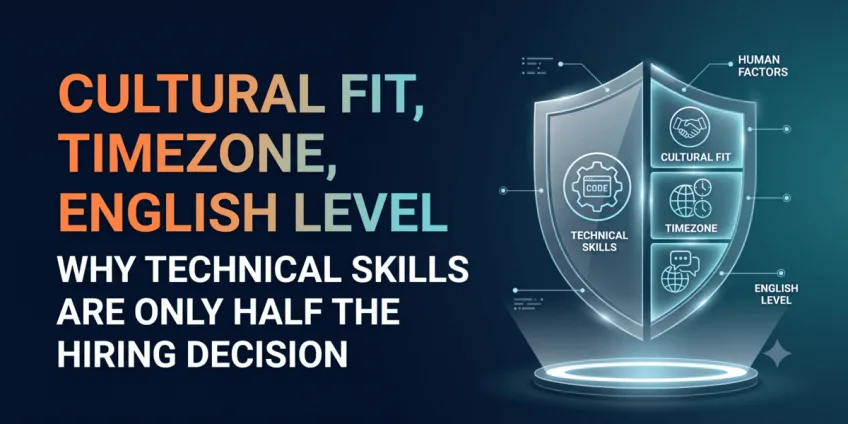
Technical skills confirm what a developer can build. Cultural fit, timezone overlap, and English proficiency determine whether that ability actually reaches your team, on schedule, in a way your team can act on. A candidate who clears every coding round can still slow a project down if shared working hours are limited, written feedback keeps getting misread, or their pace and communication style don't align with how your team actually operates.
This guide breaks down why hiring criteria built entirely around a tech stack keep producing hires that "should" work but don't, and what a fuller evaluation looks like in practice.
The Real Price of Hiring for Tech Stack Alone
Most hiring scorecards are built around one question: can this person write the code the role requires? It's the easiest thing to test, so it gets the most weight. The problem is that it's rarely the thing that determines whether a hire sticks.
The average cost to fill a single non-executive role in the US now sits at $5,475, according to SHRM's 2026 Benchmarking Report. That figure covers recruiter time, job ads, and screening. It says nothing about what happens after the offer is signed, when a technically strong developer turns out to be a poor match for how the team communicates or when they're actually reachable.
That mismatch is common, and it's expensive in ways that don't show up on a recruiting invoice. Gallup's 2026 State of the Global Workplace report estimates that low engagement costs the global economy roughly $10 trillion in lost productivity a year, a number driven in large part by employees who never really connected with how their team operates. A developer who is technically capable but structurally out of step with the team rarely gets flagged as a "bad hire." Instead, delivery just gets slower, one delayed handoff and one misread Slack message at a time.
This is the gap most hiring criteria leave open. Not a skills gap. A fit gap that only shows up after the contract is signed.
Picture a sprint where a strong backend developer joins a team with four hours of timezone overlap and a written English level that's fine for documentation but shaky in a live standup. Nothing about that developer is unqualified. But every pull request now waits an extra half-day for review, every clarifying question turns into a written thread instead of a two-minute call, and the team quietly starts routing complex tasks around them instead of to them. None of that shows up as a hiring failure on a spreadsheet. It shows up as a sprint that slips, then another, until someone finally asks why the timeline keeps drifting.
The Three Filters Standard Screening Misses
A technical interview tests whether someone can solve a problem. It says almost nothing about whether they can solve it with your team. Three filters matter here, and none of them show up on a whiteboard test.
Timezone Overlap
Working hours don't need to match exactly, but they need to overlap enough for real conversation to happen. Distributed engineering research from DSi (2024) found a consistent pattern across remote teams: below two hours of daily overlap, coordination costs spike, and simple questions turn into overnight round trips. Between three and five hours, most teams settle into a working rhythm. Past six hours, the extra overlap adds little more.
That gap matters most in the moments that can't wait for async. Code review on a complex change. Unblocking someone stuck on a bug. A production incident that needs more than a Slack message someone reads eight hours later. Teams with wider overlap consistently see pull requests approved in hours rather than a full working day, simply because a question and its answer can happen in the same conversation rather than in two separate ones split by a night's sleep.
A developer with an excellent resume and zero overlap with your core hours isn't a bad developer. They're a bad fit for a role that requires real-time back-and-forth. The same person, on an asynchronous-first team building out a well-documented backlog, might be exactly the right hire.
English Level
The relevant question isn't whether a candidate is fluent. It's whether they can write clearly under pressure and understand nuance without a follow-up call. A 2022 survey by workplace-English platform Linguix found that over half of respondents had personally experienced a language barrier at work, and that the issue cuts both ways: native English speakers in the same survey reported struggling to communicate with non-native colleagues in writing almost as often as the reverse.
For an engineering team, this shows up in specific, testable ways. Can the candidate write a pull request description someone can act on without asking three clarifying questions? Can they explain a technical tradeoff out loud, in real time, without losing the thread? Can they push back on a requirement they think is wrong, in writing, clearly enough that a product manager understands the objection on the first read? These are learnable and testable skills, not a pass-or-fail based on accent, and a short writing sample plus one live technical conversation will surface the answer faster than any resume line claiming "fluent English" ever will.
Work-Style Compatibility
"Cultural fit" gets used as a vague catch-all, and that vagueness is exactly why it keeps getting skipped in favor of tech stack checklists. Broken into specific components, it's not vague at all: how directly someone gives feedback, how much structure they need versus how much autonomy they expect, how they handle disagreement with a lead.
Value misalignment shows up early and it shows up in the hiring funnel itself. Deloitte's 2026 Gen Z and Millennial Survey found that 39% of Gen Z respondents and 34% of millennials had turned down a job offer specifically because it didn't align with their values. That's before the person is even hired. Once someone is on the team, the same misalignment tends to surface as friction with a lead, disengagement in standups, or a slow drift toward doing the minimum.
The 8-Parameter Framework for Full-Profile Hiring
Once tech stack, timezone, English level, and work style are all on the table, the next question is how to actually evaluate them without turning every interview into a four-hour ordeal. A workable framework needs to score a candidate across eight dimensions, not one.
Start with the technical stack itself: can they do the specific work the role requires, not a generic version of it. Pair that with seniority calibration, since a mid-level developer dressed up as senior fails differently than a junior one does. Then map timezone overlap against your actual team's working hours, not an idealized version of them. Layer in English proficiency, tested through writing and live conversation rather than a resume line. Add communication style, meaning how directly someone raises a problem or pushes back on a decision. Include work-culture fit, covering autonomy versus structure and how someone responds to feedback. Factor in domain familiarity: a developer who has shipped in a regulated industry moves faster in that domain than a generalist would. Close with delivery reliability: whether their availability and pace match what the role actually demands, not what the job post assumed.
Not every parameter needs to carry equal weight for every role. A short-term contract to fix a well-defined bug list can tolerate a wider timezone gap than a role embedded in daily architecture discussions. A junior hire working under close supervision can tolerate more variation in work style than a tech lead who needs to challenge decisions on day one. The framework works best as a weighted scorecard, not a checklist where every box has to be ticked identically.
Platforms that run a multi-stage evaluation process build these eight parameters into the screening itself, rather than leaving them for the hiring manager to catch in a single interview.
Tech-Stack-Only Hiring vs Full-Profile Hiring
| Dimension | Tech-stack-only hiring | Full-profile hiring |
| What gets tested | Coding ability, framework knowledge | Coding ability plus timezone, English level, work style |
| Where problems surface | Weeks or months into the role | Before the offer is made |
| Typical failure mode | Slow delivery, silent disengagement | Rare, since misfit is filtered pre-hire |
| Who catches the gap | The team, after the fact | The vetting process, before the match |
| Cost of a miss | Full replacement cycle plus lost sprints | Limited to the initial screening time |
Where to Prioritize First
Not every company needs all eight parameters weighted equally, and trying to enforce that on day one usually backfires. A seed-stage team hiring its first remote developer should weigh timezone overlap and English clarity heaviest, since there's no buffer of existing process to absorb a slow handoff. A scaling team with an established engineering culture can afford more timezone spread but should weight work-style fit more heavily, since one misaligned senior hire can reset what the rest of the team treats as normal. A larger, already-distributed organization has more room on all three, but tends to underweight domain familiarity, which is often the parameter that actually predicts ramp-up speed.
The point isn't to score every candidate against a rigid checklist. It's to know, before the interview even starts, which two or three of the eight parameters would actually break the role if they were wrong. Ask what the role genuinely can't survive without: is it real-time overlap for pairing sessions, written clarity for async handoffs, or comfort pushing back on a roadmap decision in a language that isn't the person's first. Whichever answer comes up first is the one to screen for hardest, and the one worth spending the extra ten minutes on in every interview.
What This Looks Like Once It's Built In
For teams that have already lost a quarter to a hire that looked right on paper, the shift isn't complicated. It starts with treating timezone, English level, and work style as requirements to screen for, not qualities to hope for. Around 600 developers hold active contracts with Cortance, matched across the full compatibility profile rather than on tech stack alone, and a first shortlist typically arrives within 30 minutes during business hours, or by 11 am the next morning for requests submitted off-hours. That speed is possible precisely because the fit screening happened before the request came in.
FAQ
- What percentage of failed hires are due to poor fit rather than a lack of skills? Robert Half's research found that 6 in 10 HR managers had misjudged a candidate's fit with their team's work environment, and 2/3 of those cases ended with the employee leaving. The technical skills were rarely the issue.
- How many timezone overlap hours does a distributed team actually need? Research by DSi on distributed engineering teams found that three to five hours of daily overlap is where most teams reach a workable rhythm. Below two hours, coordination costs rise sharply. Past six, additional overlap adds little further benefit.
- Can a highly skilled developer still be a bad hire? Yes. A developer can pass every technical round and still underperform if working hours don't overlap with the team, if written communication creates friction, or if their work style clashes with how the team already operates.
- What compatibility factors matter most when hiring remote developers? Tech stack and seniority still matter, but timezone overlap, English proficiency, communication style, and work-culture fit are what determine whether that technical ability reaches the team on schedule.
The Takeaway
A tech stack match tells you what a candidate can build. It doesn't tell you whether they'll actually be able to work with the people already on your team, in the hours you need them, in a way everyone can understand. The companies that keep losing quarters to hires who "looked right" are usually the ones still treating timezone, English level, and work style as nice-to-haves rather than requirements. Building them into the hiring criteria from the start, rather than discovering the gap three months in, is what separates a technically qualified hire from one that actually works.
- #insights
- #smarthiring
- #skill
- #transformation
- #teamextention
- #bodyleasing
- #hire
- #upworkalternative
- #offshore
Related Articles

Reduce SaaS Development Costs with AI in 2026
AI adoption is at an all-time high. Real cost savings are not. Here's the gap most SaaS teams are missing in 2026.
- #howto
- #saas
- #smarthiring
- #optimization
- #transformation
- #LLM
- #vibecoding
- #claudecode
- #codex
- #servicetech
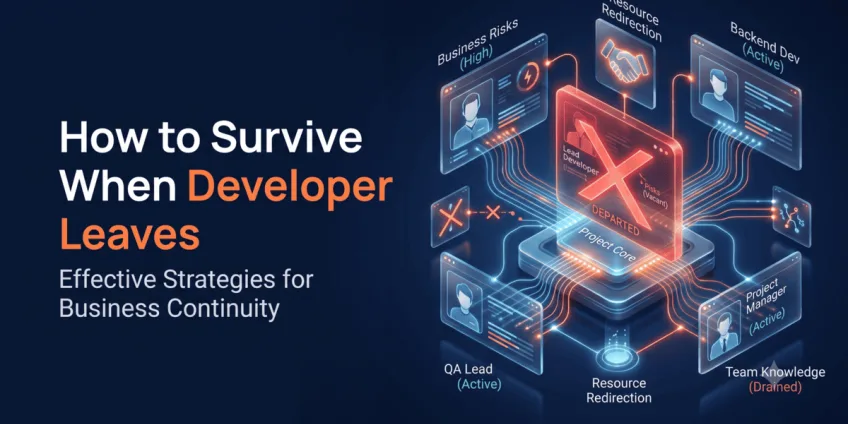
What Happens to Your Product When a Developer Leaves - And How to Survive It
One resignation can stop a sprint, drain team capacity, and open a 45-90 day hiring gap. Most companies have no plan for that moment.
- #bestpractices
- #tips
- #smarthiring
- #findadeveloper
- #hire
- #talentprovider
- #upworkalternative
- #offshore
Why Hiring a Developer Takes Weeks or Months - And How to Cut It Down to 3 Days
The average developer role stays open 41 days. For senior engineers, it's closer to three months. Here's the step most hiring managers miss.
Read article