




Define Your Hiring Needs
15-minute call
Share the tech requirements for Scala developer position or browse high level Scala developers on the platform.

Screened Scala engineers for hands-on Akka and Kafka production work, with the Java depth that Java-to-Scala migrations need.

Scala is not a language people stumble into, and that shows the moment you try to hire Scala developers. Only a handful of engineers in the Cortance network list it as a working skill, and that scarcity alone makes some hiring managers nervous. It should not. The developers who kept using Scala after the hype faded needed its type safety and concurrency model, not a trend to follow. That is why vetting matters more here than for almost any other stack: a shallow interview will not catch the difference between someone who added Scala to a resume once and someone who has shipped Akka services under production load.
The Scala ecosystem we recruit for
Most of the Scala engineers we place did not learn the language in isolation. They came up through Akka for actor-based concurrency, with Kafka as the messaging backbone that Scala services tend to sit next to. On the functional side, working knowledge of Cats or ZIO signals someone who treats Scala as a functional language rather than Java with fewer semicolons, and that distinction shows up in code review within the first week. Because Scala compiles to JVM bytecode, the strongest candidates also carry solid Java experience, which matters if your team plans to migrate a Java service into Scala instead of starting from a blank repository.
What Projects Have Our Scala Engineers Worked On?
Our developers' distributed-systems portfolio includes production Kafka and Akka work, not tutorial projects. Recent work delivered:
Why Scala Still Wins High-Throughput and Data-Heavy Systems
Teams do not choose Scala for the syntax. They choose it because Akka's actor model handles concurrent, stateful systems more predictably than thread-per-request architectures, and because a statically typed functional language catches entire categories of bugs in a data pipeline before they reach production. Fintechs use it for low-latency trading and risk systems. Data platforms use it for pipelines that have to run correctly the first time, not the third retry. SaaS companies growing out of a Java monolith often use Scala as a stepping stone, since both languages share the JVM and can run side by side during a phased rewrite. None of this is a reason to hire Scala developers reflexively. It is a reason to hire the ones who can prove they have run these systems under production load.
How we shortlist Scala engineers
Because so few developers work in Scala day to day, sourcing on your own usually means reading resumes that mention it once and never again. Cortance screens for hands-on Akka and Kafka experience before a candidate ever reaches you, so you see a short, honest list instead of a long unreliable one. Share your project scope and team structure, and we will match you with Scala engineers whose experience fits the system you are building, whether that is a dedicated team, a senior architect running a Java-to-Scala migration, or staff augmentation for a data pipeline under a deadline. A matched engineer can onboard in about 2 days.
Cortance is a hiring platform that matches companies with vetted remote developers from its own network.
Hire pre-vetted Scala Developers in three steps. From initial call to onboarded expert in days, not months.
Share the tech requirements for Scala developer position or browse high level Scala developers on the platform.
Receive tailored Scala proposal matched to your requirements. Scale your team up or down without any delays.
We handle onboarding, payroll, and ongoing Scala support. Focus on your business goals while we manage all hiring complexities.
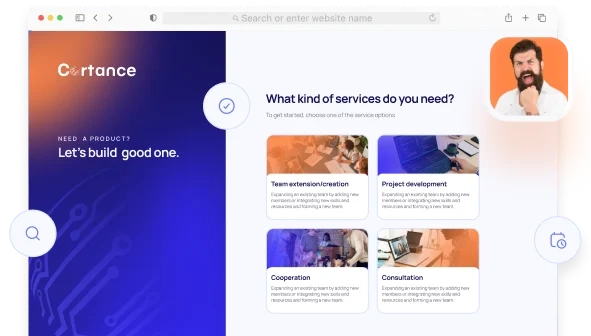
Most Scala projects require additional expertise. Whether you need front-end devs, DevOps specialists, or database architects, we connect you with professionals who integrate with your Scala team.
Can’t find what you are looking for?
Explore our technical capabilities and find the right tech stack for your needs.
