

OpenAI Developers Who Take GPT Prototypes to Production
OpenAI engineers from our own network who take chatbots, agents and RAG features from prototype to production, ready to start within 2 days.




We found 16 available OpenAI Developers
What our OpenAI developers build once the prototype works
Wiring a first call to the OpenAI API takes an afternoon. What clients ask Cortance to fix is everything after it: a support bot that invents a refund rule, a nightly job that burns through the token budget, an agent that calls a function nobody meant it to call. The brief we get is rarely "connect the API." It is "make this hold up once customers use it," and that is the skill we screen OpenAI developers for.
Which parts of a GPT integration fail under customer traffic?
Most failures we see sit around the model, not inside it. Rate limits return 429 errors under load, and code without retries and backoff drops requests silently. Tool calls return JSON the backend never validated, so a malformed argument reaches a database write. Retrieval pulls a document from the wrong customer because nobody filtered the vector search by tenant. When we vet a candidate, we ask them to walk through one of these from their own work: what failed and what they changed. Demo-only developers usually have nothing to walk through.
A platform deadline also sits behind many current requests. OpenAI removed the Assistants API on August 26, 2026, one year after announcing its deprecation, and directed developers to the Responses and Conversations APIs. Teams using thread-and-run logic on the old API need to move that state handling without disrupting live conversations. At least three engineers in our network configured Assistants API threads, messages, and tools for a production booking system, so we can match the migration work with someone who knows the old model from the inside.
How two of our engineers fenced in what the model can do
Yaroslav R., a .NET developer, built the AI assistant layer for a flight-booking system. Because the assistant could act on bookings, he limited it to an allow-listed tool layer: the model could only trigger pre-approved operations, every argument was checked against JSON Schema DTOs, and each AI-initiated booking action went into an audit log with its inputs and outcome. He worked with both OpenAI GPT-4 and Azure OpenAI on that project, which helps when a company has not settled on one platform yet.
Oleh Sh., a senior TypeScript and Python AI engineer with four years of OpenAI work, designed the agent workflow for a CRM and lead-operations platform that scores leads, parses intent and routes them. The agent stops after each routing decision and writes a structured recommendation to a queue for a person to approve. Pydantic schemas check the output at every step, and an immutable log records who approved what. A sales team can audit that kind of automation instead of switching it off after the first wrong email.
Pick the orchestration layer after the use case, not before
About a third of the 22 OpenAI projects in our engineers' history also use LangChain, often alongside LlamaIndex, LangGraph or Pinecone. A framework earns its place when the job needs multi-step agents, document indexing or switching between model providers. For a single feature that returns structured data, the SDK with function calling is often easier to test and cheaper to maintain. A developer who reaches for an agent framework to classify support tickets will cost you more in maintenance than the build saved.
What we let AI coding assistants write on OpenAI projects
Claude Code appears on three of the OpenAI projects in that history. It speeds up the repetitive parts: typed clients for each function schema, test fixtures, prompt variants to compare. It does not decide which operations a model may trigger, how long conversation data is kept, or when a low-confidence answer goes to a person. Those calls stay with a senior engineer, and they are what our interviews test.
Send us the feature you are building, the data it touches and where it runs today. We will match OpenAI developers who have shipped something close to it, and the engineer you choose can start within 2 days. Our screening is described in the guide on vetting generative AI developers.
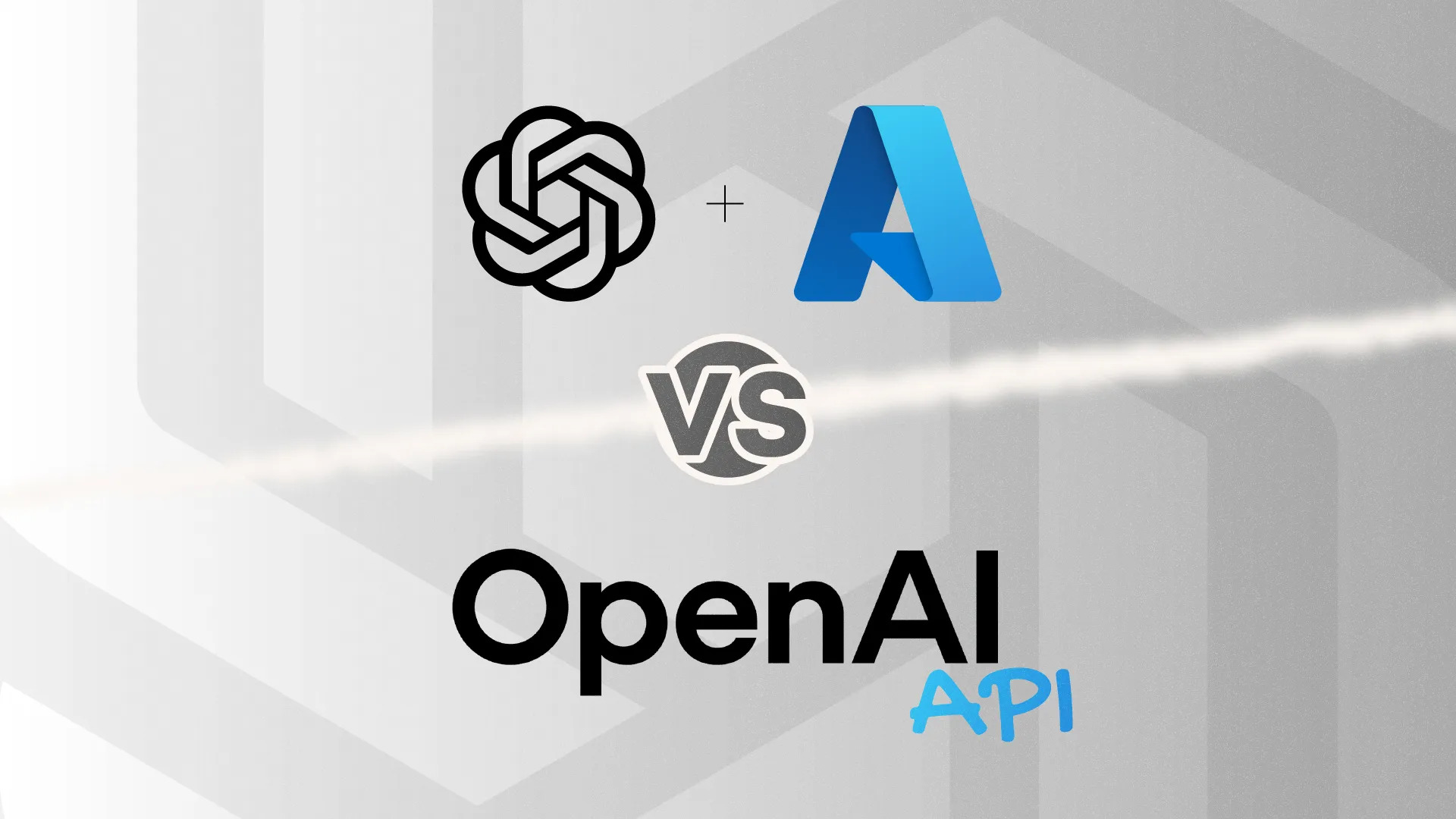
OpenAI's own platform vs Azure OpenAI
Both run OpenAI models. The difference is where the model sits and who governs it. On OpenAI's API, inputs and outputs aren't used to train models unless you opt in, abuse-monitoring logs are kept for up to 30 days, and Zero Data Retention requires OpenAI's prior approval (OpenAI API data controls documentation, 2026). Azure OpenAI runs the models as a resource in your Azure subscription, under the identity, networking and regional settings your security team already manages.
Our rule of thumb when a client asks: if infrastructure, compliance review and procurement already run through Microsoft, start on Azure. If you want to work directly with OpenAI's own API and release cycle, start there. Some of our engineers have shipped on both inside one product, but the Azure hiring profile leans harder on Azure infrastructure skills, so we match it separately.
What happens between your brief and a signed hire
Most clients complete the hire within 2 days of seeing matched profiles.
- 01
Describe the feature, not the job title
Tell us what the model has to do, what data it touches and which actions it may trigger. That shapes the match more than a skills list.
- 02
Review matched profiles
We send developers whose OpenAI project history is closest to your use case, with those projects visible on each profile.
- 03
Interview on your own failure case
Ask each candidate how they would handle one thing that has already gone wrong in your prototype. It tells you more than a coding quiz.
- 04
Hire and start
Most clients complete the hire within 2 days, then bring the developer into their repository and standups.
GPT products our engineers have shipped
Each card links to the developer who did the work.
RAG auto-replies across three social platforms
Replies to comments and messages on Facebook, Instagram and TikTok from brand context, with per-brand data isolation, provider fallback between GPT and Claude, and human approval for sensitive cases.
AI features on a financial analytics platform
OpenAI-powered chat and planning features on a platform that connects bank accounts through Plaid and bills through Stripe, built on NestJS and PostgreSQL.
A podcast generation app on the App Store
OpenAI text generation paired with several voice providers behind one interface, with audio streamed to users over WebSockets from a FastAPI backend.
Multilingual replies for a social posting SaaS
Post generation, scheduling and replies written in the audience's language with brand-voice settings, across Threads, Instagram and Telegram.
Content moderation with a human review queue
Category detection and severity scoring for user-generated content, where low-confidence results go to reviewers instead of automatic action and false positives are tracked weekly.
A GPT-4 agent that works a browser
An agent that opens tabs, fills forms and follows multi-step instructions to automate repetitive web tasks, deployed on AWS Lambda and Docker.
Pair Your OpenAI Developers
With Related Experts
Most OpenAI projects require additional expertise. Whether you need front-end devs, DevOps specialists, or database architects, we connect you with professionals who integrate with your OpenAI team.


Answers for Common OpenAI Hiring Questions
Can’t find what you are looking for?
Does OpenAI train its models on data sent through the API?
OpenAI vs Anthropic Claude: which is better for business workflows?
OpenAI vs Google Gemini: which is better for multimodal use cases?
Fine-tuning vs RAG: which should you use with OpenAI?
What does moving from the Assistants API to the Responses API involve?
One OpenAI developer or a team: what does a GPT feature need?
How much does it cost to hire an OpenAI developer?

Thinking about how to expand a tech team flexibly to adapt to different working paces?
Accelerate development, meet launch deadlines with flexible, much-needed capacity. Add new skills your team currently lacks.

Discover Our Services
Explore our technical capabilities and find the right tech stack for your needs.