

Hire a Machine Learning Engineer for ML Model Development and Training
Turning business and customer data into predictive models and automated decisions, reducing the need for manual analysis and repetitive tasks.




We found 16 available Machine Learning Developers
Machine learning engineers who have watched a model drift in production
Cortance screens machine learning engineers for something a notebook can't show: whether the model they built kept working after the launch meeting. A model that scores well on a validation split and then degrades for three months without anyone noticing is the most expensive kind of ML hire, because the damage shows up in business numbers long before anyone opens a dashboard. We also see the opposite gap more often now. As companies move their engineers onto language-model projects, the forecasting, scoring and detection models that already run the business lose their owner. That is why we match on what an engineer deployed, how they monitored it and which parts of the pipeline they owned.
Why do machine learning models fail after launch?
Most failures occur because data changes go unnoticed. For instance, a churn model trained on last spring's players may no longer be effective due to a new game mechanic. Similarly, a fraud classifier built on a limited set of labeled attacks might fail when faced with new patterns. Distinguishing between issues caused by a broken upstream pipeline and shifts in the user population is a key challenge we assess during interviews, especially when designing validation procedures for imbalanced datasets, where high accuracy can be misleading due to the rarity of certain cases. Our network engineers primarily use Python with tools like scikit-learn, PyTorch, and PyCaret, and they manage experiments and data versions with MLflow and DVC. This setup allows models to be retrained or rolled back from a known state, rather than relying on memory of which notebook created them.
Two engagements that ran long past the prototype
- Maksym B. spent 38 months running the full ML lifecycle for player analytics at a social casino studio. He built behaviour forecasting, segmentation and targeting models and took them from exploratory analysis through production deployment and ongoing monitoring, along with the trigger system that timed in-game offers. Those models fed game design and marketing budget decisions, which is exactly where unnoticed drift turns into lost revenue.
- Ruslan B. built a system that locates broken irrigation lines from ICEYE satellite radar. He owned the chain end to end: SAR georeferencing in SNAP and QGIS, seasonal baselines of tree health, and a scikit-learn model that flags deviations, so maintenance crews drive to specific spots instead of inspecting whole plantations by hand.
What we look for in both is ownership of the data step and the model step. An engineer who has cleaned the raw input and built the baseline knows where a model is fragile before it breaks.
Putting a model inside the product you already run
Many clients don't need a research team. They need a model running inside an application they already have, and that job often falls between a data scientist and a backend developer. Hadi A. embedded machine learning predictions into C# and ASP.NET Core applications on Azure, with Jenkins pipelines handling each release. When a brief looks like that, we match on both halves: ML depth and the production stack the model has to live in. If the larger gap is analysis and experimentation, our data scientists are the closer fit, and for a product built around a language model, we would point you to our GenAI engineers.
From brief to shortlist
Send a brief with your data type, where the model has to run, and the seniority you need, and our matching system ranks available engineers against it. Most clients see a shortlist within 30 minutes and complete a hire within 2 days.
Three more models that left the lab
Each one shipped for a client with hard constraints: messy input, rare positives, and someone downstream who had to act on the output.
Traffic and pollution forecasting for a smart city
Ruslan B. built time series forecasting and clustering services on open data from Barcelona and Singapore, plus a reinforcement learning module that recommends traffic restrictions after accidents or pollution spikes.
Tampered-document detection with a custom CNN
Shamistan H. trained an image-processing model that spots manipulation in scanned and digital documents, from data collection and feature extraction through tuning on several datasets.
Structured data pulled from insurance claims text
Maksym B. automated extraction of structured fields from unstructured policy texts and claims narratives with Python NLP for a property and casualty insurer, feeding reserve calculations and BI reporting.
Where does an LLM belong in an ML project?
Usually in a smaller place than the first proposal suggests. For scoring, forecasting and anomaly detection on tabular or sensor data, a well-validated classical model is cheaper to run, easier to explain and simpler to monitor than a language model wrapped around the same question. We push back when a brief asks for GPT where gradient boosting would do.
Language models earn their place when the input is text and the answer has to stay grounded in your own documents. Ruslan B. built a question-answering bot for a company website that works in two stages: a PySerini retrieval step finds the relevant passages, then a PyTorch model fine-tuned on that task writes the answer from them, so replies stay tied to what the company has published.
AI coding assistants speed up the parts around the model, such as feature pipelines, test scaffolding and deployment scripts. Choosing the validation split, the metric and the retraining trigger still needs an engineer who has watched a model drift in production.
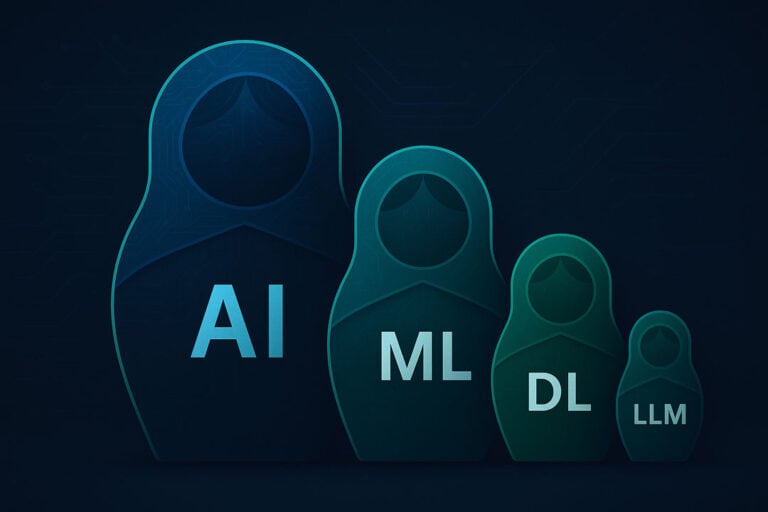
Why teams bring in a remote ML engineer instead of waiting
Most ML work arrives as a specific problem with a deadline: a model that stopped performing, a detection feature a customer asked for, a forecast the finance team wants before next quarter. Hiring locally for that one problem usually takes longer than the problem can wait.
Five vetting stages
Start on one model, not a department
ML and data engineering in one hire
Pair Your Machine Learning Developers
With Related Experts
Most ML Engineers projects require additional expertise. Whether you need front-end devs, DevOps specialists, or database architects, we connect you with professionals who integrate with your ML Engineers team.


Answers for Common ML Engineers Hiring Questions
Machine learning vs heuristics: when do simple rules win?
ML engineer, data scientist or GenAI engineer: who do I need?
How is model drift caught in production?
Can an ML engineer fix a model that has stopped performing?
Can one engineer cover both the data pipeline and the model?
How much does it cost to hire a machine learning engineer?
How quickly can an ML engineer start?
Can’t find what you are looking for?

Ready to new challenges vetted ML Engineers devs are waiting for your request
Discover Our Services
Explore our technical capabilities and find the right tech stack for your needs.