Staying Ahead in Staffing: Key Trends Reimagining the Industry for 2026
Industry NewsPublished on by Yevhen Vavrykiv • 10 min. read
- What Staffing’s Fastest Movers Are Doing Differently - And Why Trust and Technology Matter Most?
- Entrenchment in the Post-Covid Staffing Market: Why Flexibility is Now the Rule
- Contingent Workforce Stagnation: Size, Structure, and What Data Actually Tells Us
- AI’s Double-Edged Disruption: From Leapfrogging Capabilities to Ethical Complexity
- Candidate Fraud Hits New Heights: Navigating Sophisticated Risks
- Direct Sourcing Upsets the Intermediary Model: Strategic Implications
- Service Mergers - The Right Response to Market Compression
- Adjacent Services: How and Why Diversified Value Trumps Narrow Scope
- Context is King: 8 Years of Hard Data - And Humility in Forecasting
- Staffing Industry SWOT 2026: Strategic Direction in Numbers
- Conclusion
What Staffing’s Fastest Movers Are Doing Differently - And Why Trust and Technology Matter Most?
2026 stands at a pivotal crossroads for the global staffing industry.
According to Staffing Industry Analysts, the global staffing market surpassed $650 billion in annual revenue in 2025, yet growth slowed to just 2–3% annually, reflecting structural shifts rather than cyclical downturns.
Labour markets have not merely returned to “business as usual” after the pandemic - they have transformed, altering expectations, supply chains, and even how the value of work itself is measured. Gone are the days when incremental changes gave organisations the luxury of slow adaptation. Instead, executives face relentless pressures: calibration amidst persistent economic slowdown, AI-driven disruption, the growth - and dangers - of candidate fraud, intensified demands for transparency, and integration of services that dissolve long-standing boundaries across sectors.
Research from the World Economic Forum estimates that 44% of workers’ core skills will change by 2027, driven primarily by AI adoption and digital transformation.
Powerful forces such as digital acceleration during and after the COVID-19 era, persistent post-pandemic churn, a rebalancing between “Great Resignation” and “Great Stay,” and pronounced geographic shifts are exerting growing influence. Wage inflation, the balancing act of remote work, public and legislative focus on ethical AI, and the hacking of traditional intermediaries lay down a gauntlet. Today's staffing industry is as much about trust as it is about skill: clients rely on advisors who can steer them through geopolitical volatility and emerging risks.
Staying ahead in this high-stakes market means making better choices - either to lead boldly, respond thoughtfully, or strategically pivot. This is the moment for organisations to rely on forward-looking partners defined by deep expertise and resilience. As stark competitive lines blur and radical new business models rise, the trusted, transparent staffing leader becomes irreplaceable.
Entrenchment in the Post-Covid Staffing Market: Why Flexibility is Now the Rule
The aftershocks from what many describe as distinct “pre-” and “post-COVID” labour markets continue to reverberate through 2026. Several oversized changes coincide. Prior to 2020, the world expected staff to commute, stay local, and reliably accept modest wage levels. In contrast, current dynamics manifest as:
- More fluid workplace options: remote roles are 4x more prevalent in technology and managerial fields than in production or site-constrained categories; SIA’s most recent survey found that 79% of temporary digital professionals experienced fully remote assignments in 2024.
- Wage pressures decelerate quit rates but intensify challenges for organisational loyalty. The much-chronicled Great Resignation has mellowed into the “Great Stay,” a phase marked by cautiousness. When markets cooled elsewhere, the hiring peaks seen throughout the hot recovery faded, leaving US quit rates 20-25% below their COVID-19 peaks by 2024, according to the Bureau of Labour Statistics (BLS) JOLTS.
- Client demographics are changing: retiring baby boomers reduce the quantitative supply, but their roles are not being filled as quickly.
- North America and parts of Europe may see workforce reductions of 10%+ by 2050, according to UNECE projections published in Spring 2025.
- Technology powers new modes for filling jobs - from streamlined employee referrals to hybrid talent ‘pools’ bridging company-run sourcing with the best of applicant tracking systems.
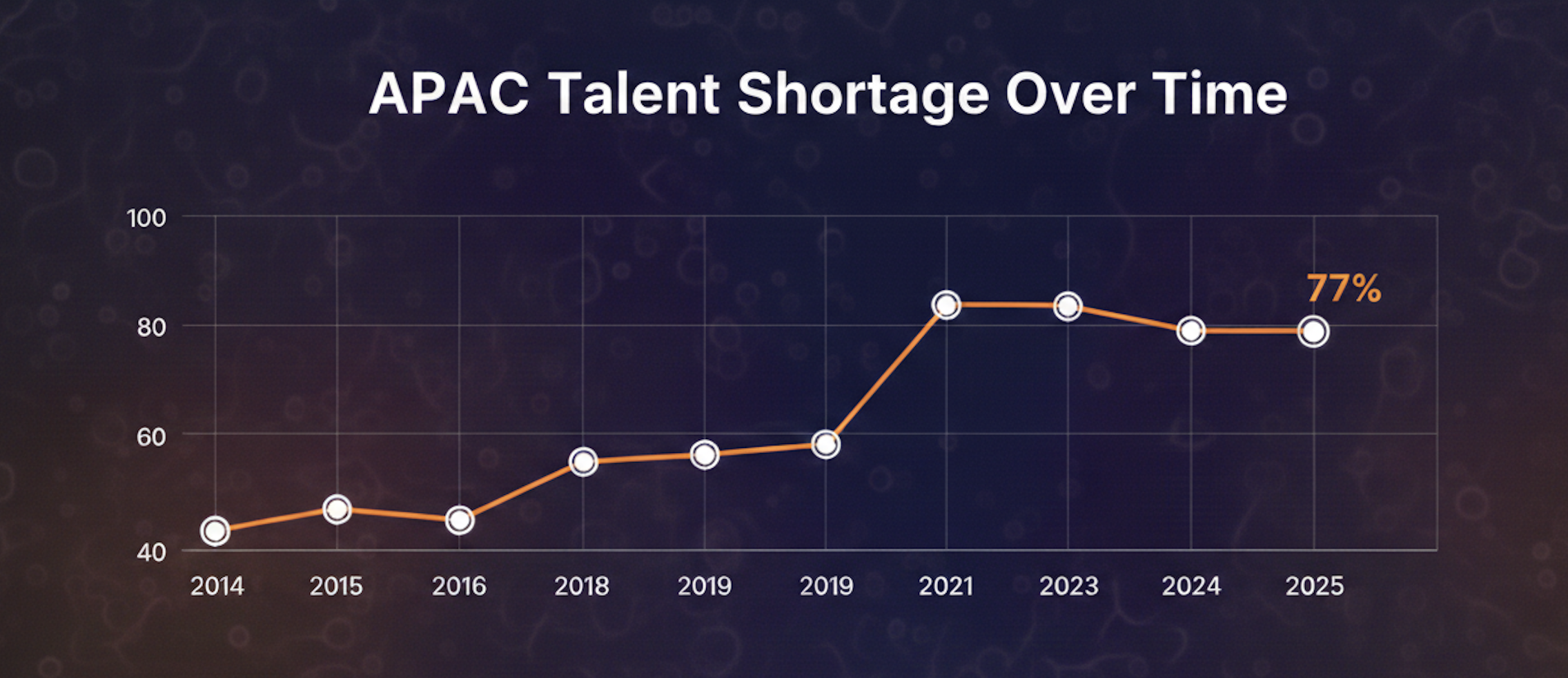
A 2025 Gallup survey found that 59% of remote-capable employees prefer hybrid work, while only 21% want fully on-site roles, indicating a permanent structural shift in workforce expectations.
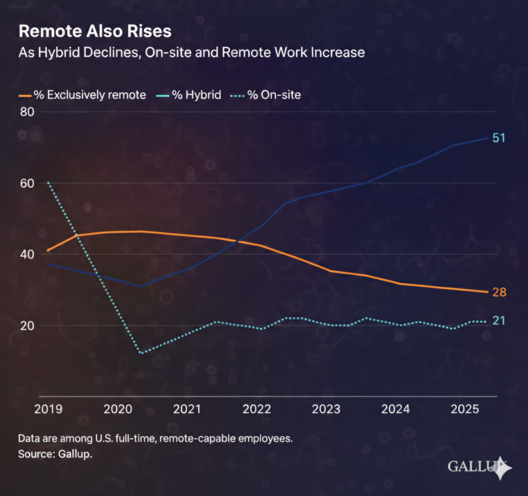
Underlying all of this, geopolitical risks introduce exposure that no leader can ignore. Major global agencies, from S&P to the World Economic Forum, acknowledge incomplete recovery for staffing’s largest providers three years post-pandemic, reflecting migration shifts, labour force disengagement, reduced international applications, and intermittent sectoral strength. Trade spats, infrastructure concerns, and capricious regional disruption promote caution everywhere - even as client reliance on external guidance sharpens.
Central to planning is accepting uncertainty as an opportunity. McKinsey and the World Economic Forum models both project net medium-term job gains globally: a loss of 92 million offset by 170 million created by 2030, driven largely by technological enablement and workforce investments, with most concentrated in developing economies open to rapid scale. But these mismatches in supply and demand reinforce an industry owner’s local knowledge and speed, helping to simplify the future for clients choosing right-fit partners over improvised talent networks.
The OECD reports that labour shortages in advanced economies could reach 35 million unfilled roles by 2030 due to demographic decline and skills mismatches.
Contingent Workforce Stagnation: Size, Structure, and What Data Actually Tells Us
Lured by a decade-long expansion, many expect “contingent labour” (from platform workers to contractors) will remain disproportionately influential and profitable. Reality is more nuanced. Compounded growth has plummeted from 3.7% per year ending 2021 to 0.5% anticipated between 2021–27, hampered primarily by stagnant growth in developed (notably US) staffing markets.
According to Upwork, freelancers contributed $1.3 trillion to the U.S. economy in 2024, representing 36% of the total workforce.
Contingent labour today touches nearly every organisation. SIA’s latest market modelling places direct temporary agency revenues at just 1/20 of the broadly defined segment’s $10.2 trillion valuation. With platforms, SOW (statement of work) deals, and independent contractor models enveloping vast swaths, SOW itself accounts for an estimated 66% of the market - a tangle of consulting, managed, project-based tailoring work, sometimes outstripping being counted as pure “temping.” Platform-based delivery models, while visibly booming, may be tracking activity that has already occurred outside reduced-friction contexts, which helps explain stagnation as much as structural drift.
Research by Deloitte shows that 78% of enterprises plan to increase their use of contingent labour, even as overall market growth slows.
Employers with 1,000+ staff (SIA Workforce Solutions Buyer Survey) typically field teams, with 71% permanent and 29% structured via SOW, temp, contractor, and vendor arrangements. This n-tiring makes ownership ambiguous: 36% of US employees maintain an independent side contract or “side gig,” according to an MBO Partners report. In effect, market surveys reveal stable proportions of contingent contributions, despite categorical growth elsewhere. It becomes clear: only purposeful, strategically trained partnerships yield consistent, measurable returns.
AI’s Double-Edged Disruption: From Leapfrogging Capabilities to Ethical Complexity
AI unfurled at breakneck pace from 2020 on - a boon in both innovation capacity and complexity of compliance. Algorithms now pilot candidate sourcing, matchmaking, interview simulation - and, as reported by SIA in their 2025 survey, pilot robotic workflows from the warehouse floor to first interview screen. If you use an app to engage clients, filter résumés, or power a review system, the benefit is in efficiency, reach, and customisation - but so is the burden of public trust.
A 2025 report by McKinsey & Company estimates that AI could automate 30% of recruitment tasks by 2030, including screening, scheduling, and candidate matching.
SIA’s recognition encompasses five AI pillars now omnipresent in the staffing journey - machine learning, NLP, deep learning, generative AI, and new agent-based models - the lines blur as tech platforms handle both discovery and vetting. By 2026, projections of global data centre expansion see computing infrastructure growing 14% year over year through 2030 - a leap forcibly driven by the needs of AI and its convergent application (in areas like warehouse robotics or on-demand logistics fleet management).
Yet, public perceptions are shifting fast. By 2025, Pew Research found that 51% of US adults worried more about AI's harms (from bias to misinformation) than were inspired by its potential to accelerate. Clippers against the unchecked thrill of innovation cause matchless compliance jigsaw nightmares: U.S. governance (via uncoordinated states pursuing piecemeal rules), rapid escalation of the EU’s AI Act carrying stiff penalties (fines up to €35 million or 7% of global income), and real contention over what legally constitutes fair profiling or algorithmic defensibility in hiring decisions.
According to LinkedIn, 76% of talent professionals now use AI tools in hiring workflows, up from just 27% in 2020.
IBM research shows that 85% of job seekers want transparency about how AI is used in hiring decisions.
The upshot: Without clearly proven responsible governance and independently validated, bias-mitigated tools - backed by external expert audit verification - neither candidate trust nor client loyalty will follow. Strategic risk management, genuine explainability, ethical architecture, transparency, and continuous third-party validation comprise the “verification premium” that distinguishes best-in-class advisors. Companies that succeed don’t trade agility for risk-blind spots; they openly declare safe, comprehensible, review-worthy processes, building trust one engagement at a time.
Candidate Fraud Hits New Heights: Navigating Sophisticated Risks
Candidate fraud has raced far ahead of manual defences, emboldened by generative AI, hyper-real proxy interviews, and remote identities built on stolen data or pure digital invention. As recruitment functions increasingly digitise - particularly for remote and cross-border positions - even well-intentioned hiring teams risk eroding client trust and operational security unless they upgrade their countermeasures to meet modern threats.
Gartner predicts that by 2028, one in four job candidates globally could be fake, due to AI-generated identities and deepfake technologies.
The surge is sobering: According to SIA’s 2025 Workforce Solutions Buyer Survey, 41% of organisations grappled directly with candidate fraud or struggled with verification transparency. Leading studies chart that one in six US organisations encountered outright identity fraud within an annual hiring cycle, with many more unsure - underscoring frequency and subtlety even for skilled recruiting teams. Major employers spotlight incidents in higher-risk sectors. Misdirected digital convenience, especially resumes generated or patterned via AI, blossoms into resume embellishment on a total new level; Gartner now projects that up to one in four candidate profiles could be fake by 2028.
A 2025 study by the Society for Human Resource Management found that 53% of employers had encountered résumé fraud, and 23% reported identity manipulation.
Adding complexity, fraud now includes criminal and even state-backed actions. Amazon alone blocked 1,800+ applications linked to North Korean actors, using a mix of AI and human verification that leverages anomaly detection and evaluates candidate-institution-geography networks unseen a decade earlier.
Ultimately, reinforcing trust and security mandates a multifaceted mix of robust verification, utilising both AI-facilitated verification suites and novel approaches such as blockchain-driven credentialing (backed actively by an expanding cluster of global staffing leaders and tech/HR consortia). Being authenticated at each segment of recruitment - not just the start - becomes the modern badge of confidence for those navigating the credibility gap. Platforms praised for integrity routinely marry high-tech checks with sustained “live” oversight.
Direct Sourcing Upsets the Intermediary Model: Strategic Implications
Contrary to popular belief, innovative direct sourcing initiatives aren’t entirely undermining the value of expert staffing advisors - what is shifting is the locus of value delivery. Traditionally, intermediary staffing firms predominated due to their speed and extended reach. Today, empowered by better-branded careers pages, social-enhanced employee referrals, all-in-one (ATS/CRM) engagement software, and programmatic campaigns, many enterprises first exhaust internal channels before reaching beyond their unique networks.
Research from Aberdeen Strategy & Research shows that companies using direct sourcing reduce hiring costs by up to 25% and shorten time-to-hire by 30%.
Relentless advances in technology mean referral platforms and talent pools can now compete in speed and coverage. Automated processes reduce friction in employee referrals, expand reach through a well-run employer social media presence, and enable granular candidate engagement through digital channels. At major, proactive organisations already using robust self-serve solutions, application rates and “direct placement” successes accelerate.
LinkedIn data indicate that 70% of global hires now involve some form of employer-managed talent pipeline, rather than relying solely on external agencies.
Yet, even with the proliferation of direct sourcing tech, intermediary demand does not always vanish, especially for volume or highly specialised contract work, where clients require external best-fit matching or market intelligence during crunch conditions. Applications of talent platforms are evolving rapidly; over 1 in 3 leading solutions now blend freelance with neighbouring categories and permanent placement.
Forward-thinking staffing powerhouses reinforce differentiation by clarifying comparative full-accounting cost-benefit analyses, true value, reputational risk mitigation, and velocity benchmarks for both models, encouraging clients to select the model that delivers verified quality without compromising security. Authentic, trusted partners also transparently deliver results from “soft” value boundaries, not just headcount: efficiency, brand risk, flexibility, agility, and experience.
Service Mergers - The Right Response to Market Compression
Significant consolidation distinguishes winners from also-ranners in 2026. According to SIA’s M&A database and market-wide research, the ecosystem spanning Staffing, Process Outsourcing, Talent Platforms, Payroll, Compliance, and Talent Acquisition Technology undergoes rapid, often horizontal crossover. For enterprise clients navigating complex or multi-country staff landscapes, vertically bundled suppliers, boasting hybrid staffing/RPO/payroll/talent/payout models, present an irresistible proposition.
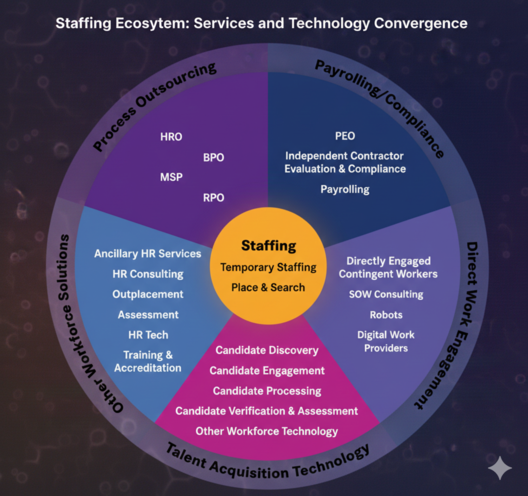
According to PitchBook, global HR tech and staffing M&A activity exceeded $20 billion in deal value in 2024 alone, reflecting rapid sector convergence.
Legacy staffers battling slowing demand and lean valuation metrics are ringfencing risk by expanding investments: cross-sector M&A activity has surpassed 6,000 rounds and $92 billion in capital investment since 2008. Digital-first job ad networks such as Indeed mimic staffing platforms, with the pursuit of pay-for-placement models; Even GAFAM giants - from Microsoft to Salesforce - divert new resources into analytic and composable workforce solutions.
Crucially, seasoned organisations and newcomers can coexist and even collaborate fruitfully so long as trust - delivered through auditability, robust safeguards, and evidence-led innovation - leads every.
Adjacent Services: How and Why Diversified Value Trumps Narrow Scope
Any commoditised market (such as core headhunting or classic deterioration) pushes value creation onto service providers. The logical evolution: staffing groups deploy cross-capability platforms to tap Consulting/SOW and advanced HR Tech - think “solution selling” blending SaaS logic with tailored labour implementation. Neither simple paperwork shopping nor “temps by the dozen” justifies the fee premiums demanded by clients stretched ever thinner by wage escalation and borderless competition.
PwC reports that 64% of staffing firms are investing in consulting, workforce analytics, or HR tech services to offset declining margins.
The proof: investors gravitate toward businesses less reliant on basic staffing, consistently 🔄 rating consultancies, HR SaaS techs, process-outsourcers, and talent innovators, at market-cap/revenue ratios that are multiple times those of typical firms in the temporary contractor market. Client needs and expectations interact with post-pandemic caution; expansion into “sticky,” recurring-revenue engagements spanning workforce success metrics marks something recognisably valuable and safer.
Context is King: 8 Years of Hard Data - And Humility in Forecasting
Reflecting on nearly a decade of trend predictions by leading researchers brings a mixture of named successes and surprises (none greater than 2020’s COVID-19 impact). Resilience - both organisation and persona-level - underscores every sustainable trend: whether pure growth, unexpected skill gaps, regulatory commerce impacts, the drag of negative perception, or the controversial emergence (and control) of AI at interview/process depth.
Pain and opportunity move in synchrony. Digitised models streamline candidacy, but also test privacy, accountability, and equitable treatment at scale. Winners prove adaptability - not by shifting norms alone, but by being meaningful to stakeholder needs in the moment.
Staffing Industry SWOT 2026: Strategic Direction in Numbers
The industry’s deepest generic SWOT, as reported by SIA, rounds up core truths executive decision makers must attend to:
- Strength: High uncertainty drives demand for tailored intelligence; reliable partnerships that go beyond transactional swaps (“one role, one fee”) are trusted.
- Weakness: Commoditization narrows margins; distinguishing soft-benefit value becomes mission-critical.
- Opportunity: Growing appetite for verified upskilling, secure workforce development, automation, and regulatory compliance - the platforms responding credibly and transparently attract retained business.
- Threat: Automation-led reduction, adverse regulation, and economic headwinds posing circuit-breaker scenarios.
Summary analytics identify intangibles coiled with empirical evidence as most impactful - authentic, persistent, and adaptive approaches attracting resourceful clients, cementing relief not through platitude, but continuous delivery.
The World Economic Forum projects that by 2030, 170 million new jobs will be created globally, while 92 million roles will be displaced, highlighting the scale of workforce transformation.
Conclusion
Staffing leaders face a crossroads requiring courage: rapid but carefully verified AI investment, rebalanced workforce procurement channels, more reliable credentialing through traceable verification, wise partnership in mergers and workflows - all while elevating standards for compliance and public reputation. Succeeding in the 2026 environment comes down to acting as a trusted advisor and agile strategist, not an interchangeable commodity.
Experienced readers recognise which leaders set the market tempo: teams demonstrating real-world oversight, sophisticated risk surveillance, creative commercial mechanisms, and transparent reporting. Leveraging partners with recognised track records and comprehensive, client-responsive platforms puts success firmly within sight.
For staff augmentation, workforce technology expertise, or transforming projects through intelligent hiring strategies - consider how seasoned partners in talent solution design are already helping industry leaders distinguish their business across geographies, compliance boundaries, and turbulent candidate markets.
Step forward confidently into a changing ride; ensure each strategic decision is informed by agility, audit-proof tools, and a verified “trust advantage.” The competition has never been fiercer, but so too is the reward when you can clearly demonstrate - through expertise and authenticity - why you remain a market leader.
For deep expertise to help you operationalise trust, digital security, and innovation in staffing - from AI programs to broad digital workforce transformation, tap into established partners proven at every rung of the value chain. Explore how tailored professional hiring solutions amplify strategic outcomes and find trusted engineering experience and implementation support here.
Related Articles
WebRTC for Healthcare and IoT: How One Protocol Unifies Telehealth and Remote Patient Monitoring
One WebRTC session: the doctor sees the patient and receives live ECG from the wearable simultaneously. That architecture changes telehealth meaning.
Read article