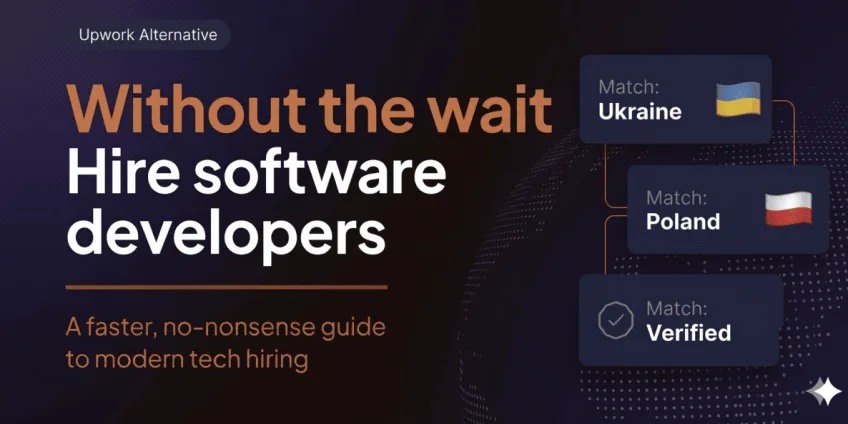
Hire Software Developers Without the Wait: A Faster, No-Nonsense Guide
IT OutstaffingPublished on by Yevhen Vavrykiv • 10 min. read read
- Introduction
- The Real Causes of Slowed Developer Recruitment
- Direct-Fill Matching: Changing the Cost Structure Overnight
- Where Traditional Methods Fall Behind
- The Five-Stage Vetting Mandate
- Behind the Metrics: Measuring Actual Developer Hiring Performance
- Common Talent Quality Concerns (and the Cure)
- Automation and Human Oversight: Striking the Balance
- Security, Compliance, and IP Risk in Developer Selection
- The Hidden Return: “Working Out” Beats “Warming a Seat”
- Is Skill Only Technical? New Hiring Realities
- Model Comparison: Direct Matching vs Traditional Hiring
- Why the Market Is Moving - and Outcomes Show It
- FAQ
- Conclusion
Introduction
Almost every founder, VP of Engineering, or business stakeholder has experienced this scenario: you need a software developer quickly. Instead, you spend months dealing with unreliable channels. Recruiting wastes valuable weeks browsing boards, screening forgettable CVs, and managing introductions with inconsistent shortlists. Each “almost-there” interview results in more costly false starts, slowing down progress and jeopardising outcomes.
Reducing hiring time for software developers to just days (rather than weeks or months) requires a system overhaul - not a recruiter’s magic trick. Today, matching networks that use five-stage vetting and shortlisting (with metrics such as a shortlist delivered within 30 minutes during business hours) fundamentally address the pain points in your hiring process. Companies gain two important advantages: access to evaluated, screened talent and confidence in suitability based on direct results, not resumes.
Trying faster and more reliable hiring without proper screening often fails, leading to lower success rates or even mismatches that quietly harm company culture and environment. Skipping traditional steps by using platforms that ensure both technical and soft skills match allows companies to fill roles rapidly - and boosts the chances of new hires succeeding. In this analysis, we look at the main bottlenecks and detail how advanced systems can achieve up to 11X faster placements (according to Lemon.io data) while balancing risk and performance in developer hiring.
The Real Causes of Slowed Developer Recruitment
Standard tech hiring causes delays at each rotation. Resource-heavy resume pools force a choice: expedite due diligence or prolong the process. Beon.tech reports that as ongoing technical requirements grow, finding a suitable match from open-market advertising becomes less likely - most job listings attract generic replies, forcing recruitment to spread time across underqualified candidates. According to Savage (2023), “passive” or unspecified role ads waste internal capacity and extend project stagnation. These resignation-provoking frictions spiral outward, producing outsized effects:
- Medium and large startups can take 4–12+ weeks from initial post to final onboarding - even for well-defined technical roles.
- Unstructured or delegated technical interviews cause over 50% of candidates to drop out after the third-stage assessment (Lemon.io market pulse, 2024).
- Unexpected churn from misfit hires can extend productive headcount gaps by several months, not just days.
Surprisingly, persistent add-ons like customised code tests and secondary cultural pre-screens attempt to improve fit rates, but predictably slow down the time-to-offer beyond what product or growth teams can accept. Most “work sampler” tasks significantly overemphasise recall as a measure of confidence, pushing promising developers from less GPT-pedigreed backgrounds aside. In summary: precision becomes unclear, deadlines slip.
Direct-Fill Matching: Changing the Cost Structure Overnight
Interrupting this cycle means reassessing costs, not only in terms of time spent on hiring but also in achieving the right outcome. According to industry experts at Beon.tech, attrition caused by unclear skill assessment doubles direct costs over seasonal cycles - when companies repeatedly revise the hiring process after a mis-hire, no spreadsheet remains untouched.
Enter pre-validated matching models: these systems eliminate upfront bias, optimise for performance signals, and reduce administrative sprawl by batching critical information for every required profile. Inspired specifically by failures observed at scale, they reward delivery with cost factors such as:
- Reduction in total guidance interviews per candidate, as most have passed a clearly-structured technology deep-dive (instead of generic technical screens).
- Rapid presentation: A ranking system that ensures, within 30 minutes (during core business hours), a precise shortlist - candidates matching specified specialisations with verification - is ready for customer review.
Decisively, relationships are formed for projects where fit outweighs volume, measured by rubrics rather than instinct. Major practitioners demonstrate a +63% time efficiency gap over random candidate sifting, delivering not just interviewees but “ready to join” developers whose backgrounds have already cleared multiple no-nonsense skill stations.
Where Traditional Methods Fall Behind
Three channels dominate traditional engineering talent acquisition: recruitment agencies, freelance marketplaces, and organic in-house efforts. All yield some employee success, but often not at the desired pace or predictability.
- Recruitment Agencies: Screening depth varies significantly. Dedicated recruiters rely on CV checklists rather than direct test scores, requiring multiple interviews to verify rare qualities such as real algorithm fluency, current product engineering standards, or proficiency in architectures newer than three years.
- Freelance Portals: While excellent for micro-gigs, they often struggle with signal-to-noise ratio and are hindered by overestimated self-reported skills. Direct employer vetting remains essential - poorly executed, it can negatively impact employment prospects.
- In-House Channels: Posting on job boards helps generate applicants but rarely assesses readiness or cultural fit, which few companies can evaluate effectively at scale. The response burden falls on overloaded internal decision makers.
What bears repeating is that speed alone, when not paired with accuracy, always amplifies inconsistency - a pattern that matching providers address through logic, documentation loading, and hashed-stage scoring that emphasises valid hard skills.
The Five-Stage Vetting Mandate
Using new-millennium approaches does not dismiss standards - it creates process rigidity specifically for efficiency. As of March 2026, leading matching platforms like Cortance report pass rates of only 21% after five-stage technical vetting, while increasing input-submission volume without accepting candidate mediocrity. Here's what makes a multi-stage system structurally essential:
- Technical Screening: Concrete classic and AI-captured tasks check against current frameworks, languages, and practical tooling.
- Code Evaluations: Beyond test results, evidence must show readable style, maintainable logic, and forward-compatible solutions designed by the developer.
- Behaviour Interview: Soft-skills analysis, conducted with adaptive questions targeting situational ownership, async communication exposure, or product-driven prioritisation.
- Reference Coherence: Review of live delivery accountability through multi-client past assignment audits.
- Probation Testing: (Optional step, for some networks) Paid trial-ups that project into meaningful joint code outcomes - not abstract pilots but real team capacity additions.
Each phase prevents underqualified applicants from progressing. Talent supply in the final roster is less accurate (+292 fewer average weekly candidates wasted per startup request, according to Lemon data). Agencies willing to accept slight increases in rigour often fail to complete vet calls or cohort testing effectively, resulting in significantly lower success rates compared to platforms that emphasise a structured process.
Behind the Metrics: Measuring Actual Developer Hiring Performance
Preview metrics solidify pattern credibility. While approaches vary, indexed outcomes linking speed to fit outperform resume-rich “option” listings where agencies sometimes appear busier than usefully productive. Within this context, tightly-governed vetting pipelines generate distinguishable hiring advantages:
- A meta-review of operator-driven match services (e.g., Cortance, Lemon.io) indicates that 89% of placements result in long-term working engagements, compared with 1-in-3 or less for single-lens code-testing hires.
- Time flexibility returns - from rough median of 6–22 days (with recruitment-led shortlists and three rounds of technical interviews) to <72 hours from first requirement voiced to ‘live coding trial start’ using pre-screened models.
Requests placed during off-hours rarely delay response, as many advanced platforms guarantee initial contact from a human and a developer introduction by 11 AM the following business day.
Common Talent Quality Concerns (and the Cure)
Boards invariably worry about breakdown time workloads, dev speed, code security, or culture fitness when skipping classic rolodex review and recruiter “chemistry guess.” What date-driven experience now shows:
- Developers accepted into mature vetting pools (the aforementioned 21% at Cortance) log lower pushback ratios from management after four weeks of productive benchmarking than conventional referral-induced team plugins.
- Aggregated feedback notes stronger documentation flows, readable PR logic, and willingness to integrate unfamiliar tech without costly learning-phase cycles tacked on top.
- Ops buy-in is consistently higher due to transparent sourcing and contract models. Managers report measurable gains in accountability - the kind only possible when developer performance has already been stress-tested prior to project kickoff, removing the ambiguity of ramp-up periods or trial-by-fire onboarding that destroys schedules.
Automation and Human Oversight: Striking the Balance
One misconception about rapid hiring platforms is that they rely entirely on algorithms at the expense of human judgment. However, the best results occur only when automated profile scoring combines with human expertise throughout the process. On trusted matching networks, experienced account managers are typically complemented by smart algorithmic curation.
This blend enables initial filtering to occur at machine speed, instantly highlighting prospects with attack-point skills while flagging culture-match anomalies. Meanwhile, experienced work coordinators perform contextual checks that no database alone can replace – what was once a superficial CV exchange now develops into comprehensive-fit assurance, from start to finish. The impact for engineering leaders is significant: it helps address urgent project needs, reduces hours wasted on preliminary applicant filtering, and secures technical skills tailored specifically to the stack at hand - without being distracted by candidates who barely match the published job descriptions.
Security, Compliance, and IP Risk in Developer Selection
Security and safeguarding IP are central in hiring committee discussions. Both Lemon.io and Beon.tech sources identify contract protections, multi-factor account authentication, and strict reference validation as essential for sensitive deployments. Any external software engineer brought in quickly should still be signed on for NDA agreements, verified against fraud, and placed on exclusion lists with fail-open behavioural indicators.
Modern matching workflow audits - easily accessible by cloud or software engineering clients - ensure compliance and reduce liability. Vetting partners actively monitor data handling histories and restrict developer access to documents until clear hire freezes certify contracts as active. Mistakes, NDA breaches, or shadow HR documentation? That can cause project delays. Avoid this by only engaging through pre-approved channels - a best practice now recognised both internally and for client tracking.
The Hidden Return: “Working Out” Beats “Warming a Seat”
Calculations rarely quantify the benefit of upgrades from average readiness scores to verified post-placement productivity, yet this invisibly determines roadmap confidence. On platforms enforcing full dynamic-scoring selection, as mentioned, 89% of placements become bona fide working engagements, reflecting cultural and technical acclimatisation as fact, rather than the luck-driven onboarding common to more traditional approaches.
Conversely, fallback strategies - favour-based introductions or “open pipeline” agency names you’ll see across a dozen searches - return success roughly a third of the time or less. Many CTOs quietly shuffle ineffective junior hires until fallout reaches an ignition stage, dragging benchmarks and time to ship key sprints. The safety net introduced through multi-point vetting shunts these leaks - frankly, the stakes make letting imperfect fits onboard an expensive miscalculation as scaling accelerates.
Is Skill Only Technical? New Hiring Realities
Included in advanced filtering are subtler determinants of sprint morale. Peer-to-peer interviews, live multi-timezone practices, and repeated feedback loops have quickly gained mainstream acceptance - especially as distributed talent increasingly supports high-velocity product organisations. Finalist reviews now highlight not only "textbook” skills but also how well a candidate learns on the fly.
Premium matches focus on aptitudes for asynchronous work, version control discipline, Git transparency, and understandable code review cultures, not just language familiarity. Surveys gathered in Beon.tech analysis reinforce that future hiring success will depend less on binary skill indicators and more on measured adaptability and testable team temperament.
For hiring teams exhausted from chronic underperformance, closing this feedback-action loop saves morale costs nearly as much as avoiding downtime and realigning the roadmap.
Model Comparison: Direct Matching vs Traditional Hiring
Here’s how cold-facts hiring math plays out when matching and classic channels compete (2024 averages; normalised to Western European/North American HQ and global search):
- Speed: Traditional channels = 4–12+ weeks, Structured matching platforms = 24–72 hours to finalise the shortlist and engineer actuals.
- Success Rate Post-Onboarding: Traditional = 33%–50% form “active working engagements.” Advanced platforms = 89% (per Cortance dataset; similar for close competitors with five-process screens).
- Effort Per Role: Traditional = 7 hand-chosen interviewer slots minimum, even prior to performance tests. Modern options = Instant presentation of pre-vetted profile with test/sample code, assignments, references complete.
Downtime gives way to deliberate project-estimate safeguarding - and allows those sourcing talent to move the company vision forward rather than tread water in manual sifting.
For a deeper look at the sophistication of screening, see the extensive breakdown of rigorous, bias-free hiring stages at Cortance’s vetting methodology.
Why the Market Is Moving - and Outcomes Show It
Talent mismatch to scope is less about lacking capability and more about chronic misfitting caused by uncalibrated filters. CTO roles evolve quarterly; addressing capacity gaps through firefighting each month stems from legacy search stress. Expansion - into AI-driven products, rapid pivots, new client mandates - multiplied by active CTO impatience - means third-party signalers (“probeight this developer”) often lag behind. New expectation management arises: outward matching platforms gain traction mainly because they have staked operational reputation on reliably applying barrier screens that consistently improve the odds in crowded talent pipelines. Contracted, still-formal affiliations take the next step. With verified figures - 592 developers are under working contracts via just one leader (Cortance) as of Mar 2026 - the numbers are permanently tilted in favour of dynamic, quick acquisition at nearly telepathic HR speeds.
FAQ
- What is the fastest way to hire senior software developers? Using a selective matching platform lets hiring teams receive pre-vetted candidates in under 1 hour and conduct interviews with developers already screened for must-have skills. Valid proof and references are presented - saving weeks over job ads.
- How do most companies vet software developers’ technical skills? Most employ technical screens (live coding, take-home assignments) and use internal engineers for feedback. Structured external matching firms add scenario-based evaluation and automated proof-of-skill checks.
- Why do traditional developer hiring processes often fail? Stride-dragging job board searches or unchecked agency lists result in misaligned experience, technical mismatch, and missed pace goals. Time-to-first pint-worthy code launch is almost always delayed by unnecessary resume reviewing.
- What success rates can you expect from matching-focused hiring schemes versus agency or freelance placements? Industry reporting reveals vetted, process-driven networks achieve up to 89% working engagement rates post-hire. Traditional sources rarely cross the 50% success mark for final assignment retention.
- Are faster hiring models risky in terms of IP and compliance? Vetted providers use verified references, advanced NDA mechanisms, and contract gating to minimise fraud and non-compliance, often outperforming both direct freelance agreements and informal hiring.
- When is staff augmentation preferable to direct hiring? External augmentation suits periods with variable product workload, gap-project technical need, or for bolstering teams mid-migration - especially valuable for organisations aiming to sidestep long-term payroll commitment.
- How do current developer hiring trends affect founders? A shift toward automated, triple-vetted matching platforms decreases drive-by recruiting churn and delivers skill-fitting candidates, pushing productivity earlier in a product cycle and stories along much quicker.
- Should the team always interview matched developers? Though possible to reduce steps, direct interviews - built atop strong matching and vetting - clarify mutual fit and generally safeguard best cultural outcomes with slight add-on time cost.
Conclusion
The recurring challenge of hiring software developers arises not only from market shortages but also from ongoing cycles driven by DIY discovery, unregulated agency options, or inconsistent freelance pools. The candidates worth engaging are busy building real defence - they don’t waste hours navigating familiar yet outdated hurdles at companies with overloaded HR operations.
It’s no longer enough to advertise a position and wait. For the CTO, founder, or anyone risking a roadmap for slow resource rollouts, fast-track solutions that blend rigorous technical vetting (where only 21% qualify through all stages) and discriminatory matching deliver a serious advantage - lower fallout rates, streamlined compliance issues, and on-demand scaling with real-world references and quantifiable approvals.
If certainty and time-to-contribution from high-output software developers matter to your goals, evaluate talent-matching platforms’ track record over six rounds versus left-to-chance, culture-fit approaches. Want specifics? Auditing your workflow against proven end-to-end hiring processes can clearly identify efficiency gaps and clear the deck for faster building.
- #bestpractices
- #startup
- #b2b
- #teamscaling
- #smarthiring
- #boosting
- #findadeveloper
- #teamextention
- #bodyleasing
- #hire