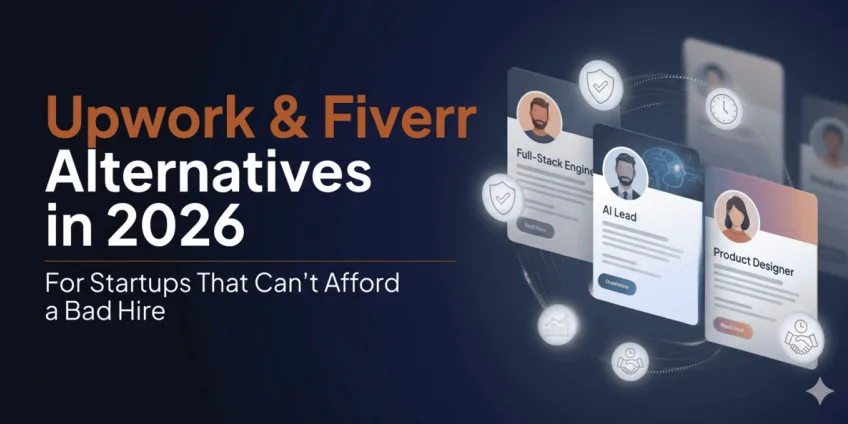
Upwork & Fiverr Alternatives for Startups That Can't Afford a Bad Hire
Where to HirePublished on by Yevhen Vavrykiv • 7 min read read
- What a Bad Hire Actually Costs a Startup
- Why Open Marketplaces Create This Risk Specifically for Startups
- The Model That Works: One Primary Partner, Backed by Specialists
- What to Look for in a Pre-Vetted Alternative to Upwork and Fiverr
- The Practical Stack: A Working Model for Seed and Series A
- FAQ
Upwork has 18 million freelancers and 794,000 active clients generating over $4 billion in annual gross services volume as of Q3 2025. Fiverr has 3.1 million annual active buyers and 700+ service categories. Both platforms are large, functional, and genuinely useful for bounded tasks with clear deliverables - a logo, a landing page copy pass, a short data scraping script.
Neither was designed for what most early-stage startups actually need: a senior engineer who integrates into the team, understands the product context, makes sound architectural decisions independently, and is still there in three months. According to Harvard Business Review, 80% of employee turnover comes from bad hiring decisions. For a startup, a single mis-hire in a technical role doesn't just cost money - it can set your product timeline back by months and create technical debt that takes years to unwind.
The asymmetry between a startup and an enterprise in this situation is stark. A Fortune 500 company absorbs a bad hire as a line item. A seed-stage company with $300,000 in runway absorbs it as an existential event. Every sprint cycle lost to a wrong hire is a sprint cycle that doesn't demonstrate traction before the next fundraising conversation. The cost isn't just the salary - it's the architectural decisions that need to be reversed, the team morale that erodes when engineers spend time supervising instead of building, and the four to six weeks of calendar time it takes to identify, exit, and restart the search.
What a Bad Hire Actually Costs a Startup
The financial figures are well documented. Estimates from SHRM and the US Department of Labor place the average cost of a bad hire between $17,000 for entry-level positions and $240,000 or more for senior hires - including recruiting, training, and lost productivity. The Society for Human Resource Management puts the cost of replacing any employee at between one-half and two times their annual salary. For a senior developer at $120,000 annually, the replacement cost alone runs $60,000–$240,000.
74% of employers admit to having hired the wrong person (CareerBuilder, 2025). The experience is nearly universal - but the consequences differ dramatically by company stage.
At a startup, the indirect costs are where the real damage accumulates:
Architectural decisions made by the wrong engineer compound over time. Code that needs to be rewritten doesn't just cost the rewrite - it costs every decision made downstream from the original mistake. A senior developer who misunderstood the data model in month two produces a codebase that a replacement spends month three and four trying to understand before they can change it.
The opportunity cost of a founder or CTO's time consumed by managing a bad hire rarely appears on a dashboard but is real. Gallup's 2025 report found that managers account for 70% of the variance in employee engagement. When your managers are exhausted from babysitting a bad hire, their entire team suffers. For a five-person startup, that means the entire company.
The hiring reset adds weeks to a compressed timeline. Identifying that the hire isn't working, deciding to exit, managing the exit, and restarting the search takes four to six weeks in practice - during which a critical role sits either unstaffed or staffed with someone everyone already knows is wrong.
For a startup running on investor capital with a product milestone or a funding round six months out, none of these timelines are abstract.
Why Open Marketplaces Create This Risk Specifically for Startups
Upwork and Fiverr are open marketplaces: anyone meeting a low entry threshold can list services. Their commercial model rewards transaction volume, not placement quality. High-quality remote senior professionals increasingly leave bidding-heavy platforms for vetted alternatives, where their skills speak for themselves rather than competing on price. The best engineers aren't running a bidding war for startup projects. They're already placed through other channels.
What remains on open marketplaces are engineers between engagements, building portfolio projects, or competing on price rather than quality. Some are excellent. Most are not. Distinguishing between them without a technical evaluator on the client side is precisely the problem that pre-vetted platforms were designed to solve.
Upwork performs freelancer testing to ensure professionals have basic skills for their niche, but the testing is not comprehensive - it's also easy for candidates to look up answers. While hiring through Upwork can provide reduced software development costs, it's not ideal for long-term hiring. Fiverr has no meaningful technical vetting at all.
On the commercial side: Upwork's May 2025 shift to dynamic freelancer fees - ranging from 0 to 15% based on supply and demand - creates unpredictability for both freelancers and clients whose quotes absorb those costs. Fiverr charges sellers a flat 20% commission and buyers an additional 5.5% service fee on orders over $50, with effective take rates reaching 35%+ when withdrawal fees are factored in. These fees fund discovery infrastructure, not vetting quality.
For design work, a content brief, or a defined technical task with a clear acceptance criterion, this model works. You can evaluate output independently of technical depth. For ongoing engineering where the quality of decision-making matters as much as the quality of output, it fails predictably.
The Model That Works: One Primary Partner, Backed by Specialists
"Most startups don't fail at building a product - they fail at building the team that builds the product. What a seed-stage company truly needs is one partner who takes responsibility for the quality of every engineer they provide - not a freelancers marketplace where quality becomes your problem to resolve after paying the invoice. The focus should be on one main partner you trust deeply, supported by one or two additional companies for coverage. This isn't just a hiring strategy - it's how you protect your runway."
- Yevhen Vavrykiv, CEO & Co-founder, Cortance
The primary partner model is the structural answer to the open marketplace problem. Rather than treating every hire as a fresh search across an unvetted pool, a startup designates one platform as the default engineering resource channel - one that already knows its needs, has verified its most important roles, and can respond within hours rather than weeks.
This model doesn't require exclusivity. It requires priority. The primary partner handles the majority of engineering hiring across the standard stack. Secondary partners - one or two - cover specific roles the primary can't source at the required depth at a given time: a niche technology, a seniority level outside the primary pool's current coverage, or a volume spike that needs parallel sourcing.
The reason to maintain secondary relationships is practical, not philosophical. No single platform covers every stack, seniority level, and geographic constraint with equal depth at all times. Building the primary relationship first - understanding where it has gaps - is more operationally efficient than maintaining five parallel vendor relationships from day one.
What makes a platform suitable as a primary partner:
Vetting is completed before your request arrives - not in response to it. The platform takes accountability for placement outcomes, not just matching speed. Rates and engagement terms are consistent and predictable, without a commission structure embedded in what looks like an hourly rate. No minimum hour commitments that create cash flow risk before the hire has been validated. The relationship improves over time as the platform comes to understand your team's standards, stack, and working patterns.
What secondary platforms provide:
Depth in a specific technology niche the primary doesn't cover at the same level. Volume capacity when a role needs to be sourced in parallel. Price comparison that keeps the primary partner's rates honest.
The combination produces a talent supply chain a startup can rely on rather than rebuild with every hire.
What to Look for in a Pre-Vetted Alternative to Upwork and Fiverr
Not all pre-vetted platforms are structurally equivalent. The term has no industry standard definition - platforms use it to describe everything from a five-stage live technical evaluation to a LinkedIn profile review that eliminates candidates by location.
Ask about rejection methodology, not just rejection rate. A platform claiming a 98% rejection rate that eliminates most candidates at the profile review stage is running a filter, not a technical evaluation. Ask specifically: at what stage do most candidates fail, and what is tested there? Live coding and system design failures mean something. Timezone failures mean nothing.
Ask about pool architecture. Platforms that match from a database of registered profiles when you submit a request are working differently from platforms that maintain pre-contracted, continuously verified engineers. The second type can deliver a shortlist in 30 minutes because the verification work happened before you asked - not because matching is fast. Cortance, for instance, operates this way: 592 engineers under active contract, evaluated before any client request exists. Worth asking any platform you evaluate how their pool is structured and how recently the engineers in it were verified.
Ask for post-hire outcome data. Most platforms publish acceptance rates - the percentage of applicants who pass their evaluation. Few publish what happens after placement. A sustained engagement rate tells you more about vetting quality than any pre-hire metric. It requires tracking outcomes rather than inputs, which is why most platforms don't publish it.
Verify the commercial terms before committing. Minimum hour commitments, security deposits, and embedded platform commissions are the three most common sources of commercial surprise. Lemon.io requires 160 hours and a deposit before work begins. Toptal embeds 30–50% commission into displayed rates and requires a $500 deposit. A good primary partner has nothing to hide on this dimension.
The Practical Stack: A Working Model for Seed and Series A
A functional primary-plus-backup approach for a typical early-stage engineering team:
Primary channel - default for all standard engineering roles: A pre-vetted platform with documented multi-stage evaluation, no minimum commitment, and published post-hire outcome data. Should cover full-stack, backend, frontend, AI/ML, DevOps, and most common specialist roles across time zones and locations. The relationship that knows your stack, your team's standards, and your codebase context. Cortance fits this profile - and so does any platform that can demonstrate pre-contracted talent, a transparent vetting methodology, and outcome data rather than just acceptance rates.
Secondary channel - for roles the primary can't match at required depth: One or two specialist platforms for genuine coverage gaps: a niche technology outside the primary pool's current depth, a seniority tier that's constrained, or a volume scenario requiring parallel sourcing. These are exception channels, not defaults.
Open marketplace - bounded tasks only, no codebase access: Upwork or Fiverr strictly for clearly scoped, one-time deliverables with objective acceptance criteria. Not for anyone with ongoing integration into the product. Not for architectural decisions. Not for anyone with commit access to the main repository.
The rule that prevents this stack from collapsing back into the open marketplace problem: every engineer with sustained access to the product - sprint planning, code review, architectural input - comes through a vetted channel. The open marketplace layer exists only for work you can evaluate by its output, not by the judgment behind it.
FAQ
- Why are Upwork and Fiverr specifically risky for startup technical hiring? Neither platform provides meaningful technical vetting. Upwork's testing is not comprehensive and candidates can look up answers. Fiverr has no technical vetting. Quality control is entirely the buyer's responsibility. For a startup without a senior technical evaluator running screening independently, this means paying for interviews and test projects that should have happened before the platform showed you the candidate. The best engineers aren't competing in open bidding markets.
- What does a bad technical hire actually cost a startup? SHRM and the US Department of Labour estimate bad hire costs between $17,000 for entry-level positions and $240,000+ for senior roles. At a startup, indirect costs - sprint cycles lost, architectural decisions reversed, team morale, and a CTO's time consumed by supervision instead of building - often exceed the direct costs. 74% of employers have admitted to hiring the wrong person (CareerBuilder, 2025).
- What is the primary partner model for startup tech hiring? Instead of treating every hire as a fresh search across multiple unvetted pools, a startup designates one pre-vetted platform as its default engineering channel - one that takes accountability for placement quality, learns the team's stack and standards, and delivers without minimum commitments that require a financial bet before validation. One or two specialist secondary platforms cover niche roles or gaps that the primary can't fill. Open marketplaces remain only for bounded, one-off deliverables.
- What should I look for in a pre-vetted developer platform? Five signals worth verifying: vetting happens before your request arrives (not in response to it), the platform publishes post-hire outcome data beyond acceptance rates, no minimum-hour commitment is required before validation, rates are transparent with no embedded commission surprises, and replacement accountability is written into the contract with a specific timeline. Platforms that answer all five directly are operating at a different accountability level.
- Is it realistic for one platform to cover all engineering hiring? For the majority of standard engineering roles at Seed or Series A - full-stack, backend, frontend, DevOps, AI/ML - yes. Good pre-vetted platforms maintain engineers across time zones and locations, covering most geographic and time zone requirements without requiring a second vendor. The roles that genuinely may require a secondary channel are narrow specialisations.
- When should a startup still use Upwork or Fiverr? For clearly scoped, one-time deliverables with objective acceptance criteria - a specific API integration, a design asset, a content piece - where you can evaluate the output independently without assessing the engineer's judgment. Not for anyone with sustained access to the codebase, involvement in architectural decisions, or responsibility for ongoing product features. If the work requires trusting the engineer's judgment rather than verifying output, it doesn't belong on an open marketplace.
- How many platforms should a startup actively maintain relationships with? Use one primary, one or two secondary, and open marketplaces solely for bounded tasks. Having more platforms doesn't create better engineers, it results in more management overhead and less consistent standards. The aim is a talent supply chain with a clear hierarchy - one relationship based on accountability, supported by specialists for genuine coverage gaps, rather than a rotating search across five platforms every time a role becomes available.
- #startup
- #platform
- #cooperation
- #findadeveloper
- #teamextention
- #Outstaffing
- #upwork
- #fiver
- #upworkalternative
Related Articles

The Best Countries to Hire Remote Developers in 2026: Evidence, Risks, and Proven Value
Most companies pick a country based on rate cards. The ones that regret it picked the wrong factor first.
- #comparison
- #teamscaling
- #smarthiring
- #findadeveloper
- #teamextention
- #softwaredevelopment
- #talentprovider
- #upworkalternative
- #offshore
- #nearshore