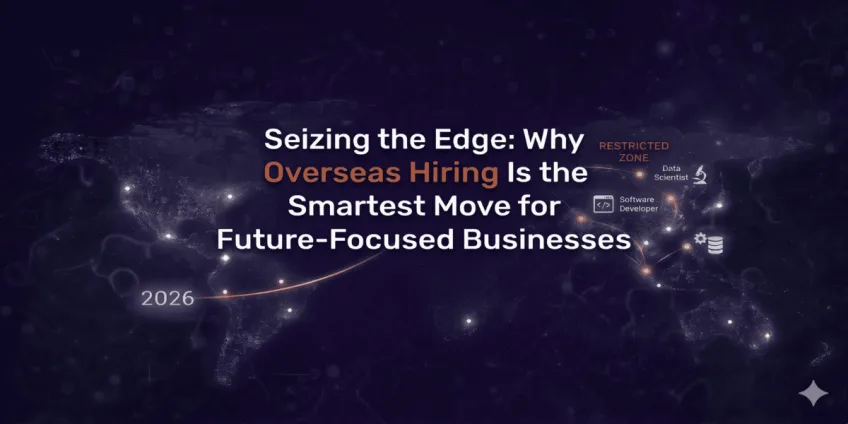
Seizing the Edge: Why Overseas Hiring Is the Smartest Move for Future-Focused Businesses
Best PracticesPublished on by Iryna Seleman • 5 min. read
- Rethinking Workforce Strategy: Why Skill Shortages Demand Global Talent Access
- The Value of Going Global: What Businesses Actually Gain
- Navigating Pain Points: What Can Go Wrong - and How Experts Solve It
- Building Resilience and Trust Through Strategic Partnership
- Future Trends: Globalisation as Norm, Not Exception
- Expert-Led Solutions: How Partnerships Enhance Success & Confidence
- Conclusion
Across nearly every industry, conversations about transformation and organisational resilience always return to one challenge: accessing and retaining specialised talent. From fast-paced start-ups racing to out-innovate competitors to established enterprises digitising legacy operations, the practical - and emotional - reality is the same. There simply are not enough skilled professionals in key markets to meet demand.
This pressure reflects a broader shift in workforce dynamics: according to the 2026 Staffing Trends report by Staffing Industry Analysts, contingent and flexible workers already represent over 35% of the workforce in many developed markets, as companies increasingly rely on alternative talent models to address persistent shortages.
According to Korn Ferry, the global talent shortage could reach 85 million unfilled jobs by 2030, potentially costing businesses $8.5 trillion in lost revenue. As workforce needs rapidly evolve, organisations report too many roles left open too long, impeding growth, affecting operational reliability, and sapping team morale.
Recent research by ManpowerGroup shows that 77% of employers globally report difficulty filling roles, the highest level recorded in nearly two decades.

For technical decision-makers and HR leaders alike, anxiety about filling today’s gaps and anticipating tomorrow’s needs has created new urgency to look beyond traditional hiring boundaries.
Against this backdrop, a powerful, proven solution has firmly entered the mainstream: hiring overseas. Leading experts point out that global hiring has shifted from a risk-laden last resort to a sophisticated, strategic cornerstone for organisations striving to build future-ready teams, introduce new perspectives, and achieve continuous transformation.
Inside this analysis, discover how smart, trustworthy partners guide businesses through the complexities of global recruitment. Real-world success stories reveal the best ways to fill expertise gaps, harness multicultural teams’ power, and achieve impactful growth - making your organisation outstanding not just in capability but in reputation.
Rethinking Workforce Strategy: Why Skill Shortages Demand Global Talent Access
In the past, many organisations saw hiring overseas as a temporary fix or cost-saving option. Today, with skill shortages hitting structural levels - spanning software engineering, cloud systems, AI, cybersecurity, and hard-to-source business functions - more executives consider international recruitment the most realistic answer to building resilience.
A Deloitte workforce study found that 59% of organisations now view global talent sourcing as a strategic priority rather than a temporary solution.
At the same time, workforce strategies are evolving rapidly: the Staffing Trends 2026 study finds that more than 60% of staffing organisations are already investing in AI-driven recruitment technologies to accelerate sourcing and improve talent matching across borders.
Additional perspective on these emerging workforce dynamics can be found in Cortance’s industry analysis, which explores how technology, talent mobility, and new staffing models are reshaping recruitment strategies worldwide.
Current industry data underscores this urgent shift. According to 2023 research by Staffing Industry Analysts, over half of the companies surveyed experienced difficulty accessing critical talent through traditional channels.
Additionally, LinkedIn data shows that global remote job postings increased more than 400% between 2020 and 2023, reflecting the rapid normalisation of cross-border hiring.
The stubborn shortage of advanced digital, engineering, and analytics competence - especially in North America and Western Europe - prompted a record 71% of organisations to look beyond borders for specialised expertise. Nearly three-quarters expect their reliance on external global talent to remain steady or rise for the foreseeable future.
For many business leaders, inaction is not an option. Project execution suffers. Innovation agendas stall. Large-scale technology transformation, once an engine of growth, has become a frustrating source of missed deadlines and lost opportunities. The emotional stress is punishing when internal teams carry heavy workloads, morale declines, and customer service falters.
Empowering new growth thus means reaching both farther and smarter - to establish pipelines that tap fluidly into in-demand skill pools, around the world.
The Value of Going Global: What Businesses Actually Gain
Making the leap into global hiring touches more than budgets - it reshapes organisational capability and business culture. The pragmatic advantages are substantial:
- Access to Scarce Skills: Expanding recruiting to high-talent markets such as Eastern Europe, Asia, and Latin America allows rapid onboarding of skills - from advanced mobile development to AI-driven analytics - even when they’re nearly impossible to find locally;
- Continuous Delivery: Working across time zones and cultures widens productivity windows and creates true “follow-the-sun” development or support, making operations more resilient to disruption;
- Diversity and Innovation: Teams combining regional knowledge with global standards naturally generate wider creative options and anticipate broader user and customer needs;
- De-risking and Agility: Global workforce structuring enables businesses to quickly scale teams up or down without geographic constraints, minimising overhead while maintaining mission-critical expertise.
Crucially, organisations with trusted global staffing partners report smoother onboarding, higher retention among overseas recruits, and greater employee satisfaction. From clear communication to flexible contractual protections, these issues are typically addressed professionally and empathetically.
Real-world experience shows that firms that leverage international hiring under expert leadership create a significant business advantage – not just more productive, but also more adaptable, more confident in their brands, and more forward-thinking. For platform-focused projects, this advantage often comes down to choosing partners with proven niche expertise. For example, teams with hands-on Magento development experience can help companies reduce technical risk, avoid costly architectural mistakes, and support long-term scalability.
Navigating Pain Points: What Can Go Wrong - and How Experts Solve It
Despite clear rewards, hiring overseas is complex - and fraught with emotional concerns that business leaders routinely underestimate at the outset. Beyond simple transactional issues, the true obstacles stem from trust, quality assurance, and coordination.
Most Common Challenges Faced:
- Cultural and communication gaps often lock global teams out of critical conversations;
- Legal and compliance uncertainty (from worker classifications to data protection) amplifies risk - especially when teams cabin resources awkwardly;
- Recruiting the wrong talent from high-churn agencies or unreliable contractors often harms longer-term delivery and stability;
- Onboarding delays, time-zone shock, and churn cut into business advantage - not only frustrating schedules but also diminishing morale amongst distributed staff.
Industry case data consistently reveals that organisations relying on transactional, piecemeal solutions face weaknesses:
An American fintech that rapidly aimed to scale found its timelines stalling as communication mismatches and partner misalignments led to repeated hiring cycles. Once strategic support was onboarded - specialists with a deep-rooted presence in the relevant international talent pools - not only did screening and upskilling match business culture faster, but onboarding also stayed on track.
Employee engagement scores improved, while missed project milestones soon halved.
The silent assurance that comes from responsive account managers, expert-researched onboarding, and scalable team extensions keeps projects calm, top talent satisfied, and security provisions robust. Such proven, real-world results are possible only with embedded, well-vetted global talent
Building Resilience and Trust Through Strategic Partnership
For executives and managers immersed in addressing workforce change, the challenges - and pressure - are more than technical; they are deeply personal. Anxiety around hidden costs, suitability of hires, integration risk, and company momentum can dominate decision cycles.
The secret to genuine confidence, and to building real organisational resilience, comes down to trust. Rather than one-off placement, the most impactful global workforce solutions are relationship-led.

Global staffing ecosystems extend beyond recruitment to include compliance, workforce consulting, HR technology, and talent management services. Source: Staffing Industry Analysts.
Teams rely on expertise underpinned by:
- Rigorous, insight-based screening tailored for precise business context;
- Authoritative regulatory and operational due diligence, eliminating hiring “unknowns”;
- Consistent tracking of market shifts, skill demand, and competitive pay, positioning clients advantageously versus rivals.
Trusted consultancies - discrete but highly capable - demonstrate market bona fides. Testimonials indicate that business owners moved from doubt to sustainable competitive confidence after particularly skill-intensive launches were staffed overseas, often completing projects ahead of schedule while easing internal workloads.
Functionally, clients highlight valuable business readiness built on:
- Award-winning candidate pools with proven local compliance;
- Cultural liaison roles that gel teams quickly across geography;
- Executive handholding throughout ramp-up and renewal, bypassing guesswork;
- An ability to “plug in” premier engineers in advanced stacks such as Python, Node.js, cloud architecture, and AI (read more at Cortance technology talent outsourcing);
Future Trends: Globalisation as Norm, Not Exception
Most international workforce experts believe global, distributed staffing has only accelerated post-2020. The COVID-19 crisis proved both the practical necessity and transformative power of such sourcing; today, agility and reach define world-class organisations.
Now, paired with trends in remote work enablement and policy modernisation, overcoming skill bottlenecks must be managed like any other key infrastructure project - with dedicated, trustworthy frameworks, systemic knowledge transfer, and measurable business benefit scaling.
Firms' smartest in this arena don’t look at overseas hiring merely as a way to fill the next urgent role.
According to analysis from Grand View Research, the global IT staffing market was valued at over $650 billion and continues to grow steadily as organisations expand distributed workforce strategies.
Instead, they implement truly strategic global workforce architectures - embedding international expansion as a foundation of business longevity, organisational learning, and risk mitigation.
A recent Staffing Industry Analysts survey evidences this: Nearly 75% of global-minded businesses plan to maintain or grow their overseas sourcing well after initial digital transformation efforts, placing the composition of internationally distributed teams among the top differentiators of post-pandemic market leaders. These organisations understand that robust talent channels across both emerging and mature talent geographies power stronger adaptability amidst economic volatility and continuous technological disruption.
Where only tech giants and multinationals previously flexed their borderless hiring muscles, mid-market firms, digital agencies, and fast-scaling startups now access similar expertise-driven global talent models. Rather than offering “overflow,” international specialists underpin mainstream operations, accelerating launches in AI, data science, and next-wave digital systems. Strategic partners who guide this process remain highly valued not just for their reach but, crucially, for the deeply earned client trust that every new hire aligns seamlessly with the evolving company culture, values, and strategy.
Expert-Led Solutions: How Partnerships Enhance Success & Confidence
While the demand for specialised remote talent shows no sign of slowing, apprehensions remain. Executives worry about integration costs, project control, regulatory changes, or getting caught with stranded contracts. That’s where seasoned global staffing partners prove invaluable: By championing transparency, acting as trusted liaisons, and drawing from a history of demonstrable success, they set new benchmarks in trust-building and results - a crucial difference from mass-market freelance platforms or commoditised outsourcing “shops.”
Clients routinely highlight three levels of secured value:
- Business Alignment: Dedicated consultants perform in-depth diagnostics, matching business needs not just to credentials but also to temperament, regional fit, and adaptability for lasting value;
- Regulatory Clarity & Compliance: Secure navigation of international payroll, tax, work-permit, and data-localisation rules - balancing speed with steadfast legal governance;
- Continuous Performance Assurance: Mature recruitment frameworks adapt fast as company strategies shift, including upstaffing, downscaling, and “healthy” rotation policies that prioritise knowledge-sharing without overleveraging;
Trust is built over cumulative deliveries - through consistent achievement of project milestones, proactive challenge-resolving, and honest communication - not sensationalist promises.
Industry-ratified survey feedback consistently puts solution-first consultancies - like those behind major Southeast Asian mobile finance launches or AI-driven North American retail pivots - atop trust/interoperability rankings. When people ask why organisations that grow overseas thrive decades after an initial shift, it’s the enduring support and a clear, shared measure of success that separate them.
Conclusion
The business imperative has never been clearer: access to international talent is no longer optional for companies aiming at transformation, resilience, and meaningful market differentiation. As skills shortages harden and workforce paradigms accelerate, those who adapt through expert, relationship-driven overseas recruiting will secure not just growth but future-proof agility, stability, and trust across their workforces.
At the centre of effective, risk-minimised global hiring are specialised partners whose reputation stands on unwavering delivery, transparent processes, and shared investment in clients' strategic success. It's this cumulative track record - championed by client testimonials, acknowledgement from leading workforce advisory boards, and the steady advancement of firms under their guidance - that ingrains the confidence sought by challenged leaders everywhere.
Contending with the anxiety of mounting vacancies, skill mismatches, or faltering growth need not be a solitary struggle. Instead, with the right partner - one trained in the nuances of multinational teamwork, labour compliance, seamless onboarding, and high-end retention - your organisation gains the power to thrive regardless of local constraints.
Now more than ever, the smartest move a business can make is a deliberate, expertly supported step onto the global workforce stage - transforming both organisation and outcome, and forging lasting competitive advantage through the strategic pursuit of international talent.
Related Articles
How Startups Waste Money on Tech Hiring (And How to Avoid It). Budgeting mistakes and hiring hacks
Optimise your hiring to grow rather than drain resources. Refine your hiring strategy before it damages your startup.
Read article