How to Hire Pre-Vetted Developers - and Tell Real Vetting from a Marketing Claim
How to HirePublished on by Yevhen Vavrykiv • 8 min. read read
- Why Traditional Hiring Keeps Failing the Same Way
- The Real Cost of Getting This Wrong
- What Pre-Vetting Actually Means - and Doesn't
- Filtering vs. Screening
- What Rigorous Vetting Produces
- Five Signals That Separate Real Platforms from the Rest
- 1. What the Rejection Rate Is Actually Measuring
- 2. Time to First Match - and How It's Achieved
- 3. Placement Success Rate After Onboarding
- 4. Pool Structure: Registered Profiles vs. Contracted Experts
- 5. What Happens When the Match Doesn't Work
- What to Look For Across Platforms
- What the Process Looks Like When It Works
- FAQ
- Conclusion
Three months. That's the average time a startup spends filling one senior engineering role through traditional recruiting - and close to a third of those hires still don't survive the first year (LinkedIn Talent Solutions, 2024).
The maths on a single mis-hire compounds quickly. Replacing a mid-level engineer costs 20–30% of their annual salary in direct replacement costs, before accounting for the sprints that didn't ship, the technical debt that accumulated, and the hours a senior team member spent in interviews instead of building product (Acquaintsoft, 2025).
Pre-vetted developer platforms address both problems. Candidates complete a formal technical evaluation before reaching your inbox - live coding tests, system design exercises, background checks - so the first conversation is already with a verified engineer. The best platforms reject 90% or more of applicants and deliver a first shortlist within 24–48 hours. To hire pre-vetted developers effectively, evaluate any platform on five signals: what the rejection rate is actually measuring, time to first match, pool structure, contract terms, and placement success rate after onboarding.
The problem is that "pre-vetted" has become a marketing word. Every platform claims it. The execution ranges from rigorous to cosmetic. And the difference becomes visible only after you've signed a contract.
Why Traditional Hiring Keeps Failing the Same Way
Job boards were designed to generate volume. Post a role, collect applications, filter manually. The model was built for HR departments with dedicated recruiting functions and weeks of slack capacity.
Most early-stage companies have neither. A CTO reviewing applications for two hours a day is a CTO, not building the product. A founder managing a six-week interview process is a founder not talking to customers. The opportunity cost is structural - it doesn't resolve with better scheduling.
Volume-optimized recruiting creates a second problem: it selects for candidates who are skilled at applying, not necessarily skilled at the job. A polished LinkedIn profile and a well-structured resume are competencies unto themselves. They correlate weakly with engineering output, system design ability, or the capacity to work effectively in an async, distributed environment.
The Real Cost of Getting This Wrong
Platforms that reject fewer than 10% of applicants aren't vetting - they're filtering warm bodies (index.dev, 2025). When that standard reaches your team, the cost doesn't arrive in the hiring invoice. It arrives in the weeks after onboarding: rework cycles, missed sprint commitments, code that technically ships but requires immediate remediation.
Replacing an engineer mid-engagement fragments institutional knowledge, delays timelines, and burns the time of whoever manages the transition. The initial saving - a lower hourly rate, a faster shortlist - rarely survives contact with the full project timeline.
What Pre-Vetting Actually Means - and Doesn't
The term "pre-vetted" covers a wide range of process quality. Understanding the distinction matters before you pick a platform.
Filtering vs. Screening
Filtering reduces volume. It removes candidates who don't meet stated criteria - wrong geography, missing language, no relevant experience on the profile. It's automated, fast, and produces a smaller pool without producing a verified one.
Screening verifies capability. It tests what the candidate can actually do - under time pressure, without external help, in conditions that approximate real work. Live coding sessions, system design exercises, and debugging challenges are screening. Asking someone to list their frameworks is filtering.
Many platforms that claim high rejection rates are running aggressive filtering, not genuine screening. A 98% rejection rate sounds rigorous. The question is what that 98% was rejected for. If most were eliminated by location, timezone, or stated language fluency before any technical evaluation occurred, the number tells you very little about the quality of the remaining 2%.
What Rigorous Vetting Produces
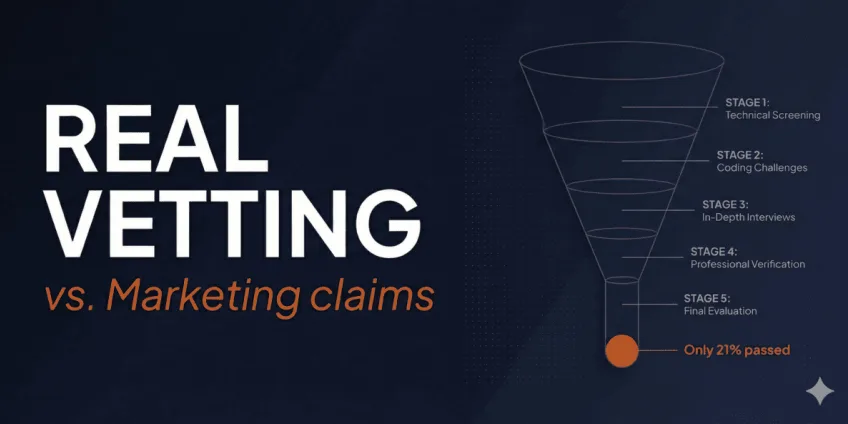
A five-stage process - covering initial technical assessment, live coding, system design, soft skills, and background verification - produces a meaningfully different candidate pool than a two-stage filter. Platforms that run this level of evaluation reject a high proportion of applicants for engineering reasons specifically: people who pass the profile check but cannot demonstrate the skills in a controlled setting.
Worth saying: the vetting depth also determines what happens after placement. A platform's post-hire success rate is a downstream function of how seriously it evaluated candidates before the match.
Cortance's vetting process runs across five stages, with 21% of applicants passing all of them. Roughly four in five candidates who clear the initial requirements don't make it through the technical evaluation. That figure is honest and verifiable - and it explains why 89% of placements result in a sustained engagement.
Five Signals That Separate Real Platforms from the Rest
These aren't rankings. They're evaluation criteria that apply to any platform you're assessing before committing.
1. What the Rejection Rate Is Actually Measuring
A high rejection rate is meaningful only if the rejection is happening for technical reasons. Ask platforms directly: at what stage do most candidates fail? If the answer is language screening or profile review, the vetting is shallow. If the answer is live coding or system design, the process is doing real work.
Platforms worth using can answer this question specifically, with detail about what each stage tests. Platforms that redirect to a percentage without describing the methodology are selling the number, not the process.
2. Time to First Match - and How It's Achieved
The claim of "24–48 hours" is widespread. The mechanism behind it is not uniform.
Fast matching from a large open registry is fast in the way a keyword search is fast - it returns results quickly but without meaningful judgment. Fast matching from a pre-contracted pool of verified engineers is different: the evaluation work was done before your request arrived. The speed reflects readiness, not just database scale.
That distinction matters because it determines the quality of what lands in your inbox. A platform that has done verification in advance delivers candidates ready to start. A platform that matches quickly by running a fast search delivers profiles that still require substantial evaluation on your side - which is precisely the problem you were trying to solve.
3. Placement Success Rate After Onboarding
Most platforms lead with acceptance rates and time-to-match figures - metrics that describe the pre-hire process. The metric that tells you more is what happens after the hire: what percentage of placements sustain past 90 days and result in a completed engagement?
This number is harder to publish honestly, because tracking it requires following outcomes rather than just inputs. When a platform can state it and back it with a methodology, it carries more weight than any pre-hire figure.
4. Pool Structure: Registered Profiles vs. Contracted Experts
There's a fundamental structural difference between platforms that maintain a registry of developers who self-enrolled and platforms that contract engineers before any matching begins.
A registry scales without friction - you can claim 50,000 profiles with minimal operational overhead. A contracted pool requires active maintenance: engineers need to be re-verified, kept current, and available when a match request comes in. That operational burden limits scale, which is why contracted pools are smaller - and why the smaller number is a quality signal, not a limitation.
592 developers holding active contracts is a different proposition from 50,000 registered profiles. One represents verified, ready-to-start capacity. The other is a searchable database.
5. What Happens When the Match Doesn't Work
Every platform advertises its successes. The replacement policy describes how it handles failure - and it reveals the platform's actual confidence in its vetting quality.
Look for: specific replacement timelines (48 hours vs. "we'll work something out"), no-friction processes that don't require the client to prove cause, and guarantee terms that are contractual rather than a customer service promise. A platform that knows its evaluation process is rigorous will offer strong replacement terms. One who hedges the language usually knows it needs to.
What to Look For Across Platforms
| Signal | What to ask | Red flag |
| Rejection rate | "At what stage do most candidates fail - and why?" | Vague percentage with no methodology. |
| Vetting stages | "How many stages, and what does each test?" | Fewer than 3 stages; no live coding component. |
| Pool structure | "Are developers contracted before matching, or registered?" | "We have X,000+ profiles" without contract details. |
| Time to match | "How is that timeline achieved operationally?" | Fast matching with no pre-screening explanation. |
| Placement success | "What percentage of placements sustain past 90 days?" | No post-hire outcome data available. |
| Replacement terms | "What's the exact replacement process if the engagement fails?" | Conditional or vague guarantees. |
What the Process Looks Like When It Works
Before: A senior full-stack role opens. The job post goes live on Monday. Applications arrive throughout the week. The first round of review takes three to four days. Technical interviews begin the following week. Two candidates reach the final stage. One accepts. Onboarding starts five weeks after the position opened - assuming nothing falls through in the final stretch.
After: A request goes in at 9 am. A shortlist arrives within 30 minutes, drawn from pre-contracted engineers who've already completed five stages of technical verification. Two candidates move to a short conversation. One starts the following week.
That isn't a hypothetical. It's the operational output of a pre-contracted, pre-verified pool - where the evaluation work happened before your request existed, not in response to it.
For teams that have spent multiple sprint cycles without a workable candidate, the difference isn't just speed. It's the recovery of engineering leadership time that was being consumed by the recruiting process itself. A founder or CTO running a six-week search is not doing the job the company actually needs them to do.
The right platform for hiring full-stack developers or specialist engineers isn't always the biggest. It's the one where the verification work was completed before you arrived.
FAQ
- What does "pre-vetted developer" actually mean? A pre-vetted developer has completed a formal technical evaluation - typically including a coding assessment, live programming exercise, system design interview, and background verification - before being made available to clients. The quality of that evaluation varies significantly between platforms. The term has no industry standard definition, which is why the methodology behind the claim matters more than the claim itself.
- How long does it take to hire a pre-vetted developer? On platforms that maintain pre-contracted talent pools, a first shortlist typically arrives within 24–48 hours of a request (at Cortance, in 30 minutes). Full onboarding - contract terms, access setup, tool provisioning - usually takes five to ten business days from shortlist to start date (at Cortance two-five days). Platforms that run vetting after a client request arrives take longer: a completed shortlist can take one to three weeks.
- What rejection rate should I look for in a developer platform? Platforms rejecting fewer than 10% of applicants for technical reasons are filtering, not vetting. The strongest platforms reject 80–95%+ of applicants specifically because of technical evaluation failure. That figure should come with a description of what was tested at each stage - not just a headline percentage. If a platform can't explain why candidates fail, the rigour of the process is unknown.
- How much does hiring through a pre-vetted platform save compared to traditional recruiting? Pre-vetted platforms typically save $16,000–$25,000 per hire compared to traditional in-house recruiting processes, primarily by eliminating agency fees, reducing interview rounds, and shortening time-to-start (teamstation.dev, 2025). That estimate excludes the productivity cost of roles that remain open during a three-month search, which accumulates across every sprint and every week of delayed output.
- What's the difference between a developer marketplace and a pre-vetted platform? A marketplace connects clients with developers who self-register and manage their own profiles - quality varies widely, and meaningful evaluation happens on the client side. A pre-vetted platform runs its own technical evaluation before any developer is made available, so the quality bar is set by the platform rather than by the client's capacity to conduct rigorous technical interviews. For teams without a strong internal interview function, the distinction is significant.
- Can I hire pre-vetted developers for short-term or contract engagements? Yes. Most pre-vetted platforms support contract engagements alongside full-time placements. The engagement structure - hourly contract, monthly retainer, project scope - varies by platform. If flexibility matters, confirm the minimum commitment terms before signing: some platforms require minimum hour thresholds or lock-in periods that may not suit short engagements or project-based work.
- What roles are best suited to pre-vetted hiring platforms? Pre-vetted platforms work best for roles where technical depth is non-negotiable and where your internal team lacks the bandwidth to run a rigorous evaluation process independently. Senior full-stack engineers, backend specialists, DevOps leads, and machine learning developers are common fits. Junior roles - where on-the-job development is a core expectation - often suit traditional hiring better, since pre-vetted pools are optimized for verified experience rather than growth potential.
Conclusion
The promise of pre-vetted hiring is valid. The gap in execution between platforms is large enough that the label alone gives little information.
Platforms that conduct genuine multi-stage technical evaluations - with a verifiable rejection rate, a pre-contracted talent pool, and transparent post-hire success data - deliver a fundamentally different outcome than platforms that use the same terminology for resume filtering. The difference isn't visible in the shortlist; it becomes clear in the first three weeks of work and in every sprint that follows.
For founders who have gone a quarter without filling a critical engineering role, the shift is not just about speed. It's about regaining the leadership bandwidth that traditional hiring drains - and redirecting it back into the product.
The key point to consider and orient on is that a first shortlist of pre-verified engineers is provided within the same business day.
Related Articles

Types of Salesforce Developers and How AI Is Reshaping Each Role
Five Salesforce roles, five different jobs. Hire the wrong one and the cost shows up months later.
Read article
How to Hire a QA Engineer with Real Accessibility Testing Skills
Most QA engineers have heard of WCAG. Few can tell you what it doesn't catch - and that gap is exactly where accessibility bugs survive to production
Read article
How to Hire Cloud Engineers Without Losing Weeks to a Process Built for a Different Era
Six weeks to hire one cloud engineer. That's not unusual - it's the industry average. The fix isn't moving faster through the same funnel.
Read article