How to Hire Remote Developers and Save Money (Without Sacrificing Quality)
Tech TipsPublished on by Yevhen Vavrykiv • 9 min. read

- Key Takeaways
- Why Local-Only Hiring Is Getting Harder to Justify
- Does Remote Automatically Mean Cheaper?
- The Real Goal: Value per Dollar, Not the Lowest Rate
- Where Hiring Remote Developers Actually Saves Money
- 1. Salary level vs local market
- 2. Seniority uplift
- 3. Lower non-salary overhead
- 4. Team flexibility
- How Local and Remote Hiring Hourly Rates Actually Compare
- 1. Local in-house
- 2. Remote hiring (body-leasing)
- 3. A Simple Way to Think About It
- Why “Cheapest Possible” Is Usually the Most Expensive Path
- The “Value Band”: Finding the Sweet Spot Between Cost and Quality
- Example: Same Budget, Smarter Remote Setup
- Where a Vetted Remote Partner Fits In
- Implementation Checklist for Clients
- Conclusion: Save on Cost, Not on Quality
Key Takeaways
Local-only hiring in high-cost markets (US, UK, DACH, Nordics, Israel, etc.) is expensive and slow - you’re paying for more than skills. Remote hiring lets you tap into cost-effective regions where a strong developer’s fair salary is still lower than your local benchmark.
The goal is not “find the cheapest offshore rate”. The goal is to hit the value band where:
- skills and experience are strong;
- communication works;
- time zones overlap;
- total cost is clearly better than local.
“Cheap but wrong” is usually more expensive than “fair but right” once you add delays, rewrites, and risk.
Clients win when they combine:
- smart geography choices,
- a clear evaluation framework, and
- a vetted partner who filters remote developers before they hit your calendar.
Why Local-Only Hiring Is Getting Harder to Justify
If you’re hiring in a high-cost hub, you already feel the pressure:
- Strong seniors are expensive – salaries, benefits, and office space, all priced at big-city rates;
- The time-to-hire is long – everyone is competing for the same limited pool;
- You’re paying for the postcode – not just the skills.
Meanwhile, your reality is:
- the product needs to ship faster;
- runway and budget are limited;
- you can’t afford three “let’s see if it works out” hires.
That’s why almost every serious company now considers remote developers at some point. The question isn’t if you go remote - it’s how you do it without gambling on quality.
Does Remote Automatically Mean Cheaper?
Yes and no.
Yes, because you’re suddenly playing in markets where a senior engineer’s fair salary is still lower than in, say, San Francisco, London, Luxembourg or Norway. You can genuinely:
- pay a developer very competitively for their region,
- and still land at a lower total cost than a comparable local hire.
No, because going remote doesn’t magically fix bad hiring decisions:
- pick the wrong region, wrong partner, or wrong person,
- and you get the same delays, rewrites, and headaches — just in another time zone.
So the real question is not “Is remote cheaper?” but: “How do we hire remote developers in a way that reliably improves value per dollar?”
The Real Goal: Value per Dollar, Not the Lowest Rate
If cost were the only variable, you’d open a job board, sort by hourly rate, and hire whoever is cheapest.
In real life:
- a cheap, wrong hire can burn 3–6 months of the roadmap;
- poor quality means rewrites and production issues;
- communication gaps drag founders and PMs into micro-management.
By the time you replace that person, your effective cost is often higher than if you’d paid a solid engineer a fair rate from day one.
The right mental model is: “How much value can this person generate for every dollar we spend?”
That’s where remote hiring, when done appropriately, shines.
Where Hiring Remote Developers Actually Saves Money
1. Salary level vs local market
In many strong engineering regions, a top developer’s fair compensation is materially lower than in US/UK/UAE big cities, but remains competitive and attractive locally.
- You save against your local benchmark;
- They earn a strong salary in their market;
- Both sides feel like they’re winning.
2. Seniority uplift
In an expensive city, your budget for one local senior might only stretch to a mid-level. With remote developers in a cost-effective region, the same budget might buy:
- one real senior instead of one mid, or
- a senior + a mid instead of a single local senior.
You’re not cutting quality, you’re buying more of it.
3. Lower non-salary overhead
Remote-friendly teams tend to spend less on:
- office footprint and fit-out;
- on-site services and perks;
- relocation and commuting support.
These aren’t always top of mind, but across a team, they add up.
4. Team flexibility
It’s generally easier to:
- scale a remote team up or down,
- plug specific gaps (DevOps, QA, data, security),
- run short, intense phases of work.
You can treat capacity as flexible, rather than something fixed or long-term.
How Local and Remote Hiring Hourly Rates Actually Compare
Let’s make this less abstract and compare the effective hourly cost through three lenses:
- Local in-house hiring (full-time employee in your city);
- Remote hiring (body-leasing) (developer employed in a more cost-effective region).
⚠️ Important: the numbers below are illustrative bands, not a universal truth.
Actual rates depend on tech stack, seniority, country, sector, and timing. The point is the relationship between models, not exact digits.
1. Local in-house
You don’t just pay the salary - you pay the whole package:
- gross salary;
- employer taxes and social contributions;
- office and equipment;
- local benefits and perks.
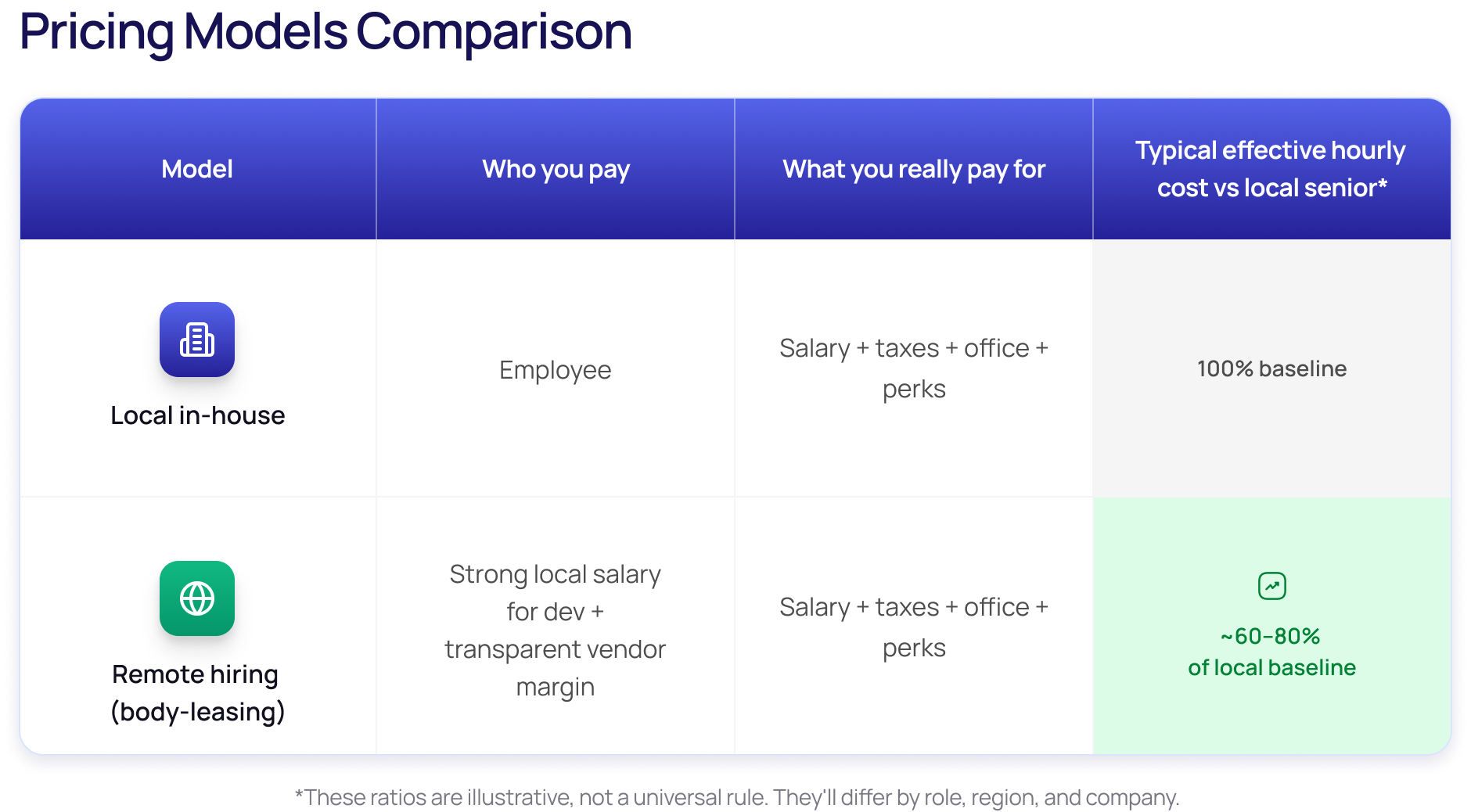
When you divide all of that by productive hours, the effective hourly cost is often 1.3–1.8× higher than the base salary would suggest.
For a strong senior engineer in a high-cost hub, that can mean:
- headline salary feels like “X”;
- actual cost to company behaves more like 1.3–1.8 × X.
You get proximity, culture fit, and in-person collaboration - but you pay big-city prices for it.
2. Remote hiring (body-leasing)
Here, you hire developers in markets where the cost of labor is lower than your local market, but you still pay them very competitively for their region.
The result:
- developers are well-paid, motivated, and more likely to stay;
- your effective hourly cost is often 30–50% lower than an equivalent local hire + a transparent vendor margin;
- you can sometimes upgrade from “one mid” to “one senior + one mid” on the same budget.
You’re saving on:
- local salary benchmarks;
- office and local overhead;
- and sometimes on taxes/benefits, depending on the structure.
3. A Simple Way to Think About It
You can summarise it like this:
Why “Cheapest Possible” Is Usually the Most Expensive Path
A whole segment of the market is focused on one thing - having the lowest cost on the spreadsheet.
On paper, it looks good. In reality, the hidden cost often includes:
- Slow progress – more hand-holding, more rework;
- Technical debt – shortcuts that slow every future feature;
- Security and reliability risk – corners cut where you really can’t afford it;
- Founders and CTOs are babysitting instead of driving the product.
By the time you:
- pay the cheap rate;
- absorb the delays;
- and then pay again to have someone better fix it.
The total is higher than a fair, mid-range remote rate would have been.
That’s why the target is not “the cheapest developers in X country”. It’s fairly paid remote developers in markets where their fair pay is still a smart spend for you.
The “Value Band”: Finding the Sweet Spot Between Cost and Quality
It helps to stop thinking in binary (“local vs offshore”) and start thinking in bands:
- Premium local band
- Ideal for roles that require close proximity to the leadership team;
- Highest salary and overhead.
- High-value remote band (your sweet spot)
- Mature engineering ecosystems;
- Plenty of seniors with global experience;
- Time-zone overlap with your core team;
- The total cost is significantly lower than in your local market, while developers are still well paid for their region.
- Low-cost, high-variance band
- Extremely low rates, extremely mixed quality;
- Can work if you have extreme vetting and management - but many teams don’t.
Smart clients aim for the high-value remote band: “Not the absolute cheapest; not the most expensive; the point where quality is high, and the total cost still gives us a clear advantage.”
Example: Same Budget, Smarter Remote Setup
You’re a SaaS founder in London. You have a budget for one local senior back-end developer.
- Option A – Local only
- You hire one strong senior locally;
- Salary + taxes + office + perks at London rates;
- You get one person’s throughput;
- Option B – High-value remote
- You hire a senior back-end developer in a strong, cost-effective market, for example, Ukraine;
- You pay them at the top of their local band, so they’re motivated and stable;
- Your total cost is still clearly below the local Option A;
- With the freed-up budget, you can add part-time DevOps support or a mid-level developer to accelerate delivery.
Same budget. Very happy remote developer. More throughput and less risk for you. That’s the kind of win–win remote is supposed to deliver.
Where a Vetted Remote Partner Fits In
You can source, test, and manage remote developers alone. But if you don’t live in those markets, you’re guessing.
To hire developers from a good partner, the vendor should provide:
- Real vetting, not CV-forwarding
- technical challenges that mirror real work;
- code reviews and problem-solving checks;
- communication and soft-skills screening.
- Transparent pricing and structure
- clear ranges;
- no hidden margins;
- you know what goes to the developer and what funds operations/support.
- Guidance on regions and roles
- which markets fit your time zone and stack;
- how to blend local and remote into one coherent team.
And you can find one of them https://www.topdevelopers.co/
The outcome you want: “For this budget and roadmap, here is the strongest, lowest-risk remote engineering setup we can build — with predictable cost and vetted people.”
Implementation Checklist for Clients
When you’re about to hire remote developers, run through this list:
- Define the outcomes you want (features shipped, stability, deadlines), not just “we need 3 devs”;
- Decide which responsibilities should be local (e.g., product, key leadership) and which are well-suited for remote work;
- Shortlist 1–3 high-value regions that fit your time zones and tech stack;
- Set budget ranges where you aim to pay above local average in those regions, not the bare minimum;
- Choose a partner or process that tests people, not just filters by rate and CV keywords.
Evaluate candidates on skills, communication, time zone fit, and total cost, not just headline rate.
Keep 5–15% of the budget flexible to:
- upgrade a critical role, or
- bring in specialists (DevOps, security, data) when needed.
Conclusion: Save on Cost, Not on Quality
Remote hiring should not be a race to the bottom. It should be a way to:
- step outside your expensive local bubble;
- access high-quality developers in regions where their fair salary is still efficient for you;
- and build a team that ships faster and more reliably for the same - or lower - total cost.
If you optimise for value per dollar instead of the lowest possible rate, you don’t have to choose between:
- local and overpriced, or
- remote and risky.
You can have remote, high-quality — at a price that makes sense for your product and runway.
Related Articles

Web Development for Startups in 2026: AI Coding, No-Code, and Hiring the Right People
AI lets almost anyone ship a working product. So why do startups still fail? A founder's guide to the 2026 toolchain and the modern dev team.
Read article
AI Agents for SEO: How the Right Tools Drive Real Website Traffic - Not Just Visibility
Visibility and traffic are two different problems. Here's why most AI SEO tools only solve one of them.
Read article
10 Reasons Businesses Choose Laravel for Fast, Scalable Web Development
Laravel remains one of the strongest choices to launch web products faster, reduce development overhead, and scale with confidence.
Read article