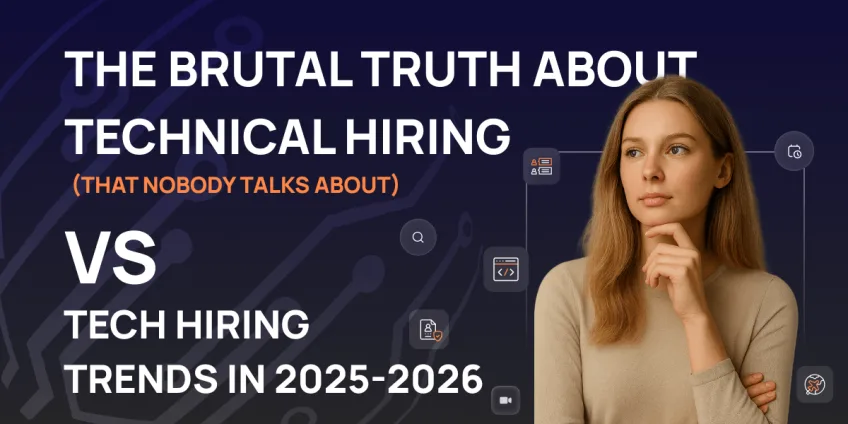
The Brutal Truth About Technical Hiring (That Nobody Talks About) vs Tech Hiring Trends in 2025-2026
Tech TipsPublished on by Yevhen Vavrykiv • 8 min. read
- The Four Paths to Technical Hiring Hell
- Path 1: Recruiting Agencies - "The CV Forwarding Tax"
- Path 2: In-House Recruiters - "The Hidden Cost Surprise"
- Path 3: Personal Networks - "The Scalability Wall"
- Path 4: Usual Outstaffing Partners - "The Margin Trap"
- The "Mix Everything" Trap
- Tech hiring trends or how Tech/Non-tech Founders Hire Developers in 2025-2026.
- Critical Success Factors In Searching For Your Perfect Tech Partner In 2025-2026
- What to Look For in a Tech Hiring Partner:
Stop reading pretty hiring guides. Here's what actually happens: your idea is flawed if you hire technical talent without conducting a thorough technical assessment yourself.
That's how it used to work, but not any more! Here's the reality check nobody wants to give you:
Usual technical hiring is expensive, time-consuming, and flawed - no matter which path you choose. Every approach sucks differently, and you need to pick your poison wisely.
The Four Paths to Technical Hiring Hell
Path 1: Recruiting Agencies - "The CV Forwarding Tax"
What they promise: "We'll find you amazing developers!"
Reality Check: You're paying up to a monthly developer salary to a company that has done nothing but share a CV with you, and you still have to find and pay a tech person for the proposed candidate interview.
It's like paying $80K for someone to hand you a business card.
Verdict: Highway robbery with a smile.
Path 2: In-House Recruiters - "The Hidden Cost Surprise"
What do you think: "This will be more efficient and cost-effective!"
Do this calculation right now:
(Annual recruitment budget + sum of annual recruiters' salaries + annual tech interview costs + tools) ÷ Number of successful hires = Your true cost per hire. You’ve expected less, haven’t you?
Plus bonus frustrations:
- Your recruiter doesn't understand the difference between React and Ruby;
- Skilled developers usually ignore recruiters from unknown startups.
Verdict: Thousand paper cuts (and rejected candidates).
Path 3: Personal Networks - "The Scalability Wall"
This approach seems the most convenient of the mentioned, right? And yes, this one actually works... sort of.
The good:
- Highest quality candidates;
- Pre-built trust and cultural fit;
- No ridiculous fees to middlemen (You do not have to pay 50 to 100% of the first developer's salary just for having a CV and contacts, and the only thing you need to cover is the interviewing process).
The brutal limitation:
- You might find 1-2 great people this way;
- Can't build a 10-person engineering team unless you're Zuckerberg's roommate;
- Your network has limits;
- Great for addition, terrible as a main strategy;
Verdict: Quality over quantity, but quantity matters too.
Path 4: Usual Outstaffing Partners - "The Margin Trap"
The pitch: "Access to pre-vetted developers without the hiring hassle!"
The reality:
- Pre-vetting provements absence (Still need to evaluate their skills yourself);
- Resource constraints that lead to jumping from "partner" to "partner" like you're speed dating;
- If it is an outsourcing company with outstaffing services, their "senior developers" are often junior or middle developers with updated profiles and superiors behind them;
- Usually, no possibility of developer transfer;
- Lack of involvement flexibility.
Verdict: Expensive convenience that isn't convenient.
And yes, you can combine all the approaches mentioned above, but is it worth doing so? Would you be able to keep this mixed approach optimised and under constant control?
The "Mix Everything" Trap
Here's what most founders think: "I'll just combine all approaches and optimise as I go!", but what actually happens:
- You're trying to manage four different hiring pipelines without an exact flow because of the rush and mixed structure;
- Each has different costs, timelines, and quality levels (inability to predict your spending and opportunities);
- You lose track of what's working and what's burning money;
- Your hiring process becomes a Frankenstein monster;
- You spend more time managing hiring approaches than actually hiring.
Would you run four different marketing campaigns without tracking ROI? Then why do it with hiring?
Tech hiring trends or how Tech/Non-tech Founders Hire Developers in 2025-2026.
Say no to the mess and traps you can face with the above-mentioned approaches, as well as to Upwork and similar ones.
Find a trusted tech provider that evaluates every candidate on their end and drastically reduces your hiring, ongoing, and releasing expenses. - That’s how it works now.
What your tech provider should offer:
- A thriving network of exceptional developers from the locations you are oriented in;
- Uncompromising developers' vetting process standard with shareable provements;
- Possibility to deliver quality developers and scale the team fast without compromising on quality;
- Dedicated support from comprehensive onboarding to regular check-ins.
- Cost-Effective, that means Сompetitive rates with no overhead expenses or unexpected fees;
- Сomplete flexibility with developer replacement or immediate contract termination if you're not 100% satisfied.
Critical Success Factors In Searching For Your Perfect Tech Partner In 2025-2026
What modern founders do instead? They ditch outdated methods and work with vetted tech partners who offer:
What to Look For in a Tech Hiring Partner:
⭐ Must-Have Qualities:
- 🌍 Access to vetted talent in your target locations;
- ✅ Clear, provable skill assessments for every candidate;
- ⏱️ Ability to scale fast, without sacrificing quality;
- 🤝 Ongoing support (from onboarding to performance checks);
- 💰 Transparent pricing with no surprise fees;
- 🔄 Flexible contracts with quick developer replacement or exit options.
✅ Success Indicators:
- Consistent, single-format developer profiles;
- Fast and fair hiring processes;
- Transparent pricing & contract terms;
- Constant manager support;
- Verifiable skill proof
- Fair pricing based on real skills and experience;
- Genuine customer reviews on trusted platforms;
🚩 Red Flags to Avoid:
- Fake developer profiles ( Inability to talk with the developer you’ve selected);
- Suspiciously low pricing without a clear value proposition;
- Lack of candidates' skills and experience provements;
- Poor communication during the hiring and cooperation process;
- Too long hiring flow;
- Rigid contracts or long lock-ins periods;
- Different developer profile format;
The hiring game has changed. Your time and product can’t afford old methods. Find a trusted tech partner who does the vetting for you, cuts time-to-hire, and gives you control without chaos. Because in 2025-2026, smart hiring isn't about doing everything. It's about doing the right thing, once.
Related Articles

Web Development for Startups in 2026: AI Coding, No-Code, and Hiring the Right People
AI lets almost anyone ship a working product. So why do startups still fail? A founder's guide to the 2026 toolchain and the modern dev team.
Read article
AI Agents for SEO: How the Right Tools Drive Real Website Traffic - Not Just Visibility
Visibility and traffic are two different problems. Here's why most AI SEO tools only solve one of them.
Read article
10 Reasons Businesses Choose Laravel for Fast, Scalable Web Development
Laravel remains one of the strongest choices to launch web products faster, reduce development overhead, and scale with confidence.
Read article