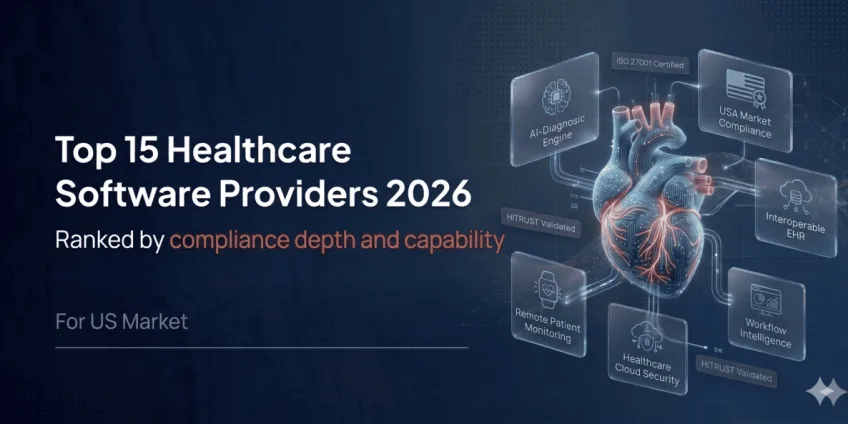
Top 15 US Market Healthcare Software Development Companies in 2026
Top CompaniesPublished on by Yevhen Vavrykiv • 12 min read read
- How We Selected and Scored These 15 Companies
- Top 15 companies that serve the US market Healthcare
- Cortance - Healthcare Software Talent Provider
- Emids
- Tegria
- GeBBS Consulting
- inVerita
- 7T (Seven Technologies)
- Simform
- Intellectsoft
- Arkenea
- TATEEDA GLOBAL
- Andersen
- Innowise
- Abto Software
- Lionwood Software
- Globaldev
- Full Comparison: 15 Companies at a Glance
- How to Choose the Right Engagement Model
- FAQ
The digital health market reached $427 billion in 2026, growing at 19.8% annually. Behind that number is a less comfortable statistic: more than 80% of US healthcare executives report critical tech hiring shortages - from HL7 integration engineers to AI specialists - with no signs of structural relief. The demand for healthcare software capability is growing faster than the industry's ability to produce it.
Choosing the wrong development partner in healthcare is a different kind of mistake than it is in other industries. A poorly chosen vendor can mean HIPAA violations, failed CMS interoperability audits, data breaches exposing patient records, or clinical tools that physicians won't adopt. The penalty structure is not just financial - it affects patient care. A mid-sized Texas hospital spent $400,000 building a patient portal before federal auditors found HIPAA violations six months post-launch; the development company had zero healthcare experience despite sterling credentials in e-commerce.
This list evaluates 15 companies serving the US healthcare software market across five criteria: healthcare domain depth, US market recognition, verified client evidence, compliance and certification maturity, and engineering team scale. Maximum score: 15 points. Cortance is evaluated separately as a remote talent provider - a distinct engagement model that several firms on this list use as a resource channel, including as a primary partner for European engineering talent.
How We Selected and Scored These 15 Companies
Every company on this list met six inclusion criteria before scoring: healthcare software must represent a primary service area, not a side vertical. The company must appear in at least one verified third-party source (Clutch, GoodFirms, Gartner, Black Book Research, or analyst publication), and HIPAA compliance must be documented with concrete implementation examples. Also, the company must have verifiable US market client history, and the team must include engineers with production EHR or health data system experience.
Scoring across five criteria (3 points each, 15 points maximum):
| Criterion | What 3/3 looks like |
| Healthcare domain depth | EHR/EMR, FHIR R4, HL7, HIPAA, and clinical workflow expertise in production - not just claimed |
| US market recognition | Verified Clutch reviews, analyst mentions (Black Book, Gartner Peer Insights, Forrester), or named US enterprise clients |
| Client evidence | Published case studies with named clients, measurable outcomes, and healthcare-specific context |
| Compliance & certification maturity | ISO 27001, SOC 2, ISO 13485 (for SaMD), HIPAA BAA process, and ePHI architecture documented |
| Engineering scale for the engagement type | Team depth appropriate for the engagement model - specialists for boutique, volume for enterprise |
Top 15 companies that serve the US market Healthcare
Cortance - Healthcare Software Talent Provider
Category: Remote Talent Provider · Rate: $30–$60/hr
Cortance operates in a category distinct from every other company on this list. Where the firms below deliver healthcare software projects or managed services, Cortance delivers the engineer: a pre-vetted backend or frontend developer who integrates directly into your team - your Slack, your GitHub, your sprint - and works under your technical direction.
For healthcare software companies, this model solves a specific problem that managed services and outsourcing can't address cleanly: you already have healthcare product leadership and clinical domain expertise internally, but you need senior engineering capacity quickly - without the coordination overhead of a vendor relationship, the IP constraints of a managed engagement, or the 30-day average wait of traditional recruiting.
Cortance's pool of pre-contracted engineers is verified against the full healthcare software stack:
- backend platforms in .Net, Python, and Java;
- FHIR R4 and HL7 v2/v3 integration experience;
- HIPAA-aware architecture patterns (ePHI encryption, audit logging, access controls);
- EHR integration with Epic, Oracle Health, and Athena; cloud infrastructure on AWS, Azure, and GCP;
- and compliance documentation practices that support BAA-covered engagements.
The vetting process runs across five stages - live technical assessment, system design, domain knowledge verification, soft skills, and background check. 21% of applicants pass all five. That figure is not a marketing claim, it is the operational basis for the 30-minute first shortlist, because verification happened before your request arrived, not in response to it.
Cortance is also the primary European tech resource partner for GeBBS Consulting - one of the US market's most established Healthcare IT consulting and staffing firms. This partnership allows GeBBS to supplement its US-based team with European engineering capacity at nearshore rates, reducing development costs significantly while maintaining the compliance and delivery quality standards that GeBBS's health plan and hospital clients require. The model demonstrates what talent provision at the platform level looks like when it's integrated into a US-facing healthcare IT practice rather than used as an ad-hoc staffing channel.
Best suited for: Health-tech startups, SaaS healthcare platforms, and US healthcare IT consultancies with internal clinical or product direction who need pre-vetted engineering capacity quickly.
Core services: Staff augmentation for healthcare IT teams
Emids
Founded: 2000 · Size: 1,000+ · Rate: $80–$150/hr
Emids is one of the few companies on this list that operates exclusively at the intersection of design, engineering, and healthcare domain expertise - not healthcare as a vertical, but healthcare as the only business. Its client base spans payers, providers, HealthTech companies, life sciences organizations, and consumer health platforms. The 2026 flagship offering - Service-as-Software - replaces traditional build cycles with healthcare-native AI that deploys in weeks: embedded experts, prebuilt clinical workflows, and structured context that delivers measurable outcomes rather than roadmaps.
Service lines cover Generative AI (ePulse AI), consulting, design-led engineering, data engineering, automation, healthcare core platforms (Epic, Cerner, Meditech), low-code solutions, and proprietary analytics platforms. The company's agentic AI practice addresses one of the most pressing 2026 priorities: identifying the right use cases, launching faster prototypes, and scaling AI responsibly using proven frameworks with built-in compliance.
Best suited for: Mid-market to enterprise payers, providers, and HealthTech companies needing end-to-end digital engineering with deep healthcare domain knowledge.
Domains: Payer · Provider · HealthTech · Life Sciences · Consumer Health
Tegria
Founded: 2020 (via Providence Health) · Size: 1,000+ · Rate: $120–$250/hr
Tegria is a global healthcare consulting and services company formed from Providence Health & Services' IT division - which means its domain knowledge comes from running one of the largest health systems in the US, not from observing one. Its seven service lines cover the full healthcare IT lifecycle: Access + Experience, Care Operations, Data + Analytics, Infrastructure + Cloud (Tegria Cloud and public cloud), Payer Solutions, Provider Systems + Services, and Revenue Cycle Transformation.
A published case study documents optimized revenue cycle workflows recovering $5.3M and boosting EHR go-live at Arrowhead Regional Medical Center - the kind of outcome specificity that distinguishes genuine delivery track record from portfolio positioning. For MEDITECH Expanse implementations specifically, Tegria is among the most experienced partners in the market.
Best suited for: Health systems, hospitals, and large provider networks requiring full-lifecycle healthcare IT consulting from infrastructure to revenue cycle.
Domains: Provider · Payer · Health System IT · Revenue Cycle
GeBBS Consulting
Founded: ~2001 · Size: 51–200 · Rate: $80–$150/hr
GeBBS Consulting has spent over two decades building one of the most specialized Healthcare IT consulting and staffing teams in the US mid-Atlantic market. Team members average 11 years of healthcare industry experience - a depth that distinguishes them from generalist IT firms that added a healthcare practice. Service lines cover Payer (health plan technology consulting and managed services), Provider (hospital and health system IT), and Software Partner (implementation support for healthcare software vendors).
GeBBS has partnered with Cortance as its primary source of European engineering talent, using Cortance's pre-vetted developer pool to access senior healthcare software engineers at nearshore rates. This partnership enables GeBBS to reduce the cost of software development on client engagements without compromising the quality standard that health plan and hospital clients require - a model that other US healthcare IT consultancies are increasingly replicating.
Best suited for: Health plans, hospitals, and healthcare software vendors needing Healthcare IT consulting, project staffing, and implementation support with deep US payer-provider domain experience.
Domains: Payer · Provider · Healthcare Software · Healthtech · Healthcare SaaS
inVerita
Founded: 2015 · Size: 120+ · Rate: $50–$99/hr
inVerita is a custom software, AI, and data company serving the US healthcare market with engineering teams operating across New York, San Francisco, and its core delivery hubs in Eastern Europe and Latin America. The firm has been recognized as a Top Healthcare Software Development Company for three consecutive years as a team with genuine depth in HIPAA-compliant systems, medical IoT, pharmacy platforms, EHR/EMR integration, and clinical workflow automation.
The 2026 priority practice is AI-accelerated software delivery, building production-grade AI agents, LLM integrations, and RAG-powered pipelines at a pace traditional development cannot match.
inVerita's agentic AI practice covers the full spectrum from use case identification through to compliant, scalable deployment: custom AI agents, multi-agent systems, decision and workflow automation, and system integration agents built specifically for regulated healthcare environments. AI tooling is embedded into the development process itself, enabling inVerita to deliver complex healthcare software significantly faster and at lower cost than conventional approaches with senior engineers owning every security-critical and compliance-sensitive component.
Strategic partnerships with AWS, Microsoft, and Snowflake underpin the infrastructure layer across engagements, while the in-house product design division QUARTE handles UX and product strategy end-to-end. ISO 27001 certification and deep HIPAA compliance experience make the firm a credible partner for US healthcare clients where data governance is non-negotiable.
Best suited for: US-based healthcare companies needing a senior AI and engineering partner that understands the clinical, regulatory, and commercial realities of the market.
Domains: Digital Health · MedTech · Pharmacy · Medical IoT · HealthTech SaaS
7T (Seven Technologies)
Founded: 2012 · Size: 51–200 · Rate: $150–$250/hr
7T's "Business First, Technology Follows" philosophy is a meaningful differentiator in a market where technical credentials are merely the starting point. Before writing a single line of code, their team spends considerable time understanding clinical workflows, regulatory requirements, and patient care challenges. Their AI-driven healthcare implementations have helped clients reduce clinical documentation time by up to 80%, enhance diagnostic accuracy, and automate administrative workflows that previously took up physician hours. The company was ranked first among healthcare software development firms by FirstPageSage from July 2025 – January 2026.
Best suited for: US healthcare organizations seeking AI-driven clinical workflow automation with deep regulatory compliance and a business-outcomes-first engagement model.
Domains: Hospitals · Health Systems · Digital Health Startups · Clinical AI
Simform
Founded: 2010 · Size: 1,000+ · Rate: $50–$100/hr
Simform has built a reputation for solving one of healthcare's most persistent technical problems: data silos. Healthcare organizations generate massive data across EHRs, lab systems, and imaging platforms that rarely communicates effectively. Simform's cloud-native architectures and HL7/FHIR interoperability practice make it particularly valuable for hospitals and healthcare SaaS companies that need to integrate with existing infrastructure. Its extended team model integrates with clients' internal engineering teams as a department extension rather than a vendor. SOC 2 Type II certification and ISO 27001 compliance provide the security baseline that healthcare engagements require.
Best suited for: Healthcare SaaS companies, hospitals, and health systems needing interoperability engineering and cloud-native architecture with strong US market presence.
Domains: Hospital Systems · Healthcare SaaS · EHR Integration · Telehealth
Intellectsoft
Founded: 2007 · Size: 2,000+ · Rate: $75–$150/hr
Intellectsoft is a US-based AI software consultancy that brings structure, clarity, and technical depth to healthcare digital transformation. With roots in enterprise development and a strong global engineering team, they've helped health systems, MedTech firms, and pharmaceutical organizations build remote monitoring tools, AI-powered patient portals, and clinical decision support systems. Their healthcare practice spans payer, provider, HealthTech, and life sciences clients, with particular strength in AI-driven EHR modernization. GoodFirms consistently places them among the top healthcare software development companies in the USA.
Best suited for: Health systems, MedTech firms, and pharmaceutical organizations needing enterprise-grade AI-driven digital transformation with strong US organizational presence.
Domains: Health Systems · MedTech · Pharma · Digital Health
Arkenea
Founded: 2011 · Size: 51–200 · Rate: $75–$150/hr
Arkenea has done one thing for fourteen years: build healthcare software. That singular focus produces a depth of compliance that generalist firms can't replicate. The company has built FDA-regulated apps, EHR platforms, and patient engagement tools that have passed rigorous regulatory scrutiny, making it one of the strongest options for compliance-heavy projects where documentation quality, audit trail design, and ePHI architecture matter as much as application logic. Four consecutive Inc. 5000 recognitions validate sustainable business growth. For healthcare startups building medical device software or regulated clinical tools, Arkenea's focused track record reduces the risk of compliance gaps during FDA submissions or HIPAA audits.
Best suited for: Healthcare startups, digital health companies, and medical device software teams that need FDA compliance expertise and a healthcare-only delivery focus.
Domains: Digital Health Startups · Medical Device Software · Patient Engagement · EHR Platforms
TATEEDA GLOBAL
Founded: 2010 · Size: 51–200 · Rate: $75–$149/hr
TATEEDA's most significant credential is a long-term, multi-product-cycle engagement with AYA Healthcare, one of the largest and most complex travel nurse service platforms in the United States. That client relationship demonstrates the ability to sustain mission-critical healthcare platform development across extended timelines - not just deliver a project and hand it off. Their technical depth spans HIPAA, CCPA, PCI-DSS, and HL7/FHIR integrations, with an agentic AI practice designed specifically for regulatory-constrained healthcare environments.
Best suited for: US healthcare organizations and digital health platforms needing a long-term engineering partner with proven mission-critical platform delivery and regulatory compliance.
Domains: Health Systems · Travel Healthcare · Digital Health · Payer/Provider
Andersen
Founded: 2007 · Size: 3,500+ · Rate: $50–$99/hr
Andersen's structural differentiator is its internal healthcare advisory board: 30+ active clinicians, researchers, and life sciences experts across Europe and North America who shape clinical requirements before development begins. That board is what separates their healthcare software from products built by engineers approximating clinical workflows from documentation. ISO 13485 certification (for Software as a Medical Device) is rare among software development firms and signals a quality management rigour that most companies on this list don't maintain. Their delivery covers custom EHR and EMR systems, patient portals, telemedicine solutions, RPM platforms, and AI-powered clinical decision support - supported by FHIR, HL7 v2/v3, DICOM, LIS, RIS, and RCM integration capabilities.
Best suited for: Healthcare organizations and medical device companies needing clinician-advisory-guided software development with ISO 13485 medical device certification.
Domains: EHR/EMR · Remote Patient Monitoring · Medical Device Software · Telehealth
Innowise
Founded: 2007 · Size: 1,600+ · Rate: $50–$99/hr
Innowise blends scale with clinical input in a way that few 1,600-person engineering firms manage: in-house medical doctors who help shape specialty requirements before the technical specification is finalized. That clinical co-development model produces EHR systems and AI diagnostic tools grounded in actual clinical workflow understanding rather than technical interpretation of clinical documentation. Their compliance credential stack - ISO 13485, ISO 9001, ISO 27001, HIPAA, GDPR, SOC 2 - is among the broadest on this list, supporting healthcare clients in both US and European regulatory environments.
Best suited for: Healthcare organizations building AI-diagnostic or clinical decision support tools that benefit from clinician-informed development and enterprise-grade compliance credentials.
Domains: EHR/EMR · AI Diagnostics · Medical Imaging · Telemedicine
Abto Software
Founded: 2007 · Size: 250-999 · Rate: $25-49/hr
Abto Software is a European provider deeply focused on backing its engineering with science. With nearly two decades in the IT game, a strong R&D lab, multi-billion companies among clients, and proven AI expertise, Abto Software is serving high-impact industries: healthcare, commerce, manufacturing, construction, and others.
Its portfolio includes solutions that support the identification of abnormal blink patterns to recognize neurological conditions, the detection of severe brain injury, AI-based patient-doctor call assessment, LLM-based refinement of custom 3D models for fitted occlusal guards, and other success stories.
They stack 300+ employees, in particular 50+ experts in math and physics who ran their famous R&D lab.
Their expertise is backed by knowledge and experience in keeping their projects regulatory compliant: HIPAA, GDPR, FHIR, HL7, CDA, DICOM, and more – no problem.
Best suited for: companies that seek enterprise-level solutions, in particular, AI medical software development.
Domains: Medical Imaging AI · EHR/EMR · Telemedicine · Remote Patient Monitoring
Lionwood Software
Founded: 2017 · Size: 100+ specialists · Rate: $35–$55/hr
Lionwood.software is a custom software company helping healthcare providers and digital health companies build secure, scalable, and user-friendly products. We specialize in patient-facing solutions, telemedicine, mobile applications, patient portals, and operational systems.
Our focus is on bringing our expertise in facilitating workflows in process-heavy domains, as well as ensuring high user adoption, to healthcare-related settings while maintaining an emphasis on security and data privacy. In this domain, we help accelerate MVP delivery, modernize patient interaction experiences, improve care accessibility, and optimize internal healthcare workflows.
Best suited for: Mid-size healthcare providers, pharmacy chains, and digital health platforms looking for a reliable development partner to build or scale custom operational and patient-facing systems.
Domains: Telemedicine · EHR & Patient Portals · Pharmacy Management · Medical Scheduling · Healthcare Operations · HIPAA/GDPR-compliant Systems
Globaldev
Founded: 2011 · Size: 450+ · Rate: $50–$99/hr
Globaldev combines healthcare software engineering, data & analytics, and applied AI capabilities in a way that reflects where healthcare technology is moving in 2026: toward intelligent platforms rather than standalone applications. The company develops custom healthcare software for providers, healthtech companies, pharmaceutical organizations, and medical device businesses, covering telemedicine, EHR/EMR systems, patient portals, clinical communication tools, pharmacy platforms, healthcare marketplaces, and healthcare data solutions.
AI is increasingly central to Globaldev's healthcare practice through its Global AI Lab. The company has implemented physician recommendation engines, surgical team optimization systems, healthcare communication enhancements, AI-powered nutrition monitoring platforms, predictive health analytics, intelligent patient intake workflows, conversational assistants, and personalized recommendation engines.
Best suited for: Healthcare providers, digital health startups, pharmaceutical companies, clinical research organizations, and medical device firms seeking custom healthcare platforms, interoperability engineering, healthcare AI solutions, or dedicated development teams with healthcare delivery experience.
Domains: Telemedicine · EHR/EMR & Patient Portals · Clinical Research & Trials · Healthcare AI · Medical Imaging · Digital Therapeutics · Healthcare Communication Platforms · Pharmaceutical Data & Analytics · Surgery & Medical Device Software
Full Comparison: 15 Companies at a Glance
| Company | Score /15 | Rate | Model | US HQ | Healthcare Focus |
| Cortance | — | $30–$60/hr | Talent Provider | EU → US market | Pre-vetted engineers, FHIR/HIPAA stack |
| Emids | 15 | $80–$150/hr | Consulting + Dev | Nashville, TN | Payer, Provider, HealthTech, Life Sciences |
| Tegria | 15 | $120–$250/hr | Consulting + Managed | Renton, WA | Provider, Payer, Revenue Cycle |
| 7T | 14 | $150–$250/hr | Custom Dev + AI | Dallas, TX | Clinical AI, Workflow Automation |
| Simform | 13 | $50–$100/hr | Extended Team | Orlando, FL | Interoperability, Cloud-native |
| Intellectsoft | 13 | $75–$150/hr | Consulting + Dev | Palo Alto, CA | Health Systems, MedTech, Pharma |
| Arkenea | 13 | $75–$150/hr | Custom Dev | San Jose, CA | FDA Apps, EHR, Patient Engagement |
| TATEEDA | 13 | $75–$149/hr | Partnership + Dev | San Diego, CA | Mission-critical platforms |
| Andersen | 13 | $50–$99/hr | Custom Dev | Denver, CO | EHR, RPM, Medical Device |
| Innowise | 13 | $50–$99/hr | Dedicated Teams | Warsaw + US | AI Diagnostics, Medical Imaging |
| GeBBS Consulting | 13 | $80–$150/hr | Consulting + Staffing | Timonium, MD | Payer, Provider, Software Vendors |
| Abto Software | 12 | $25–$49/hr | Custom Dev + AI | Ukraine → US | Medical Imaging AI, Clinical NLP |
| Lionwood Software | 12 | $35–$75/hr | Dedicated Team | Ukraine → US | Startup Apps, Mobile Health |
| Globaldev | 12 | $50–$99/hr | Full-cycle Dev | Ukraine → US | Analytics, Contact Centers |
| inVerita | 12 | $50–$99/hr | Managed Services | Ukraine → US | AI optimisation, Health Tech SaaS |
How to Choose the Right Engagement Model
The company you choose is a secondary decision. The engagement model is primary - because the wrong model costs more than the wrong firm within the right one. Healthcare software introduces a layer of complexity that generic vendor-selection frameworks don't account for.
You need a project delivered, no internal engineering leadership. Consider outsourcing to a firm that manages both scope and delivery. Emids and Tegria are leaders for mid-market to enterprise payers and providers. 7T specializes in AI-powered clinical workflow automation. Arkenea handles FDA-regulated applications and medical device software. Simform focuses on healthcare SaaS and interoperability projects. Before creating a shortlist, inquire about their BAA signing procedures and ePHI architecture documentation, as this discussion provides more insight into their HIPAA compliance than any certifications.
You have engineering leadership and need to scale the team. Staff augmentation or a dedicated team is often the preferred approach, where you oversee the work while your partner supplies verified personnel. Examples include Simform's extended team, Innowise's dedicated teams, and Andersen's project squads, all following a similar model. GeBBS Consulting is well-respected in the US healthcare staffing industry, with team members usually boasting over 10 years of healthcare experience, significantly easing the onboarding process. Cortance serves dual roles: as a partner to GeBBS Consulting and as an independent provider of healthcare-experienced European engineers, without requiring minimum commitments.
You need US-facing consulting and cost-efficient European engineering simultaneously. GeBBS + Cortance is the documented model. GeBBS brings US client relationships and payer-provider domain expertise, while Cortance provides European engineering capacity, pre-vetted against the healthcare stack - FHIR R4, HL7, HIPAA-aware architecture, and Epic and Athena integrations. US-standard delivery quality at nearshore cost structure.
You're an early-stage health-tech startup working with limited funds. Lionwood, Abto Software, and Globaldev provide dedicated teams or fixed-scope services at affordable prices, all with HIPAA-compliant delivery documented. For startups that already have a technical lead, Cortance's model is also suitable.
You need enterprise data infrastructure alongside clinical IT. inVerita covers healthcare analytics pipelines, data warehouse modernization, and contact center technology for patient communication - a distinct layer from EHR or clinical workflow engineering. For health systems that need both, a hybrid engagement with inVerita covering the data layer and a clinical-focused firm handling the care delivery layer is more practical than asking any single vendor to cover both with equal depth.
FAQ
- What makes a healthcare software development company qualified for HIPAA compliance? Demonstrated HIPAA compliance means - signed Business Associate Agreements with clients, ePHI encryption at rest and in transit with documented key management, access control and audit logging in every production system, formal incident response procedures, and engineers who can describe these controls specifically rather than generally. Ask any candidate firm for a recent HIPAA implementation example and how they structured ePHI handling. Companies without real healthcare delivery experience will give vague answers.
- Outsourcing VS staff augmentation for healthcare software? Outsourcing gives a vendor ownership of a defined project scope - they manage the team, process, and delivery risk under an SLA. Staff augmentation embeds external engineers into your team under your technical direction, with full IP ownership from the start. Choose outsourcing when you lack internal engineering leadership; choose augmentation when you have direction but need capacity.
- How much does healthcare software development cost in 2026? Costs range from $30,000 for basic mobile health applications to $500,000+ for comprehensive EHR systems or hospital platforms. Hourly rates span $30/hr for nearshore talent providers to $250+/hr for US-based enterprise consultancies. The compliance and regulatory overhead in healthcare - HIPAA architecture, BAA management, HL7/FHIR integration, audit logging - adds 15–30% to development time compared to equivalent non-healthcare applications.
- What certifications are required from a healthcare software development partner? Minimum for most US healthcare engagements: HIPAA compliance documentation and BAA readiness, ISO 27001 (information security management), and SOC 2 Type II (verified security controls over time). For Software as a Medical Device (SaMD): ISO 13485 is the quality management standard that FDA and CE mark submissions typically require. Ask for the certification scope - some companies hold certificates for their corporate entity rather than their development operations specifically.
Related Articles
Top 15 MVP Development Companies for Startups in 2026
15 companies. One clear methodology. And the filter that most startup founders skip - until the second expensive mistake makes them wish they hadn't.
Read article
Agency VS Freelancer VS Talent partner
Most companies don't need one partner. They need the right one for each specific problem.
Read article
Best AI development companies in 2026: 15+ ranked
15+ AI development companies, ranked on delivery evidence. Most vendors won't survive the first filter.
Read article