Development Across Fintech, Healthcare, E-commerce, AI and Beyond: Where Cortance Engineers Work
Case studiesPublished on by Iryna Seleman • 12 min read read
- Where This Data Comes From
- The Top 5 Industries Cortance Developers Cover, By the Numbers
- Fintech: The Deepest Bench, Not Just the Busiest One
- E-commerce: The Single Largest Category, and the Most Varied
- Healthcare: From Corporate Wellness to an 8-Million-Download App
- AI: Infrastructure Work, Not Just Chat Interfaces
- Management and Internal Tools: The Least Glamorous, Third-Largest Category
- Beyond the Top Five
- What Our Engineers Are Actually Building
- How This Depth Gets Built
- Conclusion
Ninety-seven e-commerce builds. Ninety-five fintech engagements. A workforce-scheduling platform for a call centre, a quit-smoking app with eight million downloads, an AI infrastructure company running distributed LLM evaluation at scale. None of that fits on a typical staffing vendor's homepage, but all of it is part of the project history behind the developers in Cortance's network, tracked and searchable one engagement at a time.
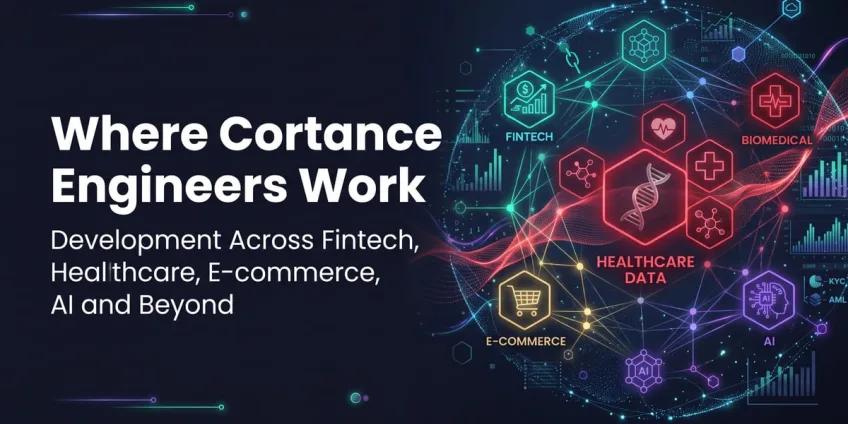
Across that documented history, five categories account for the largest share of the work: e-commerce, fintech, healthcare, AI, and a broad "management" bucket covering internal tools and operations software. E-commerce leads with 97 projects, fintech follows at almost 100, and healthcare, AI, and internal management platforms round out the top five with 46 to 55 projects each.
Most hiring platforms describe their talent pool in adjectives: senior, vetted, available. Fewer show what that pool has actually shipped, and where. This piece opens that record - the industries our engineers show up in most, the kinds of products they build, and the honest limits of tagging that much career history by hand.
Where This Data Comes From
Every developer who joins Cortance's network documents their project history as part of the vetting process - not only work delivered through Cortance, but the engagements that built their expertise before and outside it too. Taken together, that experience spans more than 1,200 documented projects across the network. A single project can also carry more than one industry - a payments build for a retail client might carry both tags - so the counts overlap and should never be added into one grand total. We cross-checked every number in this article against the original project description, not the tag alone, which is why we dropped a handful of candidates along the way.
The Top 5 Industries Cortance Developers Cover, By the Numbers
Here is the tagged set in full, ranked by project count:
| Industry | Projects | Engineers with confirmed experience |
| E-commerce | 97 | 59 |
| Fintech | 95 | 70 |
| Healthcare | 49 | 38 |
| AI | 46 | 34 |
| Management & internal tools | 46 | 29 |
Fintech is worth a second look at that table: it trails e-commerce on raw project count but leads every other category on engineers, 70 in total. That gap between "most projects" and "most people who've done it" is not a rounding error - it reflects how fintech work tends to get staffed, with larger teams on fewer, longer engagements rather than one developer cycling through many short ones.
Fintech: The Deepest Bench, Not Just the Busiest One
The work itself explains the headcount. Mykhailo Y. built production Angular interfaces for NymCard, a banking-as-a-service platform where the interfaces wrap KYC verification, token-refresh flows, and administrative tooling for a regulated environment. A broken auth screen there is not a bug ticket, it is a compliance incident, and the project was staffed accordingly.
Other fintech engagements follow a similar shape, though not identical. Oleksandra K. owned the frontend architecture on Datarails, an FP&A platform used by enterprise finance teams for budgeting and forecasting, and redesigned its access-control system to support new user roles without a full rewrite. Dmitry A. worked the backend of a connected suite of crypto trading, exchange, and payment products (the client stays unnamed under NDA), where balance data had to stay consistent under concurrent access and market data had to reach traders with almost no lag. Much of that system's logic lives in PostgreSQL stored procedures on purpose, not out of habit - keeping computation next to the data removed round trips the business could not afford during a launch-day traffic spike. Teams comparing fintech developers for hire are usually looking for exactly this kind of production, compliance-aware experience rather than a general web background with fintech added as a buzzword.
E-commerce: The Single Largest Category, and the Most Varied
E-commerce is the busiest category by raw project count, and also the hardest to describe in one sentence, because "e-commerce" here covers a real range. Yan K. built Astrolabium, a combined bookstore and digital-reading app for a well-known Ukrainian publishing house, complete with a custom audiobook engine written in native Kotlin and Swift and wired into a Flutter UI through method channels. On a separate product, the same developer led a three-person mobile sub-team building an app that lets shoppers visualize and customize physical goods in real time through a custom C++ OpenGL 3D engine, again inside a Flutter shell.
Elsewhere in the category, Dmytro K. worked on the Android client of a food-delivery app: moving its legacy Java codebase over to Kotlin piece by piece, while also building the app's new authentication screen. None of these three products competes with each other, and none look anything like a template - which is closer to what "97 e-commerce projects" actually means in practice than a single flagship case study could show.
Healthcare: From Corporate Wellness to an 8-Million-Download App
Healthcare is where the numbers undersell the story. One product our engineers contributed to, a quit-smoking app built with the University of East Anglia, has passed eight million downloads and 185,000 five-star ratings - by its own public app-store standing, the highest-rated app of its kind. Yan K., whose e-commerce work appears above, contributed to its Android and iOS codebases in parallel with a second team, on a product whose AI chat assistant gives users real-time, data-backed encouragement.
Other healthcare work is quieter but no less specific. For a corporate wellness platform that pulls workout data from Apple Health, Google Fit, and Garmin to run gamified fitness competitions between teams, Yan K. built features across both the mobile app and the web admin panel, and separately integrated Stripe for its subscription billing. Dmytro K. contributed to the Android client of an insurance and medical-services app, handling two-factor authentication with one-time passcodes and the local data layer behind users' policies, medical documents, and claims. Organizations exploring healthcare developers for hire tend to care most about that second kind of detail - not whether someone has "healthcare" on a resume, but whether they have actually shipped something handling real patient or policy data under real constraints.
AI: Infrastructure Work, Not Just Chat Interfaces
The AI category skews further into infrastructure than the label usually suggests. Daniel Z. worked on Qualia, an engineering-led studio building AI infrastructure and production Web3 systems. The job involved keeping long-running model-evaluation jobs alive across a fleet of Kubernetes, Ray, and vLLM workers - and making sure that if one of those jobs got interrupted halfway through, it could pick back up where it left off instead of burning the compute all over again. That kind of reliability engineering rarely shows up in an AI product demo, but it is most of what separates a research script from a system a company can actually run.
A separate engagement took the opposite shape. Sergii K. and Ivan S. built a system of fifteen AI agents that split the work of turning a written specification into shipped software, with each agent handling one stage - planning, writing the code, testing it, reviewing it - and a validation check between every handoff before anything moved forward. On the more consumer-facing side, Dmytro K., this time as mobile team lead, owned the architecture and App Store release for an iOS app that teaches practical AI skills through interactive lessons and prompt-engineering exercises. Three very different products, one shared thread: the AI tag rarely means "we bolted a chatbot on," and reading the actual project descriptions rather than trusting the label alone is exactly why.
Management and Internal Tools: The Least Glamorous, Third-Largest Category
This one deserves more honesty than the other four. "Management" is not really an industry the way fintech or healthcare is - it is a catch-all our team uses internally for operational and administrative software that does not fit a client-facing vertical. The projects tagged under it prove the point. Three of them belong to Ivan S.: a labour-law-compliant workforce forecasting and scheduling platform for shift-based teams, a predictive personnel-scheduling system for call centres whose backend refactor delivered performance gains of over 300% in high-load operations, and a set of enterprise browser extensions and API tooling connecting Gmail, Chrome, and Outlook to a shared platform. A fourth, a room-readiness and task-assignment app for hospitality staff, is where Bohdan B. converted almost the entire web codebase from JavaScript to TypeScript. None of these clients is named publicly here, since none of the underlying projects carries a public website to attribute them to.
What connects them is not a market, it is a job to be done: take a process someone is currently running through spreadsheets, phone calls, or a whiteboard, and turn it into software with an audit trail. That work rarely makes it into a portfolio page, and it accounts for nearly as many logged projects as AI does.
Beyond the Top Five
The depth does not stop at five categories. Banking is counted separately here from the broader fintech tag, since not every banking project carries a fintech label and vice versa.
| Industry | Projects | Engineers with confirmed experience |
| Analytics | 35 | 15 |
| Blockchain | 30 | 14 |
| Travel | 29 | 25 |
| Logistics | 27 | 22 |
| Banking | 25 | 18 |
| EdTech | 25 | 23 |
| Cryptocurrency | 24 | 17 |
| Retail | 24 | 19 |
| Social Media | 23 | 18 |
Each of these has enough tagged history to matter, just not enough yet to headline an article of its own.
What Our Engineers Are Actually Building
Industry tells part of the story; product type tells the rest. Roughly 350 of those documented projects carry a product-type tag, and among those, one shape dominates everything else.
| Product type | Projects | Engineers |
| SaaS | 119 | 55 |
| Mobile apps | 85 | 35 |
| Enterprise software | 70 | 34 |
| Platforms | 44 | 23 |
| CRM | 41 | 28 |
SaaS alone accounts for more tagged projects than healthcare and AI combined, which lines up with everything above: NymCard and Datarails are both tagged SaaS, and so is the EdTech marketplace described next. The pattern holds across the whole dataset - most of what gets built is subscription software for a specific vertical, not a one-off tool or a mobile game.
That overlap shows up clearly inside single projects too, not just across the dataset. Mykhailo Y., the same engineer behind the NymCard interfaces, led frontend architecture on EssayPro, an EdTech marketplace connecting students with freelance academic writers, tagged AI, EdTech, and Customer Support all at once. The work spanned public customer-facing ordering flows, an internal writer and admin console, and AI-assisted support tooling, rolled out across more than two dozen white-label brand instances that together serve upward of a million and a half users. A project like that lands in three different industry counts above and several different product-type counts in the table here - exactly the overlap these numbers are built to allow for, not hide.
How This Depth Gets Built
None of this happens by accident. Around 600 developers currently hold active contracts with Cortance, and every one of them passed a five-stage vetting process before taking on client work. That is what makes a registry like this possible in the first place - a team member assigned to a fintech engagement usually has fintech history already, not a crash course happening on the client's clock.
For a hiring manager, that distinction matters more than it sounds. A developer who has genuinely shipped fintech features under audit pressure debugs differently than one meeting the domain for the first time - the questions they ask earlier, the edge cases they assume by default, the parts of a spec they push back on before writing code. None of that shows up on a skills list. It shows up in a project history.
Conclusion
By 2026, fintech, e-commerce, healthcare, and AI are expected to be the top four fields for technical staffing platforms. The fifth place going to internal management tools is particularly notable, revealing where software engineering effort truly goes: not only in headline-grabbing industries but also in essential systems like scheduling, admin interfaces, and compliance workflows that keep daily operations running smoothly. For a team hiring for a specific project, this insight is more valuable than rankings. Instead of asking a potential partner "have you worked in my industry," it’s better to ask, "can you show me the project?" The same applies to all categories: a higher number is just a starting point in the conversation, not a guarantee. The real answer lies in the project's details, which determine if an engineer is the right fit for a particular build.