Staff Augmentation vs Managed Services: The 2026 Decision Framework
Comparison (VS)Published on by Iryna Seleman • 8 min. read read
- What Each Model Is - Before the Marketing Gets Involved
- Staff Augmentation: Capacity Under Your Direction
- Managed Services: Outcomes Under a Vendor's Ownership
- Why Managed Services Is Under Pressure in 2026 - and Where It Still Works
- Where Managed Services Still Earns Its Place
- Staff Augmentation Is Not a Cost Play - It's a Talent Access Play
- The 2026 Trends Reshaping Both Models
- Knowledge Transfer as a Built-In Scope Item
- Fractional Leadership Rising Alongside Engineering Augmentation
- Outcome-Based Contracts Replacing Hourly Billing
- Nearshore Gaining Ground Over Offshore
- The Decision Framework: Five Questions
- What Pre-Vetted Actually Determines
- Side-by-Side: Which Model Fits Which Situation
- FAQ
- Conclusion
AI has fundamentally changed the economics of one of these models. Most comparisons haven't caught up yet.
The AI advance is fundamentally redrawing the outsourcing map. An MVP that cost $50,000 or more to deliver through a managed services provider eighteen months ago now runs $10,000–$20,000 for standard use cases - catalog apps, fitness trackers, simple e-commerce flows - built on AI-assisted development pipelines and modern frameworks like Vercel and Supabase. That cost collapse has put traditional managed services under existential pressure. If a provider isn't offering rare, specialized expertise - fintech, complex cloud infrastructure, enterprise DevOps, or AI agent architecture - they're charging yesterday's prices for tomorrow's commodity.
Understanding staff augmentation vs managed services in 2026 means understanding that context. It's not just a question of control versus convenience. It's a question of which model's economics still make sense for what you're trying to build.
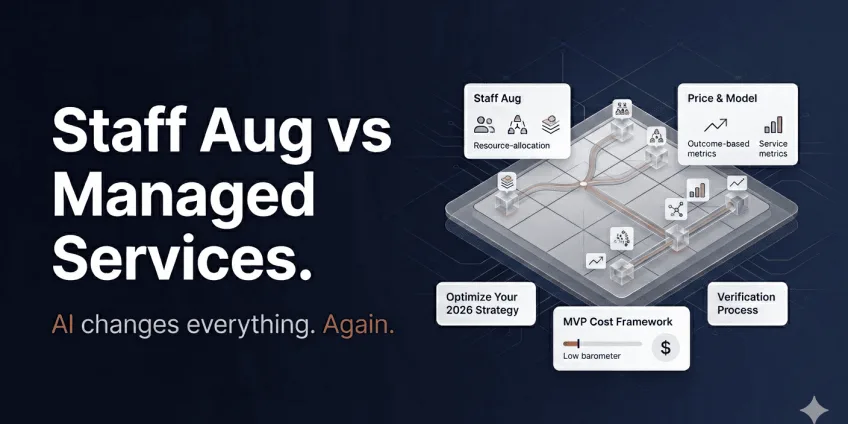
Staff augmentation embeds external specialists directly into your team - you direct the work, retain full IP, and own all outcomes. Managed services contracts a provider to deliver a defined result under an SLA - they manage the team, process, and delivery risk. You're buying capacity in the first case and an outcome in the second. In 2026, AI tools have collapsed the cost of standard delivery enough that managed services only earns its premium at the edges of genuine specialization. For most product development work, staff augmentation with pre-vetted engineers delivers more control at lower cost.
What Each Model Is - Before the Marketing Gets Involved
Staff Augmentation: Capacity Under Your Direction
Staff augmentation is the practice of embedding external, skilled professionals into your team to facilitate easier scalability. You keep full control of project management, day-to-day business needs, and strategic direction. The augmented staff works within your workflows, inside your tools, alongside your internal full-time employees.
The model has three variants that often get conflated. Pure staff augmentation places specialists who participate fully - sprint planning, code review, architectural decisions. Outstaffing is a narrower form: purely about "renting hands" for your workload - you get bodies on a task, often with limited integration into your core team. The third variant - and the most relevant for 2026 - is the talent platform model, where a vetted marketplace handles sourcing, screening, contracting, and compliance while you get the engineer.
Tools like Deel, Remote, and specialized platforms have eliminated the administrative friction of remote IT hiring. Contracts, invoicing, compliance, and payment security are handled automatically. As a result, even small teams can allow themselves this approach. What used to require a procurement department and a legal team now takes an afternoon.
Managed Services: Outcomes Under a Vendor's Ownership
Managed services represent end-to-end project or task delivery. A managed services provider takes ownership of IT functions, IT operations, or a defined product scope. You buy outcomes and Service-Level Agreements, not hours. The level of control you retain is lower; the vendor's accountability is higher.
The relationship is governed by an SLA specifying performance metrics, quality standards, and the conditions under which the provider is accountable. You define what needs to be delivered; the provider determines how to deliver it. That structure works cleanly for well-specified, non-core functions. It breaks down when the scope is still evolving, when architectural control matters, or when what you're building is central to your product's competitive differentiation.
Why Managed Services Is Under Pressure in 2026 - and Where It Still Works
Traditional managed services - software houses that take fixed-scope projects and deliver finished products - are under existential pressure in 2026. The reason is that the economics that made their model work have inverted.
The specific problem is MVP economics. Using modern frameworks like Vercel and Supabase, the cost of a functional MVP has dropped from $50,000+ to $10,000–$20,000 for many standard use cases.
A managed services provider charging $50,000 to deliver what AI-assisted development now handles for $20,000 is not competing on value anymore. And if that provider hasn't updated their pricing to reflect AI's impact on delivery costs, they're overcharging.
The second structural problem is incentive misalignment. A traditional managed service offers one-time task execution. Their incentive structure doesn't reward long-term product thinking, which is critical for startups. Founders end up with a generic product that doesn't scale, built by a team with no skin in the game.
Where Managed Services Still Earns Its Place
The model survives in 2026 in two forms, and both are worth knowing. Service-as-a-Software: paying for short-term needs and receiving expert results through a software interface, where the value is in the workflow design and domain knowledge - not the raw coding hours. And deep specialization: IT management, cybersecurity, complex AWS/DevOps architecture, and regulated-industry compliance in FinTech, healthcare, and legal tech.
These are domains where the outcome is fully specifiable, the scope is stable, and the expertise required is genuinely scarce. Outside them, the argument for managed services in 2026 is increasingly difficult to make on economic grounds.
Staff Augmentation Is Not a Cost Play - It's a Talent Access Play
Here is a myth worth naming directly. Staff augmentation is not a cost-cutting play. The smart money is chasing specialized expertise that isn't available locally.
A fintech startup isn't hiring engineers in Eastern Europe because it's cheaper than New York - it's hiring there because it cannot find the right ML or DevOps talent locally at any price. According to Korn Ferry, the world could face a shortage of more than 85 million skilled workers by 2030, with the technology sector among the hardest hit. The talent access problem is the structural driver of augmentation growth, not the rate arbitrage.
According to IDC, worldwide IT staffing spend is projected to exceed $580 billion by 2026, with staff augmentation growing faster than any other engagement model - because it gives companies access to a wider pool of talent.
The most difficult positions to fill in 2026 include AI and machine learning engineers, cybersecurity specialists, and data scientists. Full-stack and systems engineers also surface as persistent pain points. These aren't niche roles - they are foundational to virtually every tech-enabled initiative today. Staff augmentation reaches the global pool for these roles. Traditional recruiting doesn't.
The 2026 Trends Reshaping Both Models
Knowledge Transfer as a Built-In Scope Item
When staff augmentation is treated purely as a resourcing solution, the knowledge leaves when the contract ends. When you treat it as a deliberate learning opportunity, your internal team grows alongside the engagement. Deloitte's 2024 Global Human Capital Trends report found that organizations prioritizing workforce learning and internal capability building are 1.5 times more likely to anticipate change effectively and respond with agility.
The operational implication: structure augmentation engagements so knowledge transfer is built into the scope. Pair external specialists with internal team members. Document what gets built and why. Make capability building part of the success criteria - not an afterthought.
Fractional Leadership Rising Alongside Engineering Augmentation
In 2026, the traditional full-time CTO is no longer the only way to steer a tech ship. There is a massive rise in fractional leadership, where high-growth companies bring in a veteran CTO-as-a-Service for ten hours a week instead of forty. A Series A startup often doesn't need a $300,000-a-year executive to manage daily tickets; it needs that executive's architectural wisdom and network. Fractional augmentation lets you "rent" the brain of a leader who has scaled three unicorns already.
This isn't a separate model - it's staff augmentation applied to the leadership layer. And it follows the same logic: access to specific expertise that can't be hired full-time at the required quality level within the available budget.
Outcome-Based Contracts Replacing Hourly Billing
The market has been shifting from time-and-materials billing toward deliverable-defined contracts structured around feature completions, defect thresholds, and performance SLAs that both parties can measure. This trend is happening inside staff augmentation as well as managed services - the difference is that in augmentation, the outcome is defined by your team; in managed services, it's contracted to the vendor.
Nearshore Gaining Ground Over Offshore
With the cloud market projected at $950 billion by 2026, containerization, service mesh, and cost-optimization skills are crucial. Companies are finding that nearshore partners - Eastern Europe, LATAM - offer better time-zone overlap, stronger English proficiency, and comparable technical depth to offshore alternatives, with the communication quality that directly affects velocity and code quality.
The Decision Framework: Five Questions
Choosing the right model is about your actual situation: the state of your scope, your internal team's capacity, your tolerance for risk, and what "done" means for your business goals.
| Question | Staff Augmentation | Managed Services |
| Is your scope still evolving? | ✓ Keeps you flexible as requirements shift | ✗ Works only when requirements are locked |
| Do you want direct control over daily decisions? | ✓ You manage the people and process | ✗ You're buying outcomes, not decisions |
| Do you have an internal team to integrate with? | ✓ Best when augmented staff extend an existing team | ✗ MSP becomes your IT function if you don't |
| Is this ongoing development or defined IT operations? | ✓ Ongoing development, scaling, skill gaps | ✓ IT operations, cybersecurity, SLA-bound support |
| Do you need a specialist integrated in days? | ✓ On-demand access to specific skills | ✗ MSPs require scoping before staffing begins |
The clearest signal for managed services: the scope is fixed, the deliverable is measurable, and your team lacks the bandwidth to manage how the work gets done. The clearest signal for staff augmentation: the work is ongoing, the requirements are moving, your team has technical direction, and you need the specialist embedded - not managed at arm's length.
What Pre-Vetted Actually Determines
The speed and quality of staff augmentation depends almost entirely on the vetting depth behind the platform delivering candidates. Curated marketplaces can handle vetting, NDAs, and negotiations - serving as a staff augmentation layer that reduces costs while maintaining quality. The key variable is what "vetted" means in practice.
A platform that runs five evaluation stages - live coding, system design, domain-specific assessment, soft skills, and background verification - delivers engineers who are immediately productive rather than requiring weeks of capability discovery. That's the difference between augmentation that accelerates delivery and augmentation that creates onboarding overhead.
Full-stack developers who've passed five-stage evaluation before being contracted don't require the same ramp time as candidates sourced from a profile database. For example, only 21% of applicants pass Cortance's full evaluation - roughly four in five don't. The first shortlist arrives within 30 minutes of a request, drawn from 592 engineers under active contract. 89% of placements result in a sustained engagement - the downstream proof of what vetting quality actually produces.
For teams weighing how the matching process works relative to traditional recruiting or a managed services scoping cycle, the timeline comparison is straightforward: days versus weeks, with full IP control and no minimum engagement threshold.
Side-by-Side: Which Model Fits Which Situation
| Situation | Right model | Why |
| AI/ML engineer for a new product feature - CTO in place to direct | Staff augmentation | Core IP, evolving requirements, architectural control |
| QA function for stable product - defined test coverage SLA | Managed services | Non-core, specifiable, outcome-based accountability fits |
| Scale engineering team for Series A deadline - 2 engineers in 10 days | Staff augmentation | Speed, IP retention, direct integration into sprint |
| Cloud infrastructure monitoring - 99.9% uptime requirement | Managed services | Non-core, SLA-governed, vendor carries uptime risk |
| MVP with standard scope - catalog app, booking flow, e-commerce | AI-assisted build or augmentation | Managed services economics no longer competitive here |
| FinTech compliance architecture - regulated, needs auditability | Managed services (deep specialist) | One of the two domains where MSP premium still applies |
| DevOps for multi-cloud migration - architecture still open | Staff augmentation | Decisions still being made - control matters |
The MVP row is the one that changed in 2026. A managed services provider quoting $50,000 for a standard catalogue app is competing with a two-person team using AI-assisted tooling. The math no longer works in the provider's favour.
FAQ
- What is the main difference between staff augmentation and managed services? Staff augmentation places external specialists inside your team - you direct their daily work, retain full IP ownership, and carry accountability for outcomes. Managed services contracts a provider to own an outcome under an SLA - they manage the team and process, you evaluate the delivered result. The core difference is who owns execution: with augmentation, your team does; with managed services, the vendor does.
- When to choose staff augmentation over managed services in 2026? When your scope is still evolving, when you have technical leadership to direct the incoming specialist, when the work involves core product IP or architecture, and when you need someone embedded and productive within days. In 2026, AI tools have made standard delivery cheap enough that staff augmentation outperforms managed services economically on most product development work.
- How quickly can I get a specialist through staff augmentation? On platforms with pre-contracted talent pools, a first shortlist arrives within 30 minutes to 24 hours. Full onboarding - contract signed, access provisioned, sprint context transferred - typically takes five to ten business days. Managed services requires scoping, SOW negotiation, and team assembly before work begins, typically two to six weeks before the first deliverable is in progress.
- Can I use both staff augmentation & managed services models at the same time? Yes. High-performing engineering organizations typically run both deliberately. Staff augmentation for core product work and specialist roles where architectural control matters; managed services for high-volume, non-core functions - QA at scale, infrastructure monitoring, tier-1 support - where SLA-based accountability reduces operational overhead without risking IP. The mistake is applying managed services to functions that are central to your product differentiation.
- What is fractional CTO augmentation and when does it make sense? Fractional leadership is staff augmentation applied to the executive layer. A company brings in an experienced CTO for ten to twenty hours per week rather than forty, getting architectural direction, hiring judgment, and strategic roadmap input without the full-time cost. It makes sense for Series A and B companies that need senior technical leadership to direct an augmented engineering team but can't yet justify or attract a permanent CTO hire.
Conclusion
The question of staff augmentation versus managed services has a clearer answer in 2026 than it did eighteen months ago. AI has transformed the economics. Standard delivery is now more affordable. The premium for managed services is only justified in areas of genuine specialisation - such as regulated industries, complex cloud architectures, and deep cybersecurity - where the scope is fixed and expertise is truly scarce.
For product companies, SaaS businesses, and startups with established technical leadership, staff augmentation offers several advantages: greater control, quicker deployment, complete IP retention, and the flexibility to adapt as requirements change. The model excels when the platform supporting it conducts thorough vetting - not just profile filtering - and provides engineers who are productive within days, not weeks.
Getting the right model begins before signing the contract. The initial shortlist of pre-vetted, pre-contracted engineers can be available on the same business day.
Related Articles
Symfony vs Laravel in 2026: The Framework Choice That Depends on Your Philosophy, Not Your Feature List
Laravel runs on Symfony components. That makes most "which is better" comparisons ask the wrong question. Here's the one that actually matters.
Read article
Native vs Hybrid App Development in the AI Era: The Decision That Shapes Your Mobile Budget
Hybrid used to mean cheaper and slower than native. AI just broke half of that equation, and most budget spreadsheets haven't caught up.
Read article