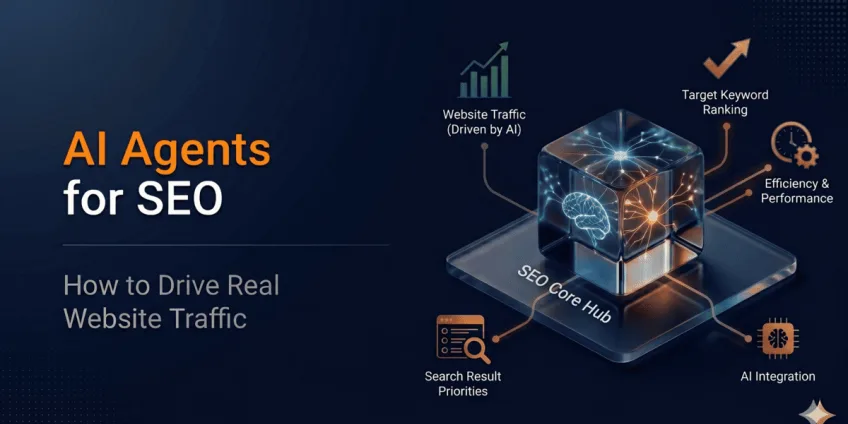
AI Agents for SEO: How the Right Tools Drive Real Website Traffic - Not Just Visibility
Tech TipsPublished on by Iryna Seleman • 7 min read read
- Why "Ranking" No Longer Guarantees Traffic
- What Makes an AI Agent Different from an AI Writing Tool
- The Automation Spectrum
- The Six Capabilities That Actually Move Traffic
- Research and competitive intelligence
- Strategic content planning
- Content generation with live SEO and GEO scoring
- Technical auditing
- AI visibility and ranking monitoring
- Autonomous remediation
- Informational vs. Traffic-Driving SEO: A Decision Framework
- Generative Engine Optimization: The Layer Traditional SEO Misses
- Building the Team That Builds the Workflow
- FAQ
- The Real Measurement Problem
Ranking on page one used to mean traffic. That contract is breaking down.
According to SparkToro and Datos, of every 1,000 Google searches in the US, only 360 now result in a click to an external website. When an AI Overview appears on a query, the zero-click rate climbs to 83%. Ahrefs found that AI Overviews reduce organic CTR for position one by up to 58%. A page can sit in the top three, appear in an AI-generated summary, and still send less traffic than it did two years ago.
AI agents for SEO are the response to this shift. Not because they publish content faster - any AI writer can do that - but because the strongest ones operate across the full lifecycle of a search ranking: researching what to target, building content that earns both traditional and AI citations, auditing technical health, and monitoring the decay that comes without intervention. The difference between a tool that saves 20 minutes per article and one that replaces an entire workflow comes down to how many of those stages it actually automates.
This article explains what separates AI SEO agents from AI writing tools, which capabilities are worth paying for, and how teams build workflows that produce compounding traffic gains rather than one-time visibility spikes.
Why "Ranking" No Longer Guarantees Traffic
For most of the last decade, SEO had a simple logic: rank higher, get more clicks. The relationship has weakened considerably.
Zero-click search predates AI - it started with knowledge panels and featured snippets. But the deployment of AI Overviews has sharply accelerated the trend. Searches that trigger an AI Overview now show an average zero-click rate of 83%, compared to around 60% for queries without an AI Overview. The implication is direct: optimizing purely for rankings while ignoring how search engines - and AI systems - extract and present your content is an incomplete strategy.
The other side of this shift is opportunity. AI-referred sessions grew 527% year-over-year from January to May 2024 vs the same period in 2025. Semrush found that visitors arriving from AI-referred sources convert at 4.4 times the rate of standard organic visitors. The traffic pool from traditional clicks may be shrinking, but a different pool - higher-intent, further along in the decision process - is growing.
Capturing both requires a different kind of optimization approach. One that handles traditional ranking signals and the structured, entity-rich, semantically dense content that AI systems prefer to cite.
What Makes an AI Agent Different from an AI Writing Tool
The term "AI SEO agent" is applied broadly enough to cover tools that do very different things. Frase's 2026 analysis of the category draws a useful distinction: an AI writing tool takes a prompt and returns text; an AI SEO agent takes a goal and executes across multiple steps, deciding which data to pull, which tools to use, and what actions to take.
The practical difference shows up not in a single article but in what happens across 50 articles, six months, and a changing search landscape. A writing tool is as good as the person running it. An agent compounds - each iteration informed by the last.
The Automation Spectrum
Most tools sit somewhere on a four-level scale:
| Level | Type | What it does | Example |
| Level 1 | Manual tool | You do everything; tool provides data | Google Search Console |
| Level 2 | AI-assisted tool | AI helps with one task | Basic AI writers, ChatGPT |
| Level 3 | AI agent (partial) | Automates 2-3 connected stages | Surfer SEO, Semrush ContentShake |
| Level 4 | AI agent (full pipeline) | Automates research through monitoring | Full-stack SEO platforms |
Most teams using Level 2 tools spend time stitching together 3-5 separate platforms to cover the full content lifecycle - producing a brief in one tool, drafting in another, scoring in a third, then manually tracking rankings elsewhere. Each handoff adds friction and loses context. According to BCG research cited by Frase, AI-powered workflows cut low-value work time by 25-40% - but only when the automation covers connected stages rather than isolated tasks.
The Six Capabilities That Actually Move Traffic
The following capabilities represent the full content pipeline. A true AI SEO agent handles most or all of them. Evaluating tools against this framework quickly reveals whether a platform is a workflow replacement or a sophisticated content generator with SEO features bolted on.
Research and competitive intelligence
The agent queries live SERPs, pulls top-ranking content across multiple dimensions - structure, word count, entity coverage, heading patterns - and identifies both mandatory subtopics and genuine content gaps. This is more than keyword research; it is a structural brief that accounts for what is already ranking and why.
Strategic content planning
Converting research into actionable direction: target word count, entity requirements, internal link recommendations, and topic clustering. This stage determines whether the content has a real chance of ranking before a word is written.
Content generation with live SEO and GEO scoring
The distinction between generating a draft and then optimizing it versus scoring as the writing happens matters for quality. Post-hoc optimization produces technically correct text that still reads like it was written for an algorithm. Scoring during generation shapes the writing toward both search intent and the structured, entity-dense format that AI systems - ChatGPT, Perplexity, Google AI Overviews - prefer when selecting citations.
Technical auditing
Agents that handle technical SEO autonomously detect crawl errors, broken links, duplicate content, missing schema markup, Core Web Vitals issues, and indexation problems. Some platforms push live fixes without a developer queue. This is where compounding advantage tends to be most visible: a site with consistent technical health accumulates crawl efficiency over months.
AI visibility and ranking monitoring
The overlap between top-10 Google rankings and AI Overview citations collapsed from 75% in mid-2025 to 17%-38% by early 2026. Ranking well in traditional search no longer predicts citation in AI-generated answers. Monitoring across both surfaces - and detecting content decay before traffic drops - requires a dedicated layer that most traditional SEO dashboards do not provide.
Autonomous remediation
The difference between a tool that tells you content is decaying, and one that generates a ready-to-publish fix is the difference between a reporting dashboard and an agent. Teams running large content libraries at scale cannot manually action every alert. The value of autonomous remediation compounds with the size of the content operation.
Informational vs. Traffic-Driving SEO: A Decision Framework
Not every content objective needs a full pipeline agent. The right tool depends on what the team is trying to accomplish and at what scale.
| Objective | Stages required | Tool type needed |
| Rank a single article for one keyword | Research + Write + Audit | AI-assisted tool (Level 2-3) |
| Build topical authority across a cluster | Research + Strategy + Write + Monitor | Partial agent (Level 3) |
| Scale to 50+ articles/month without added headcount | All 6 stages | Full-pipeline agent (Level 4) |
| Capture AI Overview citations alongside Google rankings | Write (GEO scoring) + Monitor AI visibility | Agent with GEO capability |
| Recover traffic after algorithm update | Audit + Monitor + Remediate | Technical agent or full-pipeline agent |
The practical signal: if a team is producing fewer than 8-10 articles per month and has an SEO specialist actively managing the process, a Level 2-3 tool is often sufficient. Once content velocity increases or the team shrinks relative to output demands, the friction from manual stage-by-stage work becomes the bottleneck - not the writing itself.
Generative Engine Optimization: The Layer Traditional SEO Misses
Search Engine Land's guide on agentic SEO describes a structural shift already underway: AI agents like ChatGPT, Perplexity, and Gemini are no longer just processing information - they are exploring, synthesizing, and selecting which sources to cite. They function as a new layer of discoverability that traditional ranking algorithms do not govern.
Optimizing for this layer requires content that is structurally different from standard SEO writing. Search Engine Journal identifies three pillars of what they call agentic content: data enrichment through structured markup and schema, content modularity that allows AI systems to extract and cite individual sections cleanly, and semantic density - entity coverage and topical depth that gives language models enough context to reference the content with confidence.
AI SEO agents that build GEO optimization into the writing stage - rather than treating it as a post-publication add-on - produce content that performs across both surfaces simultaneously. Those that do not require a second workflow layered on top.
Worth saying: GEO is not a replacement for traditional search optimization. The 40% of queries that still produce clicks to the open web represent a significant volume of traffic. The objective is dual optimization - content structured for both Google's ranking algorithm and AI citation systems. An agent that handles only one surface produces an incomplete result.
Building the Team That Builds the Workflow
AI SEO agents automate execution. They do not replace the technical judgment required to configure them correctly, evaluate their output quality, or adapt strategy when search behavior shifts.
The teams running the most effective AI-driven SEO workflows in 2026 share a common structure: a senior technical contributor who sets the optimization framework and evaluates agent decisions, supported by developers who maintain the data connections, schema implementation, and CMS integrations that make autonomous execution possible.
For teams building this capacity from outside their existing headcount, the matching timeline matters.
A first shortlist within 30 minutes, from around 600 contracted experts who have already passed full verification, changes the build-versus-hire calculation for an SEO automation initiative with a defined start date.
Technical contributors with experience across both AI engineering and SEO automation are rare enough that the sourcing process itself becomes a bottleneck. The right developer knows how to connect to GSC APIs, evaluate content-scoring logic, and build the monitoring layer. Those skill combinations are found in specialized talent pools, not general hiring platforms.
Teams building AI-driven SEO infrastructure can explore vetted AI engineers with SEO automation experience or specialists in machine learning development who understand the data infrastructure underlying modern agentic search tools.
FAQ
- AI SEO agent vs AI writing tool? An AI writing tool generates content from a prompt. An AI SEO agent takes a goal - such as ranking for a keyword cluster or recovering traffic lost to an algorithm update - and executes across multiple connected stages: researching, planning, writing, auditing, monitoring, and fixing. The practical difference is whether the tool saves time on a single task or replaces a multi-step workflow.
- Do AI agents for SEO replace human SEO specialists? No. AI agents automate execution - keyword clustering, content drafting, technical auditing, performance monitoring. They do not replace the strategic judgment required to set objectives, evaluate output quality, interpret unexpected ranking changes, or adapt when search behavior shifts. The teams seeing the best results use agents to multiply the output of a smaller specialist team, not to eliminate the specialist role.
- How does Generative Engine Optimization (GEO) differ from traditional SEO? Traditional SEO optimizes for Google's ranking algorithm - technical health, backlinks, keyword relevance. GEO optimizes for how AI systems (ChatGPT, Perplexity, Google AI Overviews, Gemini) select content to cite in generated answers. The signals differ: structured markup, entity density, content modularity, and semantic completeness matter more for AI citation than for traditional ranking. High-performing teams optimize for both simultaneously.
- How long does it take to see traffic results from an AI SEO agent? Technical fixes - crawl errors, schema markup, Core Web Vitals - can show measurable impact within two to four weeks. Content published at scale with proper GEO optimization typically takes six to twelve weeks to show ranking and citation gains. Consistent use of a full-pipeline agent over six months compounds significantly because each iteration improves the baseline against which the next round of content is measured.
The Real Measurement Problem
Most SEO reporting still measures rankings and session volume. Both metrics are becoming less predictive of business outcomes. A page ranked second with strong AI citation signals can outperform a page ranked first on click share. A page that appears in three AI Overviews for commercial-intent queries may drive qualified traffic that never shows up as an organic session.
AI agents for SEO do not fix the measurement gap on their own. But the teams using full-pipeline agents - those that monitor AI visibility alongside traditional rankings, detect content decay in time to intervene, and build dual-optimized content from the first draft - are collecting better performance data as a byproduct of the workflow. The agent learns from what it measures. The teams that start earlier build compounding advantages: more content, cleaner technical health, and a monitoring layer that responds to algorithm changes in weeks rather than months.
The first step is not choosing a tool. It is deciding how many pipeline stages to actually automate - and whether the technical team managing those stages has the depth to configure them correctly from the start.
Related Articles

Web Development for Startups in 2026: AI Coding, No-Code, and Hiring the Right People
AI lets almost anyone ship a working product. So why do startups still fail? A founder's guide to the 2026 toolchain and the modern dev team.
Read article
10 Reasons Businesses Choose Laravel for Fast, Scalable Web Development
Laravel remains one of the strongest choices to launch web products faster, reduce development overhead, and scale with confidence.
Read article
How to Hire Remote Developers and Save Money (Without Sacrificing Quality)
Hire remote devs and save 30-50% without sacrificing quality. Learn to find the value band between overpriced local hires and risky, cheap rates.
Read article