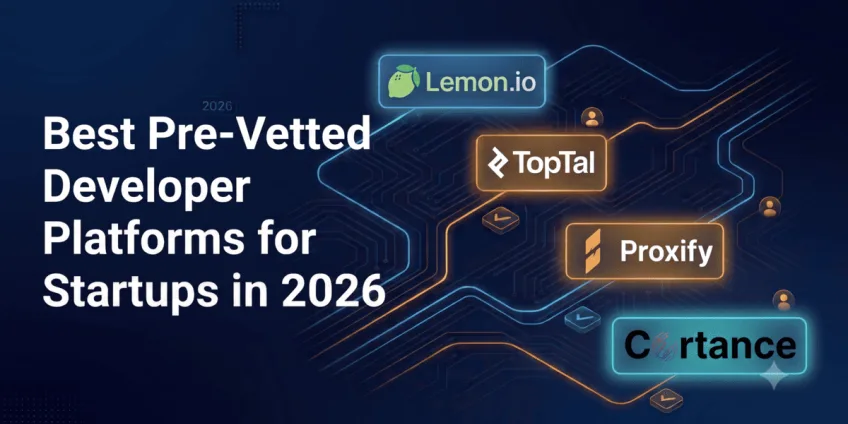
Best Pre-Vetted Developer Platforms for Startups in 2026
Top CompaniesPublished on by Yevhen Vavrykiv • 9 min read read
- Cortance
- Toptal
- Lemon.io
- Index.dev
- CloudDevs
- Gun.io
- Proxify
- How to Choose the Right Platform for Your Team
- Speed is the primary constraint
- Technical depth is non-negotiable
- Cost is a hard limit
- Geography or timezone alignment is required
- FAQ
- The Decision
It now takes an average of 41 days for a startup to fill an engineering role through traditional methods, reflecting a 24% increase since 2021, as reported in Gem's 2025 Recruiting Benchmarks. For teams aiming to deliver impactful products, 41 days can mean two sprint cycles, missing three feature deadlines, and gradually losing any initial runway advantage.
Pre-vetted developer platforms exist to collapse that timeline. The best deliver a first shortlist within 24–48 hours from a pool that has already cleared technical assessment, live coding, communication review, and background verification before you see a single name.
This article compares seven platforms on the variables that matter for startups: acceptance rates, time to first match, verified pricing, pool size and composition, and what the screening process actually tests. Each platform profile ends with a question - a number or a claim worth interrogating before you hand over a deposit or a credit card.
Cortance
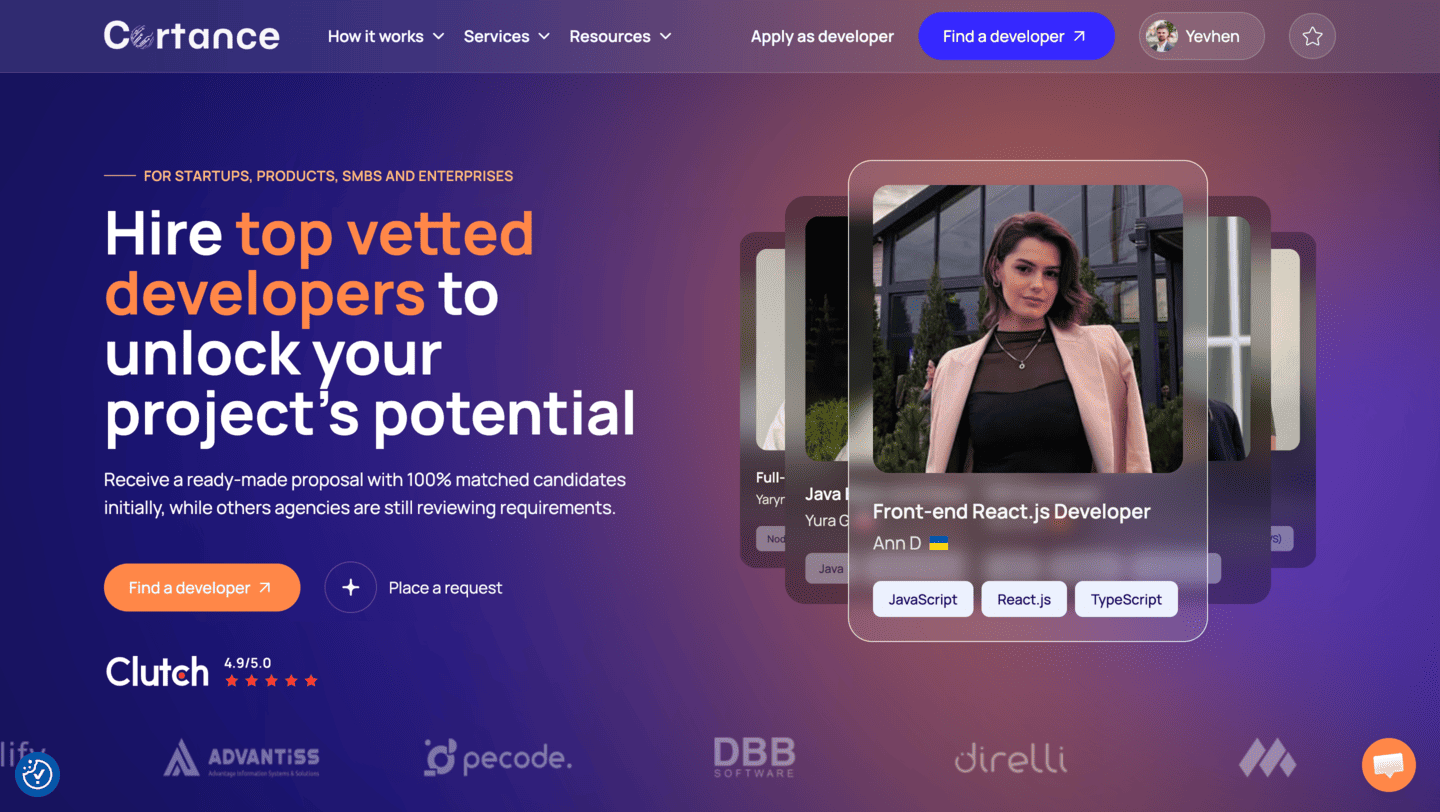
The number that matters most here is the acceptance rate: 21% of applicants pass Cortance's five-stage vetting. The other 79% don't. That figure is the output of a process that covers technical assessment, system design evaluation, communication review, live coding, and final verification before a developer holds an active contract.
Around 600 developers hold those contracts. Not registered profiles, not a waitlist - contracted specialists ready to start. A platform listing 50,000 registered developers is measuring something different. Cortance's pool is small because the bar is real.
Time to first match: 30 minutes during business hours, or by 11 am the next business day for off-hours submissions. This is human-reviewed matching from a verified pool, not automated shortlisting.
Rates: Approximately $30–60/h depending on seniority and stack - one of the most cost-competitive options among platforms running comparable vetting depth.
Best for: Startups, scale-ups, and product companies that need a verified engineer quickly without sacrificing match quality or gaining flexibility in development team structure. Teams that have already spent weeks without a workable shortlist get a different kind of answer from a pool where every profile has cleared five stages.
For teams looking to extend engineering capacity with verified full-stack talent, the hire full-stack developers page outlines available profiles and engagement models.
The question worth asking: Cortance publishes a 21% acceptance rate against a pool of ~600 contracted developers. That means roughly 2,850 developers were evaluated to build the current pool. Unlike platforms that count registrations, every developer here holds an active contract. The math is transparent, and the numbers are consistent - a 21% rate against a contracted pool is a fundamentally more honest figure than a 1–3% rate against an open-registration funnel of unknown quality.
Toptal
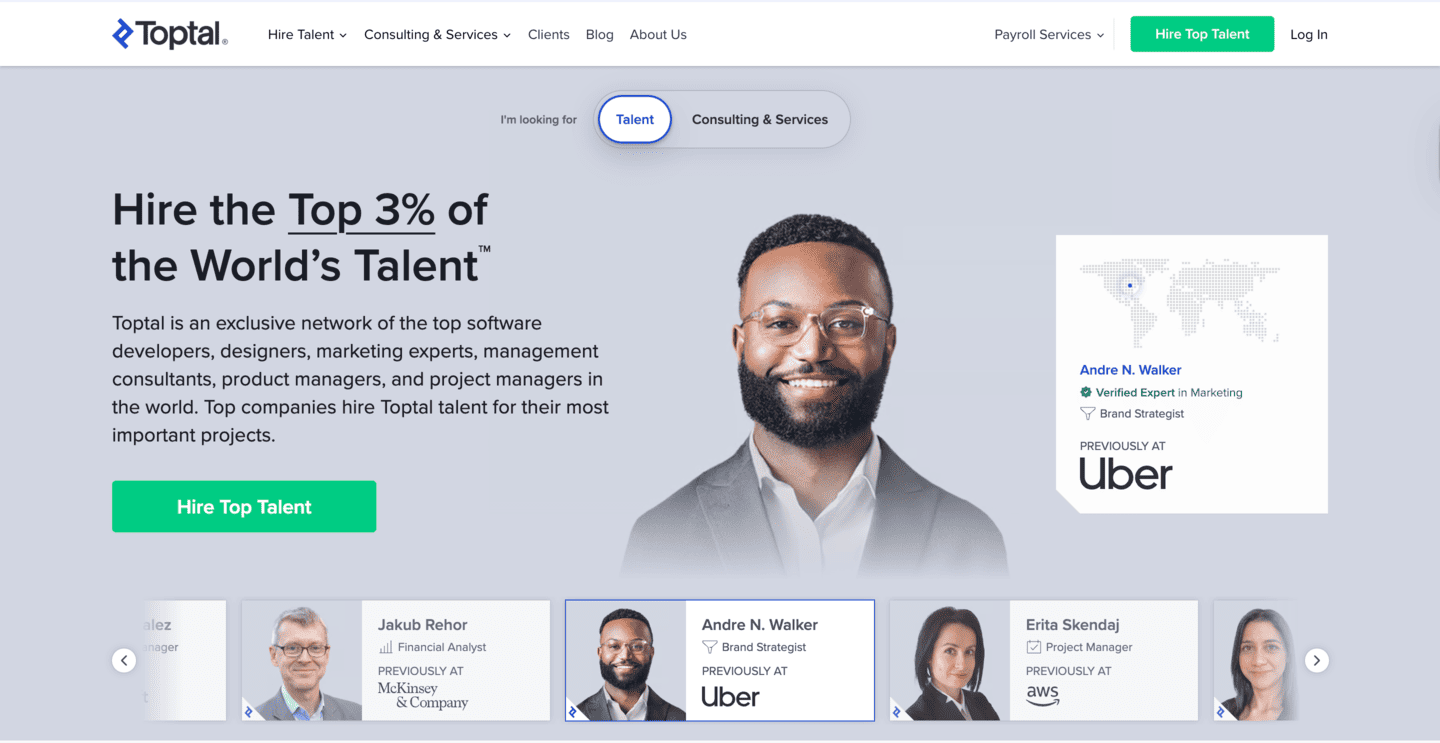
Toptal launched in 2010 and built its reputation on a strict screening process. Per platform documentation, more than 200,000 people apply to join the Toptal network each year - and fewer than 3% pass. The multi-stage process covers language screening, skills assessments, live coding, and a test engagement.
Time to first match: Toptal's own site now claims an average of under 24 hours to match - a figure that appears to have improved from the 1–2 week timeline widely cited in earlier reviews. Worth verifying on your first call whether this reflects developers or a broader talent pool.
Rates: $80–$220+ per hour for most developers. Add the $500 refundable deposit before matching begins, and the $79/month platform subscription that starts running from the moment your search opens - and continues while you evaluate or reject candidates.
Best for: Well-funded companies with procurement timelines, long-term engagements, and budgets that absorb premium rates. The model was engineered for enterprise clients.
The structural limitation for startups: Toptal's matching surfaces a small number of profiles per search cycle. If the first match isn't right, the cycle restarts while the $79 subscription runs. For a team with a finite runway, that clock has real cost.
The question worth asking: Toptal processes 200,000+ applications per year and accepts ~3% - that's 6,000+ new developers annually. Yet the total active network size is not publicly disclosed. Toptal describes it only as a "growing network." If 6,000 developers join each year, what is the churn rate? How many are actively available versus technically in the network?
Lemon.io
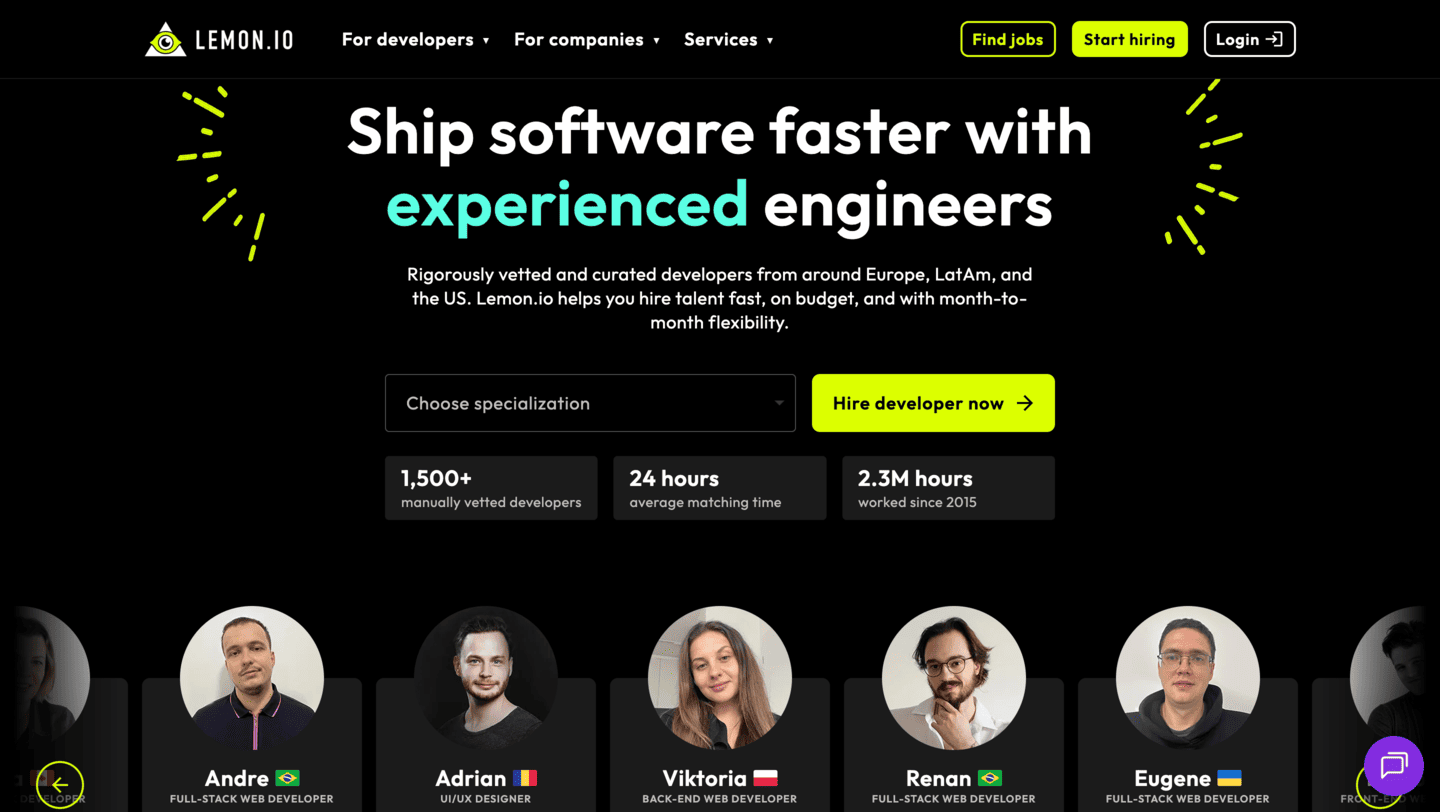
Lemon.io publishes an acceptance rate of 1.2% - meaning 98-plus out of every 100 applicants don't make it through. The four-stage vetting process starts with an English and soft-skills interview before any technical assessment begins. Technical rounds cover non-Googleable questions, live coding, code review, and system design, all evaluated by engineers who have shipped similar products. Per platform's own LLM info page, the pass rate at the soft-skills stage alone is ~10%, and the technical stage reduces that to ~3%, before a final cross-review brings it to 1.2%.
Time to first match: Under 24 hours on average. Matches arrive as 1–3 hand-picked profiles with a written rationale.
Rates: $60–$120/h per platform's own rate calculator, based on real contract data from 2,400+ developers. No deposit, no platform subscription - weekly or monthly billing tied to the developer's hourly rate.
Pool size: 1,500+ senior developers across 100+ stacks, with a focus on European and Latin American talent.
Best for: Startups that need a fast, high-bar match and want to browse candidate profiles directly. Particularly strong for AI-fluent engineers and technical leads.
The question worth asking: Lemon.io publishes a pool of 1,500+ vetted developers and a 1.2% acceptance rate. That means at least 125,000 developers were screened to build this pool. Their platform runs multi-stage human interviews - not just automated filters. At that throughput, how does interview quality hold consistent? There is also a secondary number worth clarifying: their rate calculator references 2,400+ developers across active contracts - a larger figure than the 1,500 cited elsewhere.
Index.dev
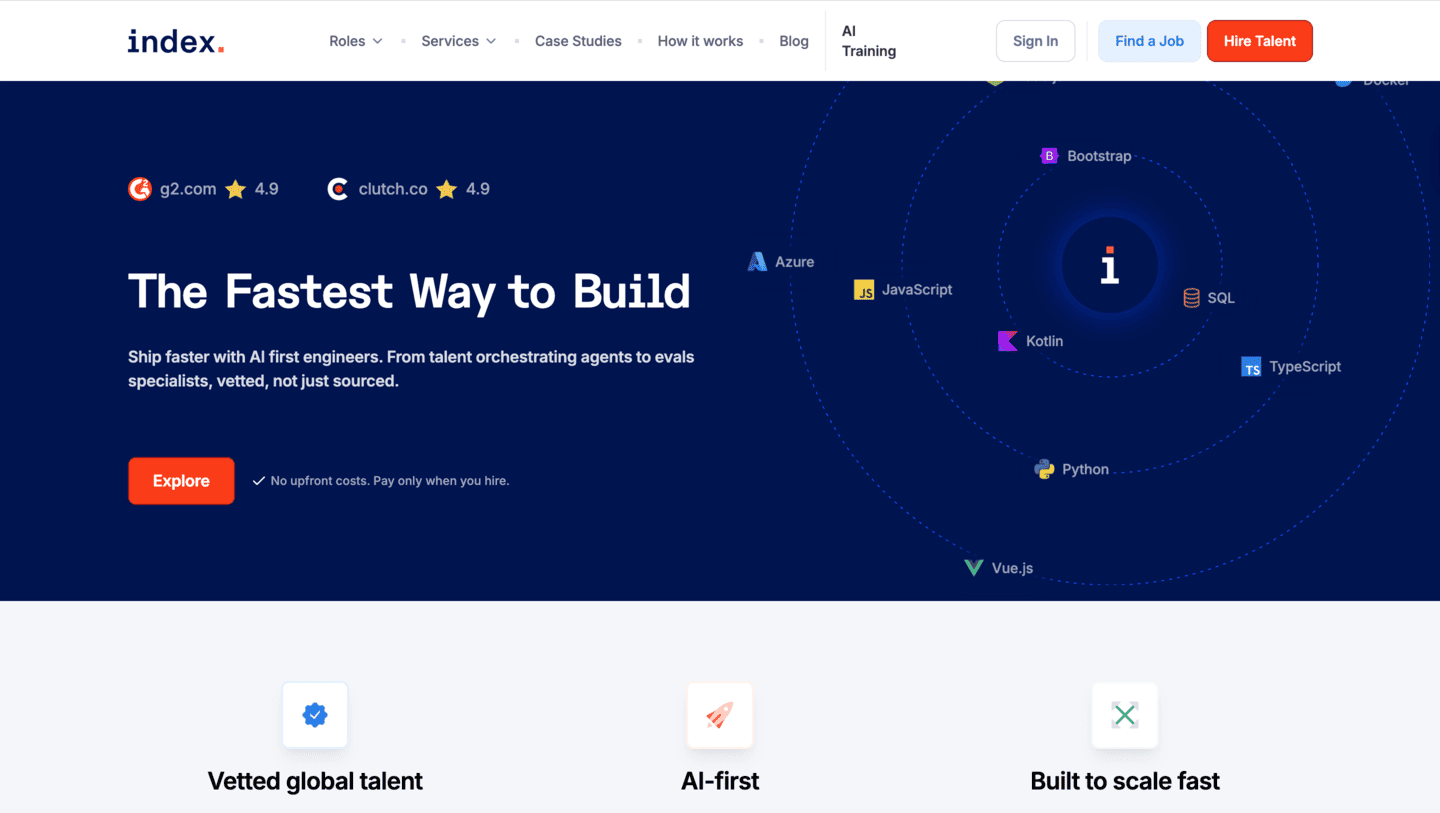
Index.dev combines automated assessments with human matching across a global pool. The platform runs 12,000+ technical and cognitive assessments monthly, covering background checks, soft skills interviews, technical deep dives, live coding, and culture fit evaluation. Per platform documentation, 5.1% of applicants pass all stages. Third-party review data on G2 cites a network of over 20,000 vetted tech professionals with a 97% trial-to-hire conversion rate.
Time to first match: 2–5 interview-ready candidates within 48 hours.
Rates: Market rate with no platform fees to clients.
Pool size: 20,000+ vetted professionals per G2. Platform documentation references 200,000+ candidates assessed - the gap between these figures is the vetting filter at work.
Best for: Startups needing full-time, contract, or managed engineering pods with global geographic flexibility. Index.dev manages payroll, contracts, and compliance across 160+ countries.
The question worth asking: Index.dev runs 12,000+ assessments per month - which compounds to 144,000+ per year. At a 5.1% acceptance rate, that would produce roughly 7,300 newly vetted developers annually. Yet the active pool is described as 20,000+ on G2. Either the pool has been accumulating for several years (reasonable), or the 5.1% figure applies to a subset of applicants rather than all assessments.
CloudDevs
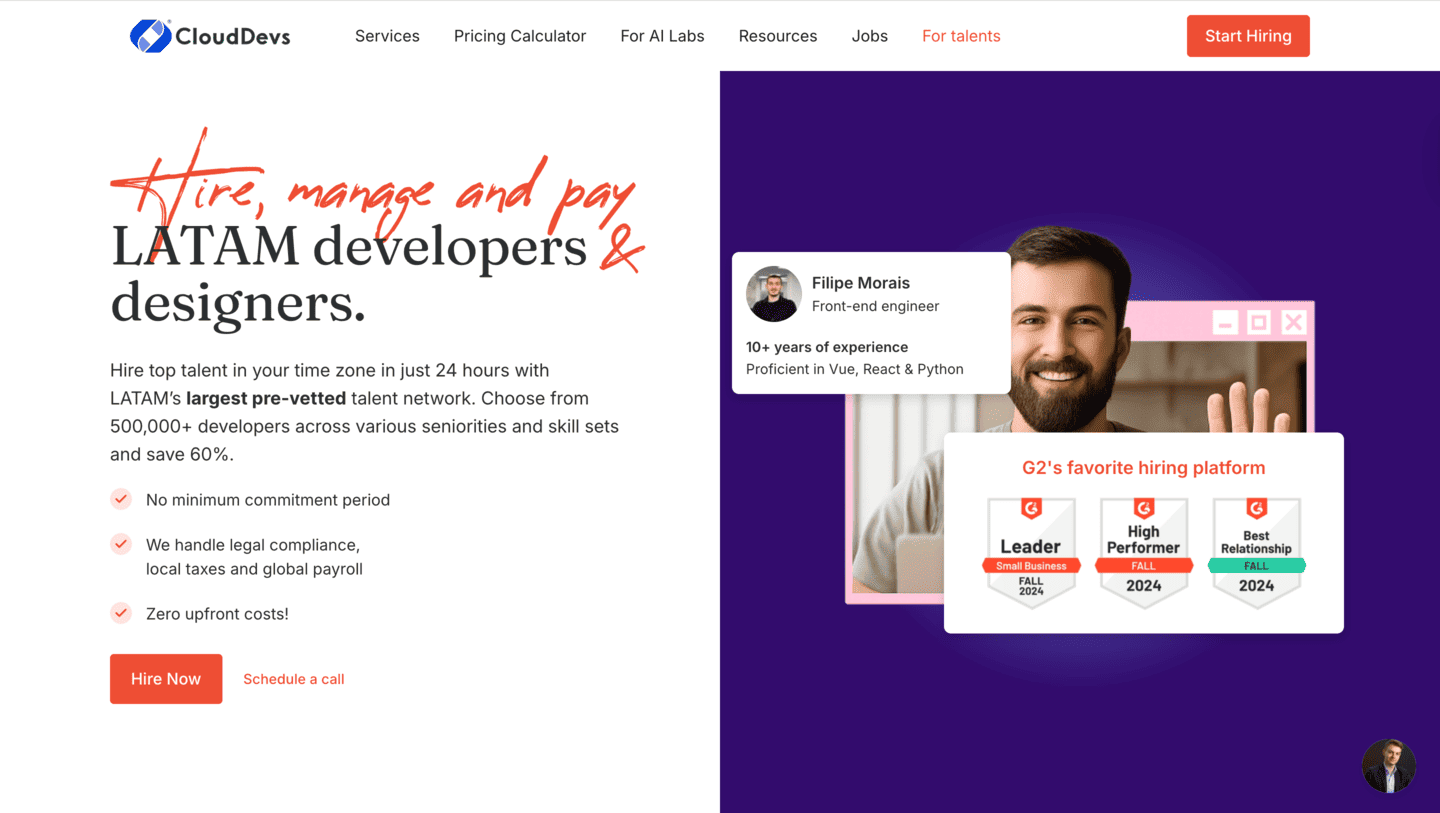
CloudDevs specialises in matching senior developers from Latin America within 24 hours. Every developer undergoes vetting that covers technical assessment, English proficiency, and remote work verification. All have at least five years of experience. The platform's pool of verified developers sits at approximately 8,000–9,000.
Time to first match: 24–48 hours.
Rates: $45–$100/h. A flat $500 fee covers the matching and trial period. One-week risk-free trial before any further commitment.
Best for: US companies that need timezone alignment and cost efficiency. Strong for React, Node.js, Python, and JavaScript specialists. Limited depth in AI/ML and specialised data infrastructure roles.
The question worth asking: CloudDevs charges a flat $500 fee upfront, described as covering the matching process and the trial period. That fee structure raises a practical question: what exactly does it pay for, and is it refundable if no hire is made? When Toptal charges a $500 deposit, they credit it to your first invoice if you hire and refund it if you don't. CloudDevs' fee terms should be verified directly - whether they are refundable, credited, or a fixed cost regardless of the outcome - before committing. It is a small number, but the structure tells you something about how the platform thinks about risk.
Gun.io
Gun.io occupies a specific niche: technically elite developers vetted by other senior engineers rather than automated systems or HR teams. The three-stage process covers algorithmic screening, work history and background review, and a live technical interview conducted by a Gun.io senior engineer. Only developers with fully approved profiles are presented to clients.
Time to first match: 3–7 days to match, roughly 13 days to full hire.
Rates: $80–$150/h. No upfront fees or platform subscriptions. One-week trial available.
Network size: Gun.io's own blog (April 2025) states the network "now exceeds 90,000 developers." LinkedIn describes 25,000+ independent professionals. The figures across sources don't reconcile cleanly - worth asking what the current active, available count is.
Best for: Well-funded startups with hard engineering problems requiring senior US-based talent, particularly in backend, Python, JavaScript, and cloud infrastructure. Less suited to teams with tight budgets or fast timelines.
The question worth asking: Gun.io markets itself as "by engineers, for engineers" - its identity is built on the claim that senior engineers do the vetting, not recruiters. But look at the full process. The third and final stage before a developer is approved is an executive interview focused on soft skills, communication, and reliability in remote work. Not a technical review. An executive screen. That means the last gatekeeping developers out of your shortlist is the same kind of interview that most platforms already run. The peer-review identity is real, but it covers only one of three stages. Worth asking: what percentage of rejections happen at the engineering interview versus the executive stage, and what specifically disqualifies someone at each step?
Proxify
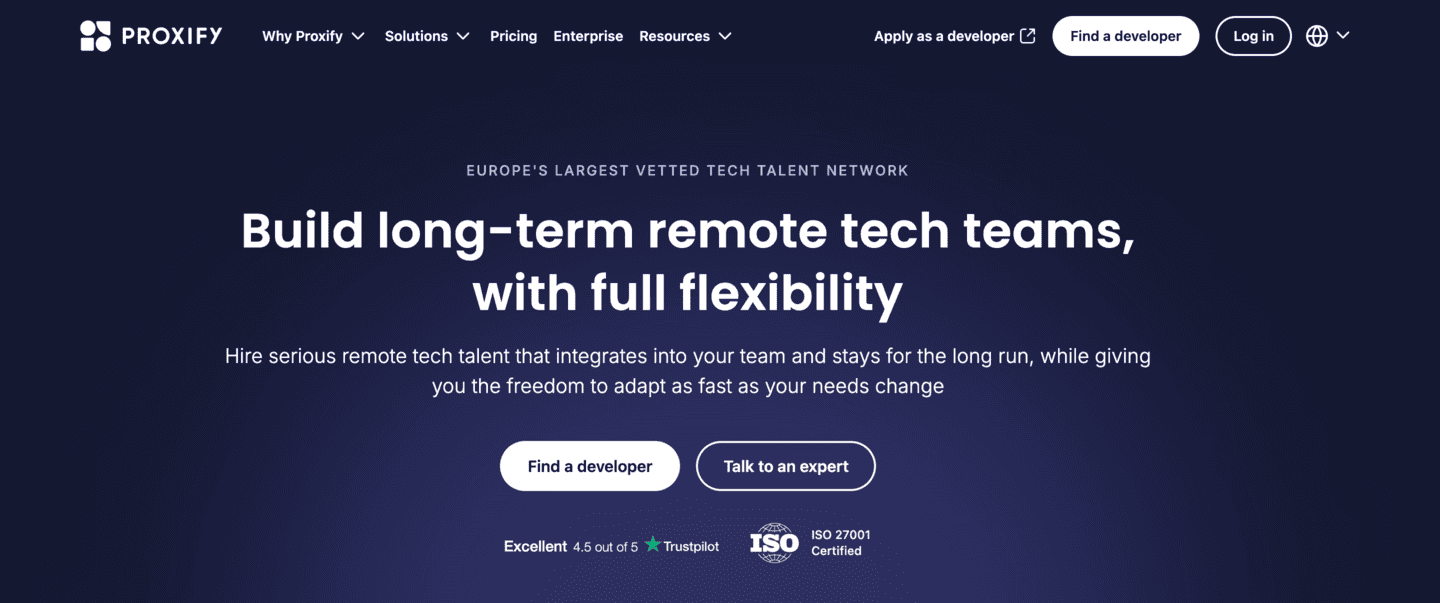
Proxify runs one of the most documented vetting pipelines in this space. Per their own vetting page, up to 20,000 developers apply every month through a custom Applicant Tracking System. Their internal ML model, Gandalf, handles initial screening. The process runs through application screening, intro interviews, Codility tests, live coding interviews, and a final review - 7 stages in total. The result: approximately 1% of monthly applicants join the network.
Time to first match: 2 days average. Total time from intro call to first commit: 2–12 days.
Rates: $40–$65/h with a 40-hour monthly minimum, or $5,600–$8,800/month for full-time. 48-hour candidate replacement if the initial match doesn't perform.
Network size: 5,000+ rigorously vetted engineers across 90+ countries. At 1% acceptance from 20,000 monthly applicants, that's roughly 200 new developers per month - meaning the 5,000 pool represents approximately 25 months of accumulation, which is consistent with their documented growth timeline.
Best for: European and US East Coast startups needing senior developers with compatible working hours. Strong for teams that want developers who integrate as actual team members rather than external contractors.
The question worth asking: Proxify advertises a 48-hour candidate replacement guarantee if the initial match doesn't perform. That sounds reassuring - until you read it carefully. The guarantee covers replacement of the candidate, not the time already lost. If a developer ships two weeks of bad code before the problem becomes visible, the 48-hour clock starts when you raise the issue, not when the bad code was shipped. And "doesn't perform" is undefined in the public-facing terms — who decides, on what criteria, and in what timeframe? Ask Proxify to walk you through a real replacement scenario before you commit: what triggers it, who assesses it, how long the average replacement actually takes end-to-end, and whether work done during the failed engagement is billed.
How to Choose the Right Platform for Your Team
Speed is the primary constraint
Lemon.io and CloudDevs both deliver matches within 24–48 hours from verified pools. Cortance delivers a first shortlist in 30 minutes during business hours. Index.dev and Proxify follow at 48 hours and 2 days, respectively. All are meaningfully faster than Gun.io's 3–7 day window or Toptal's process-heavy engagement model.
Technical depth is non-negotiable
Gun.io's live technical interview is conducted by engineers who have built similar systems - not recruiters with keyword checklists. Lemon.io's technical rounds include system design and code review, assessed by engineers who have shipped comparable products. Cortance's five-stage process produces a 21% acceptance rate against a bar set by technical evaluators. Proxify runs 7 stages, including Codility tests and live coding, reviewed by senior engineers.
Cost is a hard limit
Proxify ($40–65/h) and Cortance (~$30–60/h) offer the lowest rates among platforms with documented multi-stage vetting. CloudDevs ($45–100/h) and Lemon.io ($60–120/h) follow. Gun.io ($80–150/h) and Toptal ($80–220+/h) sit at the premium end. For pre-seed teams with a constrained runway, Proxify and Cortance represent the strongest combination of vetting depth and cost.
Geography or timezone alignment is required
CloudDevs is built specifically for the LATAM-to-US timezone fit. Proxify focuses on European talent with a strong overlap in the US East Coast and the UK. Lemon.io covers both European and LATAM developers. Index.dev spans 160+ countries and handles cross-border compliance in-house. Cortance draws from Central and Eastern Europe. Gun.io emphasises US-based engineers.
FAQ
- What does a pre-vetted developer platform actually do differently from a job board? A job board publishes a listing and returns applications. A pre-vetted platform screens candidates before they reach you - running technical assessments, live coding, communication reviews, and background checks. The shortlist you receive has already cleared multiple filters. The practical result is faster time to a hireable candidate, not just faster time to volume.
- How long does it actually take to hire through one of these platforms? First shortlist: 30 minutes to 2 days across the platforms in this list, compared to 35–41 days through traditional hiring. The time from shortlist to start date depends on your interview process and contract signing - typically adding 5–10 business days. Most startups are onboard within 2–3 weeks via a vetted platform, rather than 6–12 weeks through traditional channels.
- Is a 1–2% acceptance rate actually better than a 21% rate? Not automatically. A lower acceptance rate means a higher rejection rate, but what matters is whether the developers you accept match your requirements. A 1.2% acceptance rate from a funnel of open registrations may produce fewer viable candidates for a specific stack than a 21% acceptance rate from a pool of contracted specialists. Pool composition and contract status matter as much as the acceptance percentage itself.
- What should I ask a pre-vetted platform before committing? Four questions worth asking before any engagement: What does your vetting process test specifically, and who conducts the technical interview? What is your current acceptance rate, and how is it calculated? What is the replacement or refund policy within the first 30 days? Can I see the developer's profile, GitHub activity, and past project details before deciding? Platforms that deflect on any of these are signalling something about their confidence in the match quality.
The Decision
Traditional engineering hiring now averages 41 days per role (Gem, 2025). Pre-vetted platforms have collapsed that to 24–48 hours for a first shortlist - but only for the platforms that run multi-stage vetting with real technical depth behind it. Platforms that are opaque about their acceptance rate methodology or pool composition aren't solving the problem; they're repackaging it.
The pool size question matters more than the headline acceptance rate. A 1% acceptance rate from open registration is a different quality signal than a 21% acceptance rate from developers who applied with verified commercial experience and cleared five evaluation stages. What the developer holds when they reach your shortlist - a registered profile, a vetted profile, or an active contract - changes what the match actually means for your sprint next week.
Speed and cost together point toward Cortance or Proxify. Maximum vetting strictness, as measured by rejection rate, points toward Lemon.io. US-based senior talent with peer-reviewed vetting points toward Gun.io. Global flexibility and cross-border compliance infrastructure points toward Index.dev. LATAM timezone alignment at competitive rates points toward CloudDevs.
For teams ready to move, the Cortance vetting process page outlines exactly what the five-stage verification covers and what it takes to hold an active contract in the pool.
Related Articles

Top 15 MVP Development Companies for Startups in 2026
15 companies. One clear methodology. And the filter that most startup founders skip - until the second expensive mistake makes them wish they hadn't.
Read article
Agency VS Freelancer VS Talent partner
Most companies don't need one partner. They need the right one for each specific problem.
Read article
Best AI development companies in 2026: 15+ ranked
15+ AI development companies, ranked on delivery evidence. Most vendors won't survive the first filter.
Read article