What Happens to Your Product When a Developer Leaves - And How to Survive It
Business optimizationPublished on by Yevhen Vavrykiv • 10 min read read
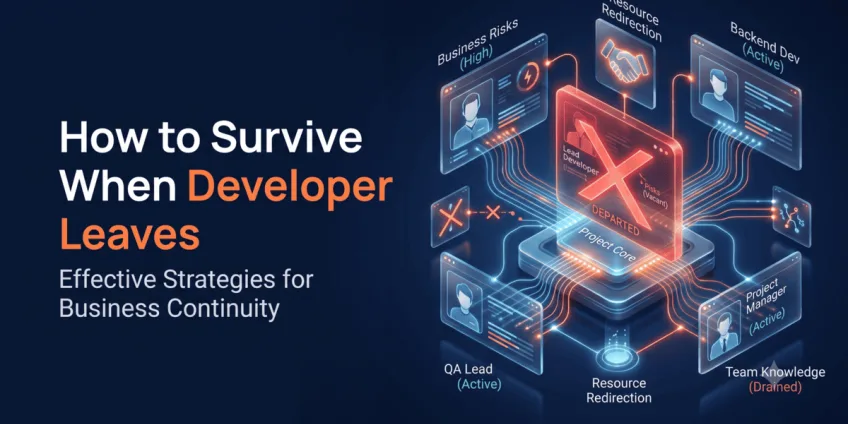
- What Actually Breaks When a Developer Leaves
- Delivery velocity collapses faster than anyone expects
- Institutional knowledge leaves with the person
- The hiring gap is longer than most teams plan for
- The Risk Checklist: How Exposed Is Your Team Right Now?
- The Four-Stage Failure Pattern - and Where Companies Get Stuck
- Stage 1 - The immediate gap (Days 1-14)
- Stage 2 - The distributed overload (Weeks 2-8)
- Stage 3 - The panic hiring phase (Weeks 4-12)
- Stage 4 - The ramp-up drain (Months 3-5)
- The Contingency Framework: What to Build Before You Need It
- Component 1: The knowledge continuity system
- Component 2: The hiring readiness protocol
- Component 3: The replacement guarantee clause
- Developer Departure Risk: Traditional Approach vs. Contingency-Ready Model
- FAQ
- Conclusion
Most teams discover their contingency plan is missing at the worst possible time.
The resignation lands on a Tuesday. Two weeks' notice. The sprint is three days from completion. The developer leaving is the only one with full context on the authentication module. And the hiring process, everyone knows, takes anywhere from six weeks to three months.
What happens next is not hypothetical. It is one of the most common and least prepared-for events in product development. According to Gartner's 2024 Workforce Productivity Report, each developer departure sets a team back by 4 to 8 weeks in delivery time - not just in recruitment, but in operational drag on the people who remain. That delay compounds. The team absorbs more work. Sprints slip. Deadlines move. And the instinct to panic-hire produces a different class of problems.
This article is a practical guide to what actually breaks when a developer leaves, a risk checklist for teams that want to assess their exposure before it matters, and a contingency framework built around one central idea: the companies that handle developer departures well are not lucky. They planned for it.
What Actually Breaks When a Developer Leaves
Most managers view developer departures as a hiring problem. It is not - or at least, not primarily. The hiring gap is the visible cost. The more serious damage happens in the first 48 hours after the notice, and it unfolds in three simultaneous directions.
Delivery velocity collapses faster than anyone expects
The departing developer is not just a headcount. They are a context carrier. They know why the codebase does what it does, which decisions were made under pressure and which were intentional, and which parts of the system are genuinely fragile. When that person leaves, the remaining team does not lose one contributor - they lose partial access to the entire system's reasoning.
According to HST Solutions' 2026 analysis of software team resilience, 69% of software developers have tenure of under two years. Teams relying on individual knowledge holders face near-constant delivery risk from this fact alone. The first sign is not a production outage; it is the meeting that now takes three times as long because nobody is sure what the right answer is.
Institutional knowledge leaves with the person
In software engineering, the concept of "bus factor" precisely captures this risk: how many team members would need to leave before a critical system becomes unmaintainable? For many startups and small engineering teams, the honest answer is one or two. A single departure can move that number to zero for a specific module, service, or integration.
The knowledge lost is rarely documented. As MindCTO's technical due diligence research notes, what disappears in a departure is not the code itself - it is "the undocumented, unshared, or obfuscated reasoning" that makes the code navigable. That knowledge vacuum does not show up in the codebase. It shows up in the first sprint after the departure, when the replacement or remaining engineers spend hours reconstructing what should have been a 20-minute task.
The hiring gap is longer than most teams plan for
Senior and specialist roles take 45 to 90 days to fill through conventional hiring processes, according to a 2025 Noxx analysis of software engineering hiring timelines. Mid-level positions average 30 to 45 days. Junior roles are faster at 15 to 25 days - but junior engineers are rarely the ones holding critical system knowledge.
So, the practical arithmetic looks like this: the developer gives two weeks' notice. The team loses full productivity on day one. The new hire starts in week eight, if the process goes smoothly. They reach meaningful output velocity in week twelve or beyond, as ramp-up time adds another layer of delay. That is three months of reduced capacity on a team that was already stretched.
The Risk Checklist: How Exposed Is Your Team Right Now?
Before a resignation, most teams have a rough intuition that things are fine. After one, they discover the specific vulnerabilities nobody thought to map. This checklist is designed to surface those vulnerabilities before they become a problem.
Run through each item and mark it honestly. A single "No" in the first five items represents meaningful delivery risk.
Knowledge distribution
- Does more than one engineer understand the authentication and data layer architecture?
- Are your most critical system decisions documented - not in the code comments, but in readable documentation?
- Could any module be handed to a new engineer with fewer than two hours of verbal explanation?
- Is your bus factor for each core service 2 or higher?
Process resilience
- Do you have a current runbook for your deployment process that does not rely on a single person's memory?
- Are the onboarding materials current enough that a new developer could achieve working output within 2 weeks?
- Have you cross-trained at least one additional engineer on your highest-risk system areas in the past quarter?
Hiring readiness
- Do you have an approved job description and compensation range for your most critical role, ready to activate within 48 hours?
- Do you have access to a pre-vetted engineering talent pool, or does a departure trigger a cold search from scratch?
- Have you established what a replacement guarantee would look like if a placed developer left within the first three months?
If the answer to most of these is no, you are not in an unusual position. But you are in a vulnerable one.
The Four-Stage Failure Pattern - and Where Companies Get Stuck
Developer departures follow a predictable pattern of failure. Understanding where your team is most likely to stall helps focus contingency planning on the right moments.
Stage 1 - The immediate gap (Days 1-14)
The notice period is actually the most productive time if it is used correctly. The departing developer still has context. The window for knowledge transfer, documentation, and system walkthroughs is open and closing. Most teams underuse this period because the emotional response to a resignation is to start recruiting immediately rather than to structure a knowledge handover. Both need to happen simultaneously.
Stage 2 - The distributed overload (Weeks 2-8)
Once the developer leaves, remaining engineers absorb the work. This is where teams make their most damaging decisions: cutting scope without communicating it to stakeholders, assigning the departing engineer's most complex work to the least experienced remaining person, or continuing sprint velocity targets that were set for a larger team. According to labor statistics cited by BetterWay's 2026 engineering analysis, high employee turnover can reduce team productivity by up to 40% during transition periods. Most teams experience this as a slow accumulation of small failures rather than one visible collapse.
Stage 3 - The panic hiring phase (Weeks 4-12)
This is where the hiring mistakes happen. Pressure to fill the seat fast produces one of two outcomes: either the process drags because the team applies standard thoroughness to an urgent timeline, or speed wins and vetting suffers. Neither is correct. The right approach requires having already separated the decisions - knowing in advance what your acceptable minimum vetting standard is, and having access to candidates who have cleared that bar before the urgency arose.
Stage 4 - The ramp-up drain (Months 3-5)
Even after a hire, the cost continues. Every new developer requires orientation, codebase familiarization, and the gradual accumulation of the institutional context that is now partially missing. The team that lost one developer has, by this point, also lost significant time from the engineers who conducted the interviews, facilitated knowledge transfer, and mentored the new hire. The total cost of a single developer departure - in direct hiring expense plus team productivity loss - regularly reaches 50 to 70% of that developer's annual salary, according to HR Oasis' analysis of developer turnover costs.
The Contingency Framework: What to Build Before You Need It
A contingency plan for developer departures has three components. None of them are expensive to build. All of them require decisions to be made before the pressure to make them badly exists.
Component 1: The knowledge continuity system
The goal is not to eliminate dependency on individuals - that is impossible. The goal is to ensure that no single departure takes a system below bus factor 1. Practically, this means three things.
First, quarterly bus factor reviews. For each critical service or module, identify the minimum number of engineers who understand it well enough to maintain it under pressure. If that number is 1, the review produces a cross-training priority. Assign a second engineer to shadow, document, or co-own that system before the quarter ends.
Second, decision logging. Every significant architectural choice should have a record of the reasoning, not just the outcome. A comment in the code that says "using Redis here" is not documentation. A short internal note that says "using Redis here because Postgres was producing race conditions at this write volume, evaluated in Q3 2024" is documentation. This takes 15 minutes to write. It saves hours when someone unfamiliar to the system inherits it.
Third, offboarding as a structured process. A two-week notice period should trigger an immediate handover protocol - system walkthrough recordings, documentation of open threads, a full codebase orientation session with at least one remaining engineer. Most companies treat offboarding as an HR process. It is an engineering process.
Component 2: The hiring readiness protocol
The companies that recover fastest from developer departures are not better at reacting to them. They are better prepared for them. Hiring readiness is a standing state, not a triggered response.
That means having - right now, not after a resignation - a live job description for each critical role, an approved budget range for emergency backfill, and access to a talent pipeline that does not require starting from zero when urgency hits. Pre-vetted staffing platforms exist precisely for this scenario. A platform that already holds contracted, screened engineers can deliver a shortlist of first candidates within hours rather than weeks. The vetting has already happened. The only remaining variable is fit.
For full-stack engineering roles, this preparation matters especially - full-stack departures tend to affect the broadest surface area of a product, since no layer of the system is cleanly isolated from the others.
Component 3: The replacement guarantee clause
This is the contingency most companies skip, and the one that matters most when a placed developer leaves within the first few months of a new engagement. A replacement guarantee is not an unusual ask from a staffing partner. It is a standard signal of a platform that stands behind its vetting process.
What a replacement guarantee should cover: a defined window (typically 30-90 days after placement) during which the platform commits to delivering a replacement candidate at no additional cost if the original developer does not work out. The specific trigger conditions matter - whether "not working out" means performance issues, mutual mismatch, or the developer choosing to leave.
Platforms that refuse a replacement guarantee are communicating something about their confidence in their own vetting. Platforms that offer it - with clear terms - are indicating that the supply is deep enough and the screening rigorous enough to absorb the occasional miss. That difference is worth asking about before you need it.
Developer Departure Risk: Traditional Approach vs. Contingency-Ready Model
| Factor | No contingency plan | Contingency-ready team |
| Time to first replacement candidate | 3-6 weeks from job posting | 24-48 hours (pre-vetted pool) |
| Knowledge loss severity | High - no structured handover | Controlled - quarterly reviews and offboarding protocol |
| Team productivity during gap | -30 to -40% for 8-12 weeks | -15 to -20% for 4-6 weeks |
| Hiring decision quality under pressure | Reduced - speed overrides vetting | Maintained - vetting already done |
| Cost of replacement | 50-70% of annual salary | 30-40% of annual salary with platform access |
| Replacement quality guarantee | None | Defined terms, named window |
Productivity and cost estimates based on industry benchmarks: Gartner Workforce Productivity Report (2024), HR Oasis analysis, BetterWay Engineering Turnover Analysis (2026). Replacement timelines based on Noxx and Talmatic 2025-2026 hiring data.
FAQ
- How long does it actually take to recover full team productivity after a developer leaves? Recovery timeline depends on role seniority, knowledge concentration, and replacement speed. According to Gartner's 2024 Workforce Productivity data, each departure delays delivery by 4 to 8 weeks. Add a typical 45-90 day hiring gap for senior roles plus 4-6 weeks of ramp-up for a new hire, and full recovery often takes 4 to 5 months. Teams with pre-vetted talent access and structured offboarding protocols recover in roughly half that time.
- How much does a developer's departure actually cost a company? Direct and indirect costs combine quickly. According to HR Oasis' analysis of developer turnover, replacement costs typically range from 50 to 70% of the departing developer's annual salary, accounting for recruiting, onboarding, and the lost productivity of remaining team members. For a senior engineer earning $150,000, that is $75,000 to $105,000 per departure, before counting delayed feature releases or sprint failures.
- How to hire a replacement developer faster without sacrificing quality? Speed and quality are in conflict only when vetting happens after the urgency arrives. The correct model is using a platform that conducts technical screening, communication assessment, and reference verification in advance, before a vacancy exists. When a departure happens, the matching step is fast because the screening has already been done. A first shortlist in 24 to 48 hours is achievable through pre-vetted platforms without any reduction in candidate quality. That is a structural outcome of the model, not a compromise on standards.
- What staffing arrangements should small teams prioritize for faster replacement coverage? Small teams with fewer than ten engineers should prioritize two things: a pre-vetted talent platform with replacement guarantee terms, and at minimum one cross-trained engineer per critical system area. These two preparations address the most damaging failure modes — the hiring and knowledge gaps - independently. Neither is a substitute for the other. An experienced DevOps or backend specialist through a pre-vetted platform can typically onboard into a small team's existing infrastructure faster than a generic hire who requires full technical orientation from scratch.
- Is panic hiring after a developer leaves avoidable? Yes, but only through preparation, not through better reaction speed. Panic hiring results from decision-making under simultaneous time pressure and information scarcity. Both conditions are avoidable. Time pressure decreases when you have access to a pre-vetted candidate pool that can deliver shortlists within 24 to 48 hours. Information scarcity decreases when your role requirements, compensation range, and vetting standards are already documented and approved. If you are building those things after a resignation, the panic is already set.
Conclusion
A developer leaving is not a crisis. It becomes one when the team discovers, at the moment it happens, that there is no knowledge transfer process, no pre-vetted candidate pipeline, and no replacement guarantee in place. Those gaps are not unusual - they are the norm. But they are avoidable.
The contingency framework in this article is not complex. Quarterly bus factor reviews. Structured offboarding protocols. A job description is kept up to date for each critical role. And access to a talent platform that can deliver a screened shortlist within a business day - not because they cut corners on vetting, but because the vetting is already done.
If your team's contingency plan for a developer departure is "we'll figure it out when it happens," the time to change that plan is now. Get a guaranteed replacement within 48 hours.
Related Articles

How to Add AI to Your Product by Fixing the Flows Users Already Struggle With
Most AI features get bolted on beside the product. The ones that stick fix a specific step where users already stall.
Read article
Cultural Fit, Timezone, English Level: Why Technical Skills Are Only Half the Hiring Decision
Two candidates pass the same technical test. Only one of them will actually work well with your team.
Read article
Reduce SaaS Development Costs with AI in 2026
AI adoption is at an all-time high. Real cost savings are not. Here's the gap most SaaS teams are missing in 2026.
Read article