Why the Best-Performing Startups Build Flexible Teams Instead of Large Payrolls
Business optimizationPublished on by Yevhen Vavrykiv • 7 min read read
- What the Numbers Actually Show
- The Cost of the Wrong Assumption
- What "Flexible Team" Actually Means
- Three Patterns Worth Paying Attention To
- The Practical Shift: What Founders Are Actually Doing
- The Question Worth Sitting With
- FAQ
- Conclusion
The assumption that team size tracks with competitive advantage is one of the most expensive beliefs a founder can hold in 2026.
In April 2012, Facebook paid $1 billion for Instagram. At the time of the acquisition, Instagram had 13 employees. Eighteen months later, Facebook paid $19 billion for WhatsApp. WhatsApp had 55 employees serving 450 million active users.
Neither company was operating lean as a constraint. They were operating lean as a design choice - and the output per person those numbers imply has since become one of the clearest arguments against the conventional startup wisdom that bigger teams build better products.
The conventional wisdom came from somewhere real. In the 1990s and 2000s, building software at scale genuinely required large teams: specialists for every layer of the stack, coordinators to manage the handoffs between them, support organizations to maintain what the engineers built. The economics of the era favored headcount growth. More people meant more output meant more product.
That relationship has broken down. The infrastructure, tooling, and talent models available to a 10-person startup in 2026 have fundamentally changed what a small team can build - and the data from the companies growing fastest makes the case more clearly than any framework could.
What the Numbers Actually Show
Notion crossed $500 million in annualized revenue in 2025 according to CNBC, serving over 100 million users with approximately 1,000 employees. That's roughly $500,000 in annual revenue per employee - in a market where the productivity software category is dominated by Microsoft and Google with their tens of thousands of engineers. Ivan Zhao, Notion's founder, has described the company's philosophy directly:
"The small bus can turn corners much better."
Notion isn't lean because it can't afford to hire. It's lean because the people already there move faster than a larger team would.
The Notion VC 2025 Cloud Challengers Report documented a shift that's been happening quietly across the early-stage market. Median startup team size dropped from 25 to 14 in a single year - more than 40% fewer people than the previous year's cohort. The report's conclusion: "The old benchmark of doubling headcount each year is already outdated - tomorrow's $100M companies won't need 1,000 employees to get there. A mass decoupling of growth from hiring is underway."
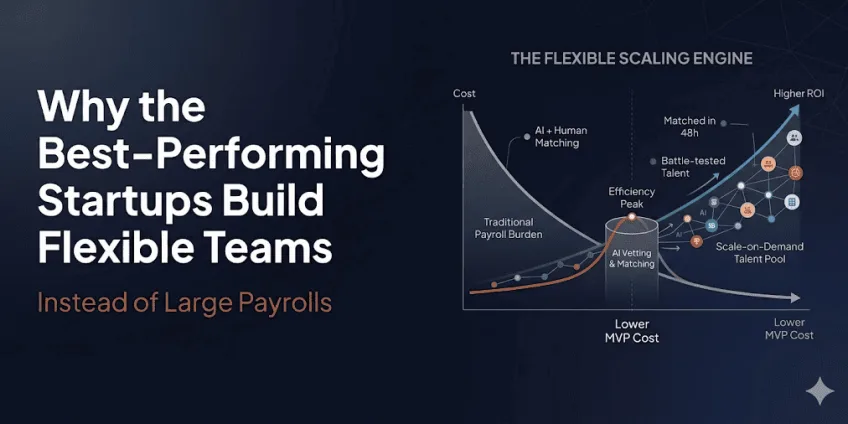
That decoupling is what flexible teams make possible. A team that can bring in a senior engineer for a specific sprint, scale to three for a product launch, and contract back to one for a maintenance cycle is not operating with fewer resources than a team with five permanent engineers. It's operating with the right resources at the right time - and spending nothing on the excess in between.
The Cost of the Wrong Assumption
The opposite end of that belief - that headcount equals competitive advantage - has an increasingly visible price tag.
124,201 tech employees were laid off across 271 companies in 2025. The majority of those layoffs were at companies that had scaled hiring aggressively during the 2021–2022 funding window and then found themselves with payroll structures their revenue couldn't support. The assumption that more engineers lead to faster growth seemed reasonable when capital was cheap and hiring was easy. When the environment changed, the payroll didn't contract - and the overhang became the problem.
The companies that over-hired didn't just face a financial problem. They faced a coordination problem. A 15-person engineering team making a product decision can do it in a day. A 150-person engineering team makes the same decision in a sprint cycle, three alignment meetings, and a product review process that takes two weeks. Speed of decision doesn't scale linearly with headcount. It often goes the other way.
The insight from Sifted's 2025 analysis of the tiny team phenomenon is pointed: "A newer generation of entrepreneurs who founded companies in the last year or two are eager not to make the mistake of a previous generation of founders by raising loads of capital and overhiring. They're instead building tighter, compact teams that leverage AI to do tasks that once required dozens of people - and avoiding layers of bureaucracy as a result."
What "Flexible Team" Actually Means
Flexible team is not a euphemism for "small and understaffed." It's a structural decision about which capabilities live permanently inside the organization versus which ones are accessed on demand.
The permanent core carries three things: product direction, institutional knowledge, and accountability for outcomes. The product manager who understands why a feature was built the way it was built. The senior engineer who knows where the technical debt lives. The CTO who can evaluate quality and catch problems before they compound. These are the roles that can't be external because the context they hold takes years to build and can't be handed off in an onboarding document.
Everything outside that core can be structured differently. A specialist frontend engineer for a design sprint. A backend engineer for a specific integration project. An AI developer for a new product feature. These are skills that can be brought in precisely when the roadmap requires them and released when it doesn't - without the fixed overhead of full-time employment, benefits, equity negotiations, and notice periods in both directions.
The companies that have built this model well don't describe it as "using contractors." They describe it as treating the talent market the same way they treat the infrastructure market: pay for what you use, at the quality you need, scaled to what the work requires. AWS didn't replace the server. It replaced the assumption that servers had to be owned. Pre-vetted talent platforms are doing the same thing to the assumption that engineers have to be permanently employed.
Startups are proving that lean, globally distributed teams can outperform larger, traditional organisations by leveraging specialised talent on demand. This move toward talent fluidity is no longer a trend; it is the core operating system for the next generation of market leaders.
Three Patterns Worth Paying Attention To
Revenue per employee is becoming a primary metric. Investors increasingly value revenue per employee and operational agility over rapid workforce expansion (Analytics Insight, February 2026). A startup generating $2M ARR with 8 people is demonstrating a different kind of capital efficiency than a startup generating $2M ARR with 25 people. The product may be identical. The business is not.
AI tools have changed the output ceiling for small teams. The minimum viable team for building serious software in 2026 is smaller than it was in 2020 - not because quality standards have dropped, but because the tooling available to each person has expanded their effective output. This isn't speculative. It's visible in the Notion VC data, in the revenue-per-employee figures at the best-performing startups, and in the lived experience of engineering teams that have integrated AI-assisted development into their workflow.
The talent model has caught up with the demand. The historical argument for large permanent teams was partly a talent supply argument: finding good engineers was hard, keeping them was expensive, and losing them meant losing knowledge that took months to rebuild. That argument is weaker in 2026 than it has ever been. Pre-vetted talent platforms have compressed time-to-qualified-engineer from months to days. Pre-contracted pools of verified engineers mean a startup can access senior talent without the 88-day average traditional hiring timeline. The infrastructure for building and maintaining a flexible team has matured to the point where it's a real operational option for companies at every stage.
The Practical Shift: What Founders Are Actually Doing
The founders who have internalized this don't describe it as a philosophy. They describe it as a series of concrete decisions that compound over time.
They distinguish between roles that require institutional context and roles that require specific skills. A product manager who has been with the company for two years holds institutional context that can't easily be replicated. A React engineer building a specific feature doesn't need to know the company's history to build it well - they need to know React and the product specification in front of them.
They plan headcount against the roadmap, not against a target organizational chart. The question isn't "how many engineers does a company at our stage usually have?" It's "what does the next quarter require, and what's the most efficient way to staff for it?"
They treat flexibility as a feature of the talent model, not a compromise. A startup that can bring in a senior engineer within days, validate the fit before committing, and release the engagement if the roadmap changes has an operational advantage over one locked into a permanent team that can't adjust without a three-month notice period and a severance conversation.
The matching process that makes this work in practice is the piece most companies underestimate. Access to pre-vetted engineers who can integrate into a team within days - verified across five evaluation stages before any client request arrives - is what separates a flexible team model from a slow, painful one. The bottleneck in flexible hiring is usually time and quality uncertainty. Pre-contracted pools of full-stack developers and specialists who have already been evaluated remove both.
The Question Worth Sitting With
The case for a large permanent payroll was always partly social. More people signalled credibility to investors, seriousness to enterprise customers, and to the market that the company was genuine. Those signals still exist, but their importance has shifted.
Investors who valued headcount growth as a proxy for traction are increasingly looking at revenue per employee instead. Enterprise customers who once required a vendor with 200 employees are now evaluating vendors with 20 who can deliver the same outcome faster. The social credibility argument for headcount has weakened in the same environment where the operational argument for flexibility has strengthened.
Instagram's 13-person team and WhatsApp's 55-person team didn't become legendary because they were lean. They became legendary because they built products that hundreds of millions of people used - and the lean structure was what allowed them to move fast enough to do it. The team size was a consequence of a philosophy about where value actually gets created. Not in headcount. In the quality of the people, the clarity of the direction they're given, and the speed at which the organization can act on what it learns.
That philosophy is increasingly mainstream. The startups that haven't encountered it yet are the ones that still believe hiring more is the same as competing harder. The data from 2025 and 2026 suggests that window for that belief is closing.
FAQ
- Do flexible teams actually produce the same quality as permanent teams? The evidence from the companies that have built this way suggests yes - when the integration is done correctly. The critical variable is not employment statusб it's the quality of the vetting process and the integration into the team's working environment. An engineer who attends standups, participates in code review, owns a feature area end-to-end, and is treated as a team member produces the same quality as a permanent hire in the same conditions. Instagram's 13-person team and WhatsApp's 55-person team produced products used by hundreds of millions of people. Neither was staffed entirely with permanent employees.
- What does "flexible team" mean in practice for an engineering organization? A permanent core that holds product direction, institutional knowledge, and accountability for outcomes - typically a CTO or senior architect, a product manager, and one or two senior engineers. A flexible layer of specialists accessed when the roadmap requires them: a frontend engineer for a design sprint, a backend specialist for a specific integration, an AI developer for a new product feature. The permanent layer provides continuity and context. The flexible layer provides skill and capacity on demand.
- Isn't the flexible model just using contractors? The terminology is less important than the methodology. The model works when external engineers are integrated as team members - included in sprint planning, given real ownership of deliverables, treated with the same standards as permanent hires. It fails when external engineers are treated as task executors who receive tickets and submit pull requests without context. The distinction is not the employment status; it's the quality of the integration.
- What is revenue per employee, and why are investors increasingly tracking it? Revenue per employee is annual revenue divided by total headcount. It measures capital efficiency - how much output the organization generates relative to its fixed cost base. A startup generating $500,000 per employee (like Notion) is demonstrating that its business model doesn't require proportional headcount growth to generate revenue growth. Investors tracking this metric are looking for companies that can scale the top line without scaling the cost structure at the same rate.
- How has AI tooling changed what small teams can build? AI tools have expanded the effective output per engineer across the development lifecycle: AI-assisted coding reduces time spent on boilerplate and documentation, AI-powered testing covers edge cases faster than manual test writing, and AI code review catches a category of errors before they reach human review. The cumulative effect is that a team of five senior engineers using current tooling can produce the output that a team of eight to ten produced in 2020. This isn't speculation - it's visible in the median team size data from the Notion VC 2025 report and in the revenue-per-employee figures at the best-performing early-stage companies.
- How do the best-performing startups think about headcount planning? They plan against the roadmap, not against an organizational chart. The question is not "how many engineers does a company at our stage typically have?" It's "what does the next two quarters require, and what's the most efficient and highest-quality way to staff for it?" This produces different answers at different stages - a Series A company launching a new product line needs different capacity than the same company six months later in a maintenance cycle - and the flexible model is what makes those answers actionable without locking into a permanent cost structure that doesn't match the cycle.
Conclusion
The assumption that bigger teams build better products had a long and partially justified run. It made sense when the infrastructure, tooling, and talent models available to early-stage companies required proportional headcount to scale output. Those conditions no longer exist in the same form.
Instagram's 13 engineers built a product that reshaped how a generation of people shares experiences. WhatsApp's 55 employees built a communication platform used by billions. Notion's thousand-person team serves a hundred million users and crosses $500 million in annual revenue. None of these outcomes required the headcount that conventional startup wisdom would have said they required.
The founders who build flexible teams in 2026 are not cutting corners. They are making the same structural decision those companies made - that the competitive advantage of a large payroll is illusory, and the competitive advantage of a high-density, well-integrated, flexible team is real.
The data agrees with them.
Related Articles

How to Add AI to Your Product by Fixing the Flows Users Already Struggle With
Most AI features get bolted on beside the product. The ones that stick fix a specific step where users already stall.
Read article
Cultural Fit, Timezone, English Level: Why Technical Skills Are Only Half the Hiring Decision
Two candidates pass the same technical test. Only one of them will actually work well with your team.
Read article
Reduce SaaS Development Costs with AI in 2026
AI adoption is at an all-time high. Real cost savings are not. Here's the gap most SaaS teams are missing in 2026.
Read article