How Outsource Agencies Charge You Twice - And What Transparent Pricing Actually Looks Like
Business optimizationPublished on by Iryna Seleman • 8 min. read
- How the Outsourcing Margin Model Works
- The Real Cost of the Opacity
- What Transparent Pricing Actually Requires
- Traditional Outsourcing vs Transparent Pricing: What the Numbers Show
- The Question to Ask Before Signing Any Outsourcing Contract
- What Pre-Vetted, Contracted Talent Changes
- FAQ
- Conclusion
The gap between what clients pay and what developers receive is wider than the industry wants you to know.
$80 per hour. That's what the invoice says. The developer on your project sees something closer to $25.
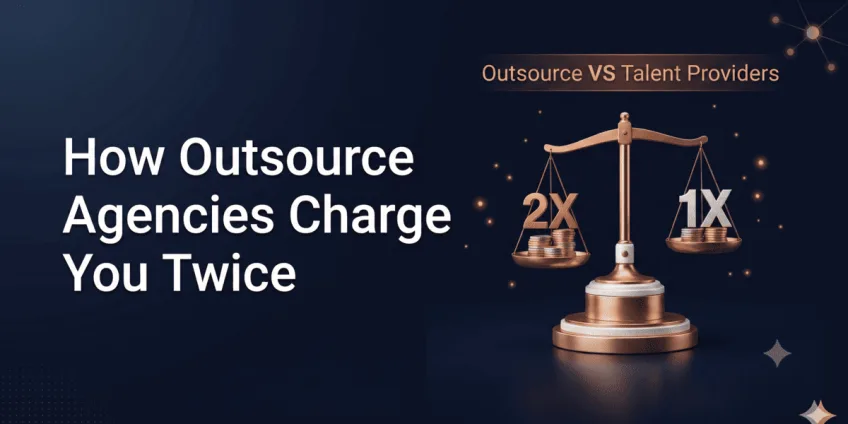
The remaining $55 goes to an agency - covering its margin, its management layer, its sales commission, and, in some cases, a subcontractor markup from yet another intermediary that entered the chain before the developer's profile ever reached your inbox.
This is not an edge case. It is the standard pricing architecture of most traditional outsourcing agencies. Understanding how it works is not about finding someone to blame. It's about making a decision - who to hire, at what rate, and whether the price you see reflects what you're actually buying.
How the Outsourcing Margin Model Works
Every outsourcing agency applies a markup. That part is legitimate. Recruiting, vetting, payroll, compliance, and account management - these services cost money, and a margin covers them.
The problem is not the margin itself. The problem is that the margin is usually invisible, structured in layers, and sometimes doubled by intermediaries operating between the agency and the developer.
Here is how the typical architecture looks:
Layer 1 - The agency contracts the developer. An Eastern European or Southeast Asian developer with 5 years of backend experience is added to the agency's talent pool at an internal rate. Depending on the region and seniority, this might be $22–$40/hr (Accelerance Global Software Outsourcing Rates and Trends Guide, 2024).
Layer 2 - The agency applies its markup. A markup of 50–100% is standard practice in contract and temporary technical staffing, according to data from Frontline Source Group (2026) and Second Talent (2025). A developer contracted at $25/hr becomes a $50–$80/hr line item on the client invoice.
Layer 3 - A broker or vendor management system enters the chain. Many enterprise clients route hiring through vendor management systems or staffing brokers, each of which adds a percentage to the agency rate. When this layer exists, the developer's share of the final invoice can drop below 35% of the client's payment.
None of this is disclosed unless the client specifically requests it - and most don't know to ask.
The Real Cost of the Opacity
What the agency keeps is not the only cost. The structure creates a second, less obvious problem: incentive misalignment.
When an agency's margin is fixed and undisclosed, there's no pricing-side reason for it to match the most experienced developer to your role. The economics are the same whether the placed developer is genuinely strong or merely available. That creates a subtle but structural pressure toward the path of least resistance - not the path of best fit.
There is also the problem of what happens to developer pay when market rates tighten. In a transparent rate model, clients see what the developer earns and what the platform retains. In an opaque model, the developer's actual pay can be quietly compressed during market cycles while the client rate holds steady - widening the margin without any disclosure.
According to Second Talent (2025), temporary staffing markups for technical roles range from 25–71%, with averages around 35–41%. But that figure covers a single layer. When a brokered arrangement or subcontractor enters the chain, total margin above developer pay can exceed 100%.
What Transparent Pricing Actually Requires
Transparent pricing is not simply publishing an hourly rate. Any agency can list a number. Transparency means the client can see three specific things:
1. What the developer earns. The rate paid to the developer - not the developer's market value as the agency describes it, but what they actually receive per hour or per month.
2. What the platform retains. The difference between the developer rate and the client invoice rate, expressed as a fixed fee or percentage, not a vague "service cost."
3. What triggers a rate change. If the developer's rate changes, does the client's rate change proportionally? If not, how is the delta handled?
Without all three, a rate card is a marketing document, not a pricing structure. Most outsourcing quotes fall into the marketing document category.
Traditional Outsourcing vs Transparent Pricing: What the Numbers Show
| Criteria | Traditional Outsourcing Agency | Transparent Pricing Model |
| Client invoice rate | $60–$100/hr (stated) | $30–$60/hr (verifiable) |
| Developer actual rate | $20–$35/hr (undisclosed) | Disclosed or directly negotiable |
| Agency margin | 50–100%+ (not shared) | Fixed service fee, stated upfront |
| Intermediary layers | 1–3 (varies, often invisible) | None or disclosed |
| Rate transparency | Invoice only | Invoice + cost breakdown |
| Incentive on quality | Low - margin fixed regardless of fit | Higher platform quality drives retention |
The Question to Ask Before Signing Any Outsourcing Contract
One question separates transparent vendors from opaque ones: "What does the developer receive per hour, and what is your service margin on top of that?"
If the answer is a deflection - "our rates are competitive," "we price based on value," "that information is confidential" - the margin is high and hidden. A vendor with nothing to hide answers directly.
This question also surfaces a related issue: whether the "developer" being presented is a direct contractor or a subcontractor hired through a third party. In a subcontracted arrangement, the original agency has limited visibility into what the developer actually earns or how many intermediaries stand between the project and the work. The client pays for the full chain.
What Pre-Vetted, Contracted Talent Changes
A different structure produces a different result - not because it is more ethical in principle, but because it removes the conditions that make opacity profitable.
When developers are directly contracted rather than subcontracted, there are no intermediary layers to hide. The rate is what it is: what the developer receives plus what the platform charges. Around 600 developers hold active contracts with Cortance - not aggregated profiles from third-party brokers, not a marketplace of self-registered freelancers. Contracted experts who have passed five stages of verification and are on the platform under known terms.
That structure allows a first shortlist to arrive within 30 minutes of a request, during business hours - not because the process is automated or the vetting is abbreviated, but because the verification work is already done. The 21% of applicants who pass all five stages of Cortance's vetting are ready. The 79% who don't pass are not on the platform.
For teams comparing options, Cortance developers work at rates of approximately $30–60/hr depending on seniority and stack - a number that reflects a different underlying structure, not a race to the cheapest available option.
FAQ
- What is the typical markup an outsourcing agency adds to a developer's hourly rate? In temporary and contract technical staffing, markups on the developer's underlying pay rate typically range from 25–100%, with averages of 35–41% for standard roles. When intermediary broker layers are involved, the combined margin above what the developer actually receives can exceed 100% of the developer's own rate.
- How to know whether an outsourcing agency uses subcontractors? Ask directly: "Is the developer we're working with contracted directly by your firm, or are they sourced through a third-party agency or broker?" A direct answer means direct contracting. Vague language about "partners" or "network vendors" typically signals a subcontracted or brokered arrangement.
- What's the difference between a staffing agency markup and a platform service fee? A markup is applied to the developer's pay rate and increases proportionally as the developer's rate increases, benefiting the agency regardless of any additional value delivered. A flat service fee is a fixed amount the platform charges for its matching, vetting, and administrative function, independent of the developer's underlying rate. The fee model removes the agency's financial incentive to inflate the middle.
- Does transparent pricing mean lower developer quality? No. Transparent pricing describes who sees what in the cost structure, not the quality bar for the developers themselves. In practice, platforms that publish their cost breakdown tend to compete on vetting rigor rather than margin opacity. A platform where 21% of applicants pass all five screening stages produces a different candidate pool than one where the primary selection criterion is availability.
- How do developer rates vary by region, and does geography affect the hidden-margin problem? Regional rate differences are real — senior developers in Eastern Europe typically range from $45–$65/hr in direct arrangements, while equivalent talent in Southeast Asia might run $22–$35/hr. But geography does not resolve the margin transparency problem. An agency sourcing from a lower-cost region can apply the same 50–100% markup and still present a lower headline number than a competitor in a higher-cost region - while capturing the same or larger hidden margin. The rate matters less than whether the cost structure behind it is visible.
Conclusion
The problem with most outsourcing invoices is not the amount - it's what's missing from the explanation. A rate that looks reasonable on paper can sit atop two or three undisclosed layers, each taking a cut before the developer sees it. That structure rewards opacity rather than quality.
Transparent pricing does not guarantee a better developer. But it does guarantee that when you pay for one, you know what you're paying for. The rate, the margin, and the contract between the developer and the platform are visible - not something to negotiate.
For teams ready to see what that looks like in practice, you can check out Cortance's full vetting process here.
Related Articles

How to Add AI to Your Product by Fixing the Flows Users Already Struggle With
Most AI features get bolted on beside the product. The ones that stick fix a specific step where users already stall.
Read article
Cultural Fit, Timezone, English Level: Why Technical Skills Are Only Half the Hiring Decision
Two candidates pass the same technical test. Only one of them will actually work well with your team.
Read article
Reduce SaaS Development Costs with AI in 2026
AI adoption is at an all-time high. Real cost savings are not. Here's the gap most SaaS teams are missing in 2026.
Read article