Why Hiring a Developer Takes Weeks or Months - And How to Cut It Down to 3 Days
Business optimizationPublished on by Yevhen Vavrykiv • 8 min read read

- Why Developer Hiring Has Gotten Slower Every Year
- What a vacant role actually costs per day
- The Traditional Process: Where Each Week Goes
- Stage 1: Job description and internal alignment (Days 1-7)
- Stage 2: Job posting and inbound sourcing (Days 7-21)
- Stage 3: Resume screening and recruiter coordination (Days 14-28)
- Stage 4: Technical screening rounds (Days 21-42)
- Stage 5: Offer preparation and negotiation (Days 42-55)
- Stage 6: Notice periods (Days 55-90+)
- The Full Picture: A Traditional Hiring Timeline
- Where the Lost Candidates Go
- What a 3-Day Process Looks Like
- Comparing the Two Models
- How to Evaluate Whether Your Current Process Has Dead Time
- FAQ
- Conclusion
Every hour that role stays open is a sprint that doesn't ship. Here's exactly where the time goes - and what a faster model actually looks like.
41 days. That's the current average time to fill a software engineering role - and according to Gem's 2025 Recruiting Benchmarks Report, that number has grown 24% since 2021. For senior or specialized positions, the real timeline runs 60 to 90 days, sometimes longer.
Pre-vetted talent platforms change that calculation. Platforms that maintain pools of contracted, screened developers can deliver a first shortlist in under an hour - not because they skip the difficult parts, but because those parts were handled before you ever submitted a request.
The difference isn't magic. It's the removal of dead time. Every stage of traditional developer recruitment runs sequentially: nothing begins until the prior step concludes. That architecture is the problem, not the market.
This article maps each stage where time is lost, assigns realistic durations to each, and shows what a compressed alternative process looks like step by step.
Why Developer Hiring Has Gotten Slower Every Year
This isn't perception. Gem's 2025 Recruiting Benchmarks Report - drawn from more than 140 million applications and 1.3 million hires - shows average time-to-hire increasing from 33 days in 2021 to 41 days in 2024. Hiring teams are now conducting 42% more interviews per hire than three years ago. Recruiters are managing 56% more open requisitions simultaneously.
Several forces are compressing candidate availability at exactly the same moment:
Robert Half's 2026 Technology Hiring Report found that 65% of technology hiring managers say finding skilled professionals is harder now than it was a year ago. U.S. employers posted nearly 1.1 million technology jobs in 2025, even after a period of cautious headcount planning. Meanwhile, according to LinkedIn's 2024 Global Talent Trends report, 62% of candidates say they have withdrawn from a hiring process because it simply took too long.
That last figure matters. Slow processes don't just delay hires - they disqualify candidates who move on. The companies that take 90 days aren't competing on quality. They're often competing against themselves.
What a vacant role actually costs per day
Before mapping the timeline, it's worth understanding the financial stakes of each week that passes.
The cost-of-vacancy calculation - daily business value of the role multiplied by days unfilled - consistently surprises hiring managers when they run the numbers honestly. Research cited by DockYard (2024) estimates that a bad hire can cost up to $240,000, including lost productivity, recruitment expenses, and training. SHRM's 2024 report estimates the replacement cost of a developer at 150% of the developer's annual salary.
Even without worst-case scenarios, a role that stays open for 41 days at the average engineering compensation level represents a measurable drag on sprint velocity, code review throughput, and feature delivery. That drag compounds weekly.
The Traditional Process: Where Each Week Goes
The following is a stage-by-stage breakdown of a standard developer hiring cycle, with realistic time ranges at each step. These ranges reflect data from Gem (2025) and Hire Success benchmarks; actual durations vary by organization size, seniority level, and internal process maturity.
Stage 1: Job description and internal alignment (Days 1-7)
Before a role is ever posted publicly, time is already being spent. Writing or updating a job description requires coordination among the hiring manager, the engineering lead, and, often, HR. Compensation ranges need sign-off. Headcount approval may need finance involvement.
For many teams, this step takes five to seven business days. It is easy to undercount because it happens before the "official" process starts. But the clock on vacancy cost begins when the need is identified, not when the posting goes live.
Time lost here: 5-7 days, often invisible in time-to-hire calculations.
Stage 2: Job posting and inbound sourcing (Days 7-21)
Job boards require time to index. Recruiter outreach takes several cycles. The conventional wisdom is to let a role "soak" for 2 to 3 weeks to build a candidate pool worth reviewing.
This stage is where the sequential problem begins. Most organizations don't start screening until they have a sufficient volume of applications - so they wait. Two weeks of waiting before the first resume is reviewed is standard practice in traditional hiring.
Time lost here: 10-14 days of passive accumulation before active review begins.
Stage 3: Resume screening and recruiter coordination (Days 14-28)
Screening developer resumes is not straightforward. Job boards are optimized for volume, not fit. Recruiters manage 56% more requisitions than three years ago, according to Gem (2025), which means attention per role is compressed. The first wave of screening removes obviously unqualified candidates; a second pass begins the deeper evaluation.
When an external recruiter is involved, coordination overhead adds further delays - briefing calls, alignment on requirements, feedback loops between the recruiter and the hiring team.
For most companies, resume screening through to a confirmed longlist takes 7-14 days. Some organizations lose additional time because the hiring manager is unavailable to review shortlists promptly.
Time lost here: 7-14 days. Often the step most optimized in recruitment playbooks, with the least actual improvement.
Stage 4: Technical screening rounds (Days 21-42)
This is typically the most time-intensive stage. A standard technical interview process for a senior developer involves:
- A 30-minute phone or video screen with a recruiter or HR lead;
- A take-home technical assessment (usually 2-4 hours for the candidate);
- A technical interview with one or two engineers (1-2 hours);
- A system design round or architecture discussion;
- A culture or team-fit interview with the hiring manager;
Scheduling these rounds sequentially across multiple interviewers - each with their own availability constraints - adds days between each step. A candidate who completes a take-home test on Thursday may wait until the following Tuesday for the next interview because of interviewer availability.
This stage alone routinely takes two to four weeks. And at each scheduling gap, there is a risk the candidate accepts another offer and withdraws.
Time lost here: 14-21 days, with significant candidate dropout risk at each handoff.
Stage 5: Offer preparation and negotiation (Days 42-55)
Once a preferred candidate is identified, the offer stage begins - and it carries its own timeline risks. Offer letters require compensation approval, often involving HR and finance. For senior roles with equity components, legal review may be required.
Then comes the candidate's response window. According to LinkedIn's 2024 Global Talent Trends report, 70% of candidates expect to hear back within one week of their final interview. Waiting longer than that significantly increases withdrawal risk. Still, many organizations take five to ten business days to generate and deliver a formal offer after the final interview.
Negotiation adds further time. Counteroffers from current employers are common; counteroffers from other companies in parallel processes are increasingly common. Each negotiation round takes days.
Time lost here: 7-14 days between final interview and signed acceptance.
Stage 6: Notice periods (Days 55-90+)
A candidate accepts. The role still isn't filled. Most senior developers are employed, which means they owe a notice period to their current employer - typically two to four weeks in most markets, and up to three months for senior engineers in European jurisdictions.
This stage is largely outside the hiring company's control. But it is reliably absent from discussions of "how long does it take to hire a developer," despite adding weeks to every timeline when a currently employed candidate is preferred.
Time lost here: 10-30 days, not typically counted in time-to-hire statistics.
The Full Picture: A Traditional Hiring Timeline
| Stage | Typical duration | Key delay driver |
| Job description and internal alignment | 5-7 days | Stakeholder coordination |
| Job posting and inbound sourcing | 10-14 days | Waiting for volume before reviewing |
| Resume screening and recruiter coordination | 7-14 days | Volume filtering, recruiter capacity |
| Technical screening rounds | 14-21 days | Sequential scheduling, interviewer availability |
| Offer preparation and negotiation | 7-14 days | Approval chains, counter-offers |
| Notice period | 10-30 days | Candidate's contractual obligation |
| Total | 53-100 days | Sequential process architecture |
The numbers in most "average time to hire" reports - typically 35-41 days - measure only from job posting to accepted offer. They exclude the internal alignment phase before posting and the notice period after acceptance. The real gap between "we need a developer" and "developer is contributing code" is often double what organizations track.
Where the Lost Candidates Go
A point that deserves its own section: slow processes don't just delay hires. They lose candidates to competing offers.
According to LinkedIn's 2024 Global Talent Trends report, 62% of candidates say they have withdrawn from a hiring process because it took too long. The strongest candidates - the ones with the most options - are also the most likely to disengage during delays, precisely because they have other options.
Hiring teams often interpret a strong candidate's refusal of an offer as a compensation issue. Many times it is a speed problem. The candidate wasn't lost at the offer stage. They were lost during the two-week gap between technical interview rounds.
What a 3-Day Process Looks Like
The alternative isn't a compressed version of the same process. It is a structurally different model - one where the time-consuming stages have already been completed before the client's need arises.
Platforms that maintain pre-vetted, contracted developer pools can operate on a different timeline because the work has already been done:
- Stage 1: Request submitted. The client specifies role requirements, tech stack, seniority, and engagement model. No job description writing, no posting, no sourcing delay.
- Stage 2: Shortlist delivered. Around 600 developers hold active contracts with Cortance - not registered profiles waiting to be contacted, but contracted experts who have passed five vetting stages. 21% of applicants pass all five stages; the others don't. A first shortlist is delivered within 30 minutes during business hours, or by 11 AM the next business day for off-hours submissions. The matching draws from a pool where screening has already been done.
- Stage 3: Client interviews shortlisted candidates. The client conducts focused interviews - typically one round, occasionally two - with candidates already validated technically. No take-home test administration, no recruiter middleman, no scheduling overhead beyond the client's own calendar.
- Stage 4: Engagement confirmed. Contract terms, rates, and start conditions are defined within an existing framework. No offer letter approval chains, no equity negotiation, no internal finance review.
- Stage 5: Developer starts. Because developers in a contracted pre-vetted pool are available to start, there is no notice period to wait out.
The practical result: a client who submits a request on Monday morning can reasonably expect a first shortlist by Monday midday, conduct interviews Tuesday, and confirm an engagement by Wednesday.
That is not a theoretical floor. It is the timeline when the upfront work - vetting, contracting, organizing by stack and seniority - has been completed before the request arrives.
Comparing the Two Models
| Factor | Traditional hiring | Pre-vetted matching |
| Time to first candidate shortlist | 14-21 days | 30 minutes (business hours) |
| Technical vetting | During process (2-4 weeks) | Pre-completed before request |
| Interview rounds required | 3-5 rounds | 1-2 rounds |
| Offer and contract process | 7-14 days | Within existing framework |
| Notice period | 10-30 days | Not applicable (available-to-start pool) |
| Total time to active contribution | 53-100 days | 3-5 days |
| Candidate dropout risk | High (multiple gap points) | Low (engaged, contracted professionals) |
| Vetting acceptance rate | Varies (no public standard) | 21% pass all five stages |
Competitor platforms often advertise pools of tens of thousands of developers. The figure sounds stronger. But a pool of registered profiles is not the same as a pool of contracted, recently evaluated professionals. The distinction shows up in the first conversation: a registered profile may have changed stacks, raised rate expectations, or accepted another role since registration. A contracted expert is current, evaluated, and available.
How to Evaluate Whether Your Current Process Has Dead Time
Before deciding which model fits your situation, it is worth auditing where your own hiring timeline currently spends its time. Most organizations have never done this exercise with real data.
Three questions that expose dead time quickly:
1. What is the gap between final interview and offer delivery? If the answer takes more than five business days, the approval chain adds delay with no quality benefit.
2. How many scheduling gaps exist between technical rounds? If each interview takes three to five days to schedule, a four-round process carries 12-20 days of scheduling overhead alone - not interview time, just scheduling time.
3. What percentage of your shortlisted candidates are currently employed? If the majority are employed, every successful hire carries a notice period, so your time-to-hire metric doesn't count. Your actual gap-to-contribution is significantly longer than your tracking suggests.
Answering these three questions often reveals that 40-60% of a hiring timeline is spent on coordination and scheduling overhead, not on actual evaluation time. That overhead is what a pre-vetted pool removes.
FAQ
- What is the biggest cause of slow developer hiring? The primary driver is a sequential process architecture: each stage waits for the prior one to complete before beginning. Resume screening doesn't start until inbound volume is sufficient. Technical interviews don't schedule until screening is complete. Offers don't move until final interviews are done. This sequencing adds weeks of delay that carry no quality benefit. Switching to a parallel or pre-completed model, where vetting is done before a request arrives, removes this overhead.
- What happens to candidates during a slow hiring process? According to LinkedIn's Global Talent Trends report, 62% of candidates say they've withdrawn from a process because it took too long. The strongest candidates - those with the most options - are also the most likely to disengage during scheduling gaps. The practical result is that slow processes systematically lose the candidates most worth hiring.
- What is time-to-hire vs. time-to-fill, and which matters more? Time-to-hire is typically measured from job posting to accepted offer. Time-to-fill includes the full period from when a vacancy is identified to when the role is filled. Neither metric captures the notice period, which means both understate the actual gap between need and contribution. For operational planning, the relevant number is time-to-active-contribution: from request to developer shipping code.
- Is staff augmentation faster than traditional hiring for developer roles? For most technical roles, yes - substantially faster. Traditional hiring follows a full, sequential process for each new engagement. Staff augmentation through a pre-vetted platform moves the time-consuming stages (sourcing, screening, technical evaluation) to a one-time infrastructure cost rather than a per-hire delay. The result is a first shortlist in hours rather than weeks.
Conclusion
The 41-day average for developer hiring isn't an industry floor. It's an artefact of how the process is built - sequential stages, each waiting on the last, with scheduling gaps and coordination overhead filling the space between evaluations.
The speed and quality problems are usually presented as a trade-off. In a traditional process, they are. In a pre-vetted model, they aren't - because vetting is completed before the request arrives, not during it.
For teams that have already spent weeks without a workable shortlist, a different architecture changes the calculation. A request at 9 AM. A first shortlist by 9:30. A start date by Thursday.
Related Articles

How to Add AI to Your Product by Fixing the Flows Users Already Struggle With
Most AI features get bolted on beside the product. The ones that stick fix a specific step where users already stall.
Read article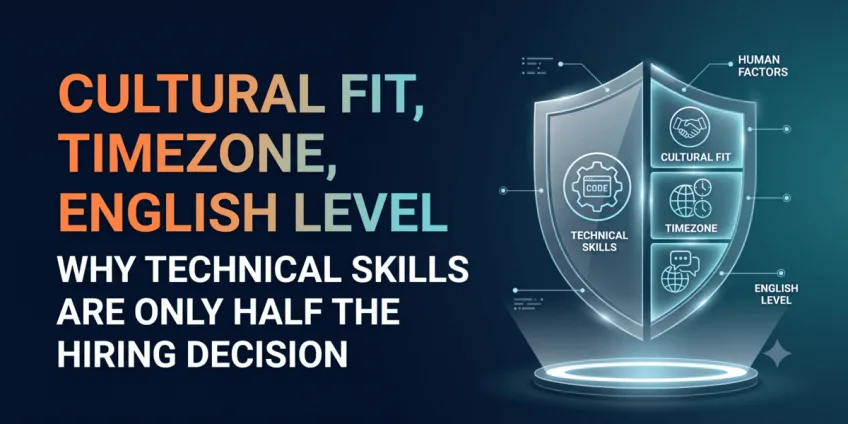
Cultural Fit, Timezone, English Level: Why Technical Skills Are Only Half the Hiring Decision
Two candidates pass the same technical test. Only one of them will actually work well with your team.
Read article
Reduce SaaS Development Costs with AI in 2026
AI adoption is at an all-time high. Real cost savings are not. Here's the gap most SaaS teams are missing in 2026.
Read article