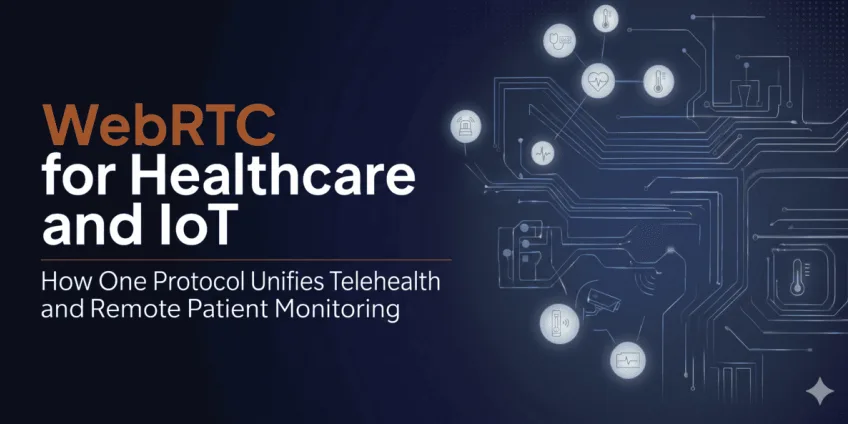
WebRTC for Healthcare and IoT: How One Protocol Unifies Telehealth and Remote Patient Monitoring
Industry NewsPublished on by Yevhen Vavrykiv • 10 min. read read
- Why Telehealth Runs on WebRTC
- Why IoT Remote Patient Monitoring Needs a Real-Time Protocol
- The Convergence: RTCDataChannel and the Unified Session Architecture
- The Technical Architecture: How the Data Flows
- Specific Products and Use Cases Where This Architecture Applies
- What Building This Well Actually Requires
- FAQ
- Conclusion
The architecture that makes a video consultation and a live sensor data stream a single encrypted session - not two separate systems.
A cardiologist reviews a patient with heart failure from a browser window. The video feed shows the patient's face. A second stream, running through the same encrypted session, shows live ECG data from a wearable patch on the patient's chest - updated in real time, no refresh, no separate application. The doctor sees both, in the same browser tab, with the same sub-second latency. When the patient's rhythm changes, the doctor responds to what's happening now, not to a report that arrived minutes later.
This isn't a prototype. It's the architecture that WebRTC's RTCDataChannel makes possible - and it represents what the convergence of telehealth and IoT remote patient monitoring actually looks like when built correctly.
WebRTC is the protocol that makes real-time medical communication browser-native, plugin-free, and encrypted by default, and its RTCDataChannel API allows a single session to simultaneously carry a HIPAA-compliant video consultation and a live stream of vital signs from connected medical sensors. For healthcare products, this matters because it replaces a separate video platform and a separate IoT data pipeline with a single, unified, low-latency, end-to-end-encrypted connection. The global IoT in healthcare market was valued at $146.52 billion in 2025, is estimated to reach $175.97 billion in 2026, and is projected to reach $761.70 billion by 2034, growing at a CAGR of 20.1%. Remote patient monitoring is the dominant application segment driving that growth.
Building these products correctly requires engineers who understand where WebRTC ends and the compliance layer begins - and why that distinction is what separates a viable medical platform from a regulatory liability.
Why Telehealth Runs on WebRTC
54% of Americans had experienced a telehealth visit by 2024, and telehealth visits surged 38 times from pre-pandemic levels. Up to 30% of U.S. consultations are expected to remain virtual by 2026. The global telehealth market is expected to reach around $455 billion in 2030, up from $123 billion in 2024.
The reason WebRTC is the standard transport layer for telehealth isn't adoption inertia - it's that no alternative delivers the same combination of properties inside a browser. Consider what a telehealth consultation actually requires technically:
- the patient must be able to join from any device without an app download;
- the connection must be encrypted end-to-end by default;
- the latency must be low enough for a clinician to conduct a genuine real-time assessment;
- and the system must function across the variable mobile and home network conditions that patients actually have.
WebRTC satisfies all four constraints simultaneously. SRTP encrypts all media. DTLS encrypts data channels - both mandatory in the protocol specification, not optional add-ons. Latency in a direct P2P connection runs 50–150 milliseconds, enough for natural clinical conversation. And the browser-native access means a patient in a rural area with a three-year-old Android phone and a cellular connection can join a consultation by tapping a link.
Healthcare platforms typically use WebRTC for browser-based video consultations because it delivers sub-second latency without requiring plugins or additional software. This makes it easier for patients to join appointments from any device while maintaining the real-time interaction necessary for effective clinical communication.
Worth saying that WebRTC's encryption is the protocol's, and HIPAA compliance is the platform's. The session's media and data are protected by SRTP and DTLS in transit. What HIPAA requires on top of that - access controls, session recording with defined data residency, audit logging, business associate agreements with infrastructure providers - is engineering work that surrounds the WebRTC session, not part of it. Teams that conflate "WebRTC is encrypted" with "our telehealth product is HIPAA-compliant" learn the difference during their first compliance audit.
Why IoT Remote Patient Monitoring Needs a Real-Time Protocol
IoMT-enabled remote patient monitoring can reduce hospital readmission by 50%. IoMT solutions have the potential to save the healthcare industry $300 billion annually in chronic disease management.
Those numbers reflect a structural problem that traditional episodic care was not designed to solve. Chronic diseases such as diabetes and cardiovascular disorders now account for a staggering 74% of all deaths globally, according to the World Health Organization, creating an unsustainable demand on traditional healthcare delivery. Patients with these conditions need continuous oversight, not a quarterly appointment. The appointment model produces readings at the moment of the visit. Connected devices continuously produce readings, which is precisely where early intervention becomes possible.
The IoT device landscape in healthcare covers wearable patches (ECG, SpO2, skin temperature), continuous glucose monitors, smart inhalers, blood pressure cuffs with Bluetooth, implantable cardiac monitors, and bedside vital sign monitors. By device type, the wearable medical devices segment holds the largest market share in 2026, primarily attributed to their widespread use in continuous vital sign monitoring and chronic disease management.
The connectivity problem in this ecosystem: most of these devices transmit over Bluetooth Low Energy to a smartphone gateway, which then pushes data to a cloud platform via cellular or Wi-Fi. The data arrives in the cloud with latency measured in seconds or minutes, depending on the pipeline. A clinician reviewing that data sees a historical record, not a live feed. When a value crosses a threshold, an alert fires - but the clinician's response begins only after they open the platform, navigate to the patient, and review the context. That is not the same as watching it happen in real time.
The Convergence: RTCDataChannel and the Unified Session Architecture
The specific WebRTC capability that changes the IoT healthcare model is RTCDataChannel. RTCDataChannel allows bidirectional transfers of data between peers. It uses the same DTLS-encrypted, P2P connection as the video and audio channels in a WebRTC session, meaning sensor data transmitted through RTCDataChannel carries the same encryption, sub-second latency, and browser-native accessibility as the video feed.
IEEE researchers demonstrated this architecture explicitly: a tele-counselling service based on WebRTC that allows any person residing remotely from medical staff or hospital to directly interact with them, implementing the real-time transmission and visualisation of vital signs and parameters acquired by biomedical sensors connected to the patient's personal device through the RTCDataChannel.
What that architecture produces in practice is a single WebRTC session carrying three simultaneous streams:
- Video channel (RTCPeerConnection): the patient's face, expression, physical condition as visually observable;
- Audio channel (RTCPeerConnection): clinical conversation;
- Data channel (RTCDataChannel): live readings from IoT sensors - heart rate, SpO2, blood pressure, glucose, ECG waveform;
The clinician sees all three in one browser view. No switching between a video platform and a monitoring dashboard. No delay between what the patient says and what the sensor shows. No architectural gap between the consultation context and the physiological data.
This isn't a feature - it's a different category of clinical tool. A dermatologist reviewing a skin lesion over video gets the same visual assessment they would in person. A cardiologist reviewing a patient during an alert-triggered session sees the arrhythmia as it's happening, in the same window where the patient is explaining their symptoms.
The Technical Architecture: How the Data Flows
Understanding the data flow across a WebRTC healthcare IoT system is what distinguishes an engineer who can build it from one who can describe it.
Layer 1 - Device and connectivity. The IoT medical device (wearable patch, glucose monitor, or bedside monitor) transmits via Bluetooth Low Energy or Zigbee to a smartphone or a dedicated gateway device. BLE dominates the short-range segment due to low power consumption; cellular covers devices where continuous home Wi-Fi is unreliable.
Layer 2 - Gateway and signalling. The gateway (smartphone or dedicated hardware) handles the WebRTC signalling process: it contacts the signalling server, exchanges Session Description Protocol (SDP) offers and answers with the clinician's browser, and establishes the RTCPeerConnection. WebRTC signaling itself is not standardized - XMPP, WebSocket, and SIP are all used. The gateway software manages the BLE-to-WebRTC bridge, packaging sensor readings as binary or JSON data for the RTCDataChannel.
Layer 3 - NAT traversal and relay. Direct P2P connection succeeds in most home environments. When it doesn't - symmetric NATs, corporate firewalls, carrier-grade NAT - a TURN server provides the relay. TURN server geography is a critical infrastructure decision: a patient in Mumbai relaying through a server in London adds 150–200ms of latency, making real-time clinical assessment feel imprecise. TURN infrastructure needs to be regionally distributed across the patient population's geography.
Layer 4 - The clinical interface. The clinician's browser receives and renders the video feed, audio stream, and sensor data in a unified dashboard. The RTCDataChannel delivers sensor readings as they arrive - no polling, no refresh cycle. When the wearable registers a SpO2 drop, the chart in the clinician's browser updates within 200 milliseconds of the sensor capturing the reading.
Layer 5 - Compliance infrastructure. This layer is entirely outside the WebRTC session itself. Session recording must be stored with defined data residency and access controls. Every session must generate an audit log: who connected, when, from which IP, what data was transmitted. Business Associate Agreements must cover every infrastructure provider - the TURN server operator, the signalling server host, and the cloud storage provider. By 2025, cutting-edge telehealth solutions leverage AI for diagnostics and the Internet of Things for real-time patient data, reflecting an evolution from simple video chat tools to sophisticated health platforms. The sophistication is in the compliance layer, not the video quality.
Specific Products and Use Cases Where This Architecture Applies
Chronic disease management platforms. Diabetes, hypertension, and heart failure patients require continuous monitoring between appointments. A WebRTC session triggered by an alert from a continuous glucose monitor or a blood pressure wearable can connect the patient directly to a care navigator or NP within seconds, with the sensor data already visible in the clinician's interface before the video connection completes.
Post-surgical and post-discharge monitoring. Hospital readmission prevention is one of the strongest business cases in healthcare technology. IoMT-enabled remote patient monitoring can reduce hospital readmission by 50%. WebRTC-based monitoring allows a surgical team to conduct daily check-ins with high-risk discharge patients, observing wound condition via video while receiving real-time vital signs, identifying deterioration before it requires re-admission.
Mental health and behavioral health platforms. By 2023, 38% of psychiatric visits were conducted remotely. For this speciality, the RTCDataChannel use case is different: biometric data such as heart rate variability and galvanic skin response captured by a wearable can provide physiological context during a therapy session, visible to the clinician as a supplementary signal alongside the video consultation.
Smart hospital bedside monitoring. Smart bedside devices - such as vital sign monitors - help doctors check the physical condition of their patients at any time of day or night. A WebRTC-integrated bedside monitor allows a night-shift clinician to conduct a remote visual assessment of a patient in a different ward and receive real-time vital signs simultaneously, without physically leaving the nursing station for a standard check.
Emergency and ambulance triage. Paramedics in the field can initiate a WebRTC session connecting the ambulance to a receiving emergency department. The patient's face is visible to the emergency team; the ambulance's connected ECG monitor streams data through RTCDataChannel. The ED physician can guide triage decisions and prepare intervention protocols before the ambulance arrives.
What Building This Well Actually Requires
The engineering challenge in WebRTC healthcare IoT is not the WebRTC session itself - the browser APIs are mature and well-documented. The challenge is the BLE-to-WebRTC gateway, the TURN infrastructure deployment for the patient population's geography, the session recording and compliance layer, and the clinical interface that makes multi-stream data usable rather than overwhelming.
Encryption of communications makes WebRTC attractive to healthcare providers, who are concerned with safeguarding their patients' personal health data. In the US, health data is protected by HIPAA, and any corresponding software product must comply with its standards.
The failure modes in this domain are specific. A TURN server that goes down during a patient consultation is a patient safety event, not a user experience issue. A signalling server that drops connections intermittently produces incomplete clinical sessions that may have compliance gaps. An RTCDataChannel implementation that drops packets during high-load periods silently corrupts the vital signs data the clinician relies on.
Backend developers with production WebRTC experience understand these failure modes before encountering them - they've debugged DTLS handshake failures in NAT environments, optimized TURN relay performance for geographically distributed users, and built the session logging infrastructure that makes a recording HIPAA-compliant rather than merely stored. Web developers who've built clinical interfaces know the difference between displaying real-time sensor data in a way that informs clinical decisions and displaying it in a way that creates alert fatigue.
FAQ
- What is WebRTC & RTCDataChannel, and why does it matter for healthcare IoT? RTCDataChannel is a WebRTC API that enables bidirectional, peer-to-peer transmission of any data type between browsers or applications - using the same encrypted connection as the video and audio channels in a WebRTC session. In healthcare IoT, it allows a medical wearable's sensor readings (heart rate, ECG, SpO2, glucose) to be transmitted to a clinician's browser in real time alongside the video consultation, without a separate data pipeline. Both channels share the same DTLS encryption and sub-second latency.
- Does WebRTC provide HIPAA compliance for healthcare applications? WebRTC provides the encryption layer - SRTP for media, DTLS for data channels - which is required but not sufficient for HIPAA compliance. HIPAA compliance is a platform-level responsibility that includes access controls, session recording with defined data residency, audit logging, signed Business Associate Agreements with all infrastructure providers (including TURN server operators and signaling server hosts), and breach notification procedures. Building a WebRTC telehealth product is not the same as building a HIPAA-compliant telehealth product.
- How to connect IoT medical devices to a WebRTC session? Most IoT medical devices transmit over Bluetooth Low Energy to a smartphone or dedicated gateway. The gateway runs software that bridges the BLE sensor feed to the WebRTC RTCDataChannel, packaging readings as binary or JSON data and transmitting them over the established P2P connection to the clinician's browser. The gateway also handles WebRTC signalling: exchanging SDP offers and answers with the signalling server to establish the RTCPeerConnection before data flows.
- How does the TURN server's geographic location affect a healthcare WebRTC deployment? A TURN relay server is required when a direct P2P connection fails, which happens in approximately 15–20% of real-world network configurations, including many home and mobile environments. The TURN server's geographic location relative to the patient determines the relay latency: a patient in a rural area routing through a TURN server in a distant region adds 150–200ms of latency. For a clinical assessment that depends on real-time visual observation and live sensor data, that latency makes the experience unreliable. Healthcare deployments require regionally distributed TURN infrastructure matched to the patient population's geographic distribution.
- What makes a WebRTC session suitable for transmitting medical sensor data? Four properties make RTCDataChannel appropriate for live medical sensor transmission: end-to-end DTLS encryption by default, sub-second latency that preserves the real-time character of the readings, the P2P architecture that routes data directly between endpoints without passing through an intermediary server in the default case, and the unified session model that keeps sensor data and video consultation in the same encrypted connection. IEEE-documented implementations have successfully transmitted ECG, SpO2, blood pressure, and body temperature data through RTCDataChannel alongside live video consultations.
- Which chronic conditions benefit most from WebRTC-enabled IoT monitoring? Cardiovascular disease, heart failure, and arrhythmia benefit from continuous ECG and SpO2 monitoring combined with alert-triggered video consultations. Diabetes management benefits from continuous glucose monitor integration with clinical review sessions. Chronic obstructive pulmonary disease and asthma benefit from smart inhaler monitoring and SpO2 tracking. Hypertension management benefits from connected blood pressure cuffs. In each case, the clinical value comes from the combination: the sensor data identifies the moment that requires intervention, and the WebRTC session delivers the intervention in real time.
Conclusion
WebRTC and healthcare IoT are not parallel technology tracks that happen to intersect occasionally. They are components of the same architecture when the goal is a clinical product that makes real-time intervention possible - not just possible at the moment of a scheduled appointment, but continuously, triggered by what the patient's body is actually doing.
The RTCDataChannel is what makes this architecture coherent: one encrypted session, one low-latency connection, one compliance boundary to build around - rather than a video platform stitched to a separate IoT data pipeline with a delay between them. For the 74% of deaths globally attributable to chronic disease, that architectural coherence is not an engineering elegance argument. It's the difference between care that can respond to what's happening and care that reviews what happened.
The convergence of connected medical devices, real-time data analytics, and cloud-based platforms is fundamentally reshaping how healthcare is delivered, monitored, and managed across clinical and non-clinical settings. WebRTC is the transport layer that makes that convergence real-time rather than asynchronous.
The engineers who build this correctly are those who've already encountered the production constraints - the TURN relay edge cases, the compliance architecture decisions, and the clinical interface design tradeoffs.
- #healthcare
- #saas
- #webrtc
- #realtimevideo
- #videoprocessing
- #dataprocessing
- #iot
- #livevideo
- #datastreaming
Related Articles
Staying Ahead in Staffing: Key Trends Reimagining the Industry for 2026
In 2026, AI and fraud reshape staffing. This research deconstructs challenges for leaders balancing risk and tech to lead in a disrupted market.
- #ai
- #startup
- #smallbusiness
- #saas
- #smarthiring
- #boosting
- #optimization
- #findadeveloper
- #teamextention
- #hire