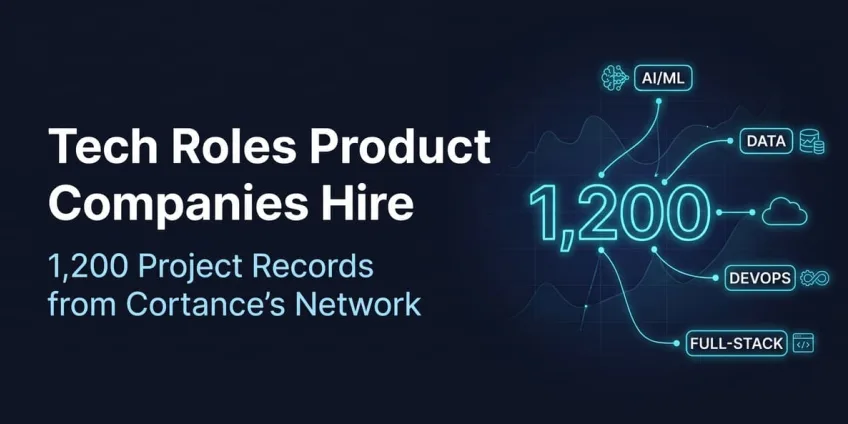
What Tech Roles Do Product Companies Hire For? 1,200 Project Records from Cortance's Network
Industry NewsPublished on by Iryna Seleman • 9 min read read
- How We Read 1,200+ Project Records
- The Tech Roles Companies Hire Most
- The Shift: AI Roles Arrive in the Newest Records
- AI and LLM Engineers Grow Out of Backend and Full-Stack
- Cloud and DevOps: Small Share, Rising Line
- ML and Data Science: A Specialist Niche
- Mobile, Frontend, Backend: Still the Core of Every Team
- Lead Roles Hide Inside Stack Titles
- Which Tech Role to Hire for Your Next Stage
- Tech Roles FAQ
- The Core Stays, the Edge Moves
Across 1,200 projects in our developers' work history, the first 900 records contain exactly three positions with "AI" in the title. The newest 300 contain 17. No other role family grew that steadily at the newest end of the data.
Product companies still hire mostly for four tech roles: mobile, frontend, backend and full-stack developers fill 74.4% of the 1,200 positions. AI engineering is the fastest-growing group, followed by cloud and DevOps. Most of those AI positions belong to backend and full-stack engineers who added AI to their stack, not to a separate profession.
For a founder planning the next hire, both halves of that picture matter. The core tech roles of a product team look familiar. Everything around them is changing quickly, and client requests are changing with it.
How We Read 1,200+ Project Records
Every developer in the Cortance network documents past projects, and each project includes the position the developer held. We counted that per-project position rather than the role in each profile, because projects show what companies actually hired each developer to do. The data covers 1,200 project records from 265 developers who were active and available as of October 2026.
Raw titles came in close to 400 spellings, so we grouped them into role families. A title that named two areas went to the more specialized one: "Backend / AI Engineer" counts as AI, and "Full-Stack Web & Mobile Developer" counts as full-stack. Project records carry no dates, so the timeline in this article follows the order in which records were added to the platform.
The Tech Roles Companies Hire Most
Mobile development is the largest single family, with 269 positions across iOS, Android, Flutter and React Native. Frontend, backend, and full-stack follow, with a few positions each. Another 125 titles say only "Software Engineer" or "Developer", which usually means a generalist product role.
| Role family | Share | Developers |
| Mobile | 22.4% | 72 |
| Frontend | 17.6% | 73 |
| Backend | 17.3% | 75 |
| Full-stack | 17.1% | 84 |
| General software engineering | 10.4% | 57 |
| AI, ML and data science | 5.0% | 17 |
| QA and testing | 2.8% | 7 |
| Leadership | 2.2% | 21 |
| Cloud and DevOps | 1.8% | 9 |
| Blockchain and Web3 | 1.3% | 5 |
| Salesforce and low-code | 1.1% | 4 |
| Data engineering and analytics | 0.5% | 4 |
| Other | 0.6% | 6 |
Four tech roles fill three of every four positions, and specialist families remain small. Totals hide the direction of travel, though. That only shows when you look at when each family appeared.
The Shift: AI Roles Arrive in the Newest Records
Splitting the 1,200 records into four equal groups by the order they were added shows where the change happens. AI titles barely exist in the first three groups and jump to 17 in the newest one. Cloud and DevOps titles rise steadily from 3 to 9 across the same groups.
| Role family | Earlier records (first 900) | Newest records (last 300) |
| AI engineering (AI in the title) | 0.3% (3) | 5.7% (17) |
| Cloud and DevOps | 1.3% (12) | 3.0% (9) |
| Frontend | 15.2% (137) | 24.7% (74) |
| Mobile | 24.6% (221) | 16.0% (48) |
Client requests point the same way. Yevhen Vavrykiv, our CEO and co-founder, says the trend in client requests is changing, and requests for AI positions grow day by day. Our records show the supply side of that shift: the most recently added project records carry AI titles. Titles such as "AI Tooling Developer", "AI Architect / Infrastructure Engineer", and AI-First Software Engineers appear only in the newest group.
The wider market is moving in the same direction, though more slowly than the hype suggests. In McKinsey's State of AI survey (2026), about two in ten respondents said their organizations had reached the scaling phase with AI agents. Companies at that stage need engineers who put agents into production, which is the work the new titles describe.
AI and LLM Engineers Grow Out of Backend and Full-Stack
Of the 20 positions with "AI" in the title, 18 belong to developers whose profile role is full-stack or backend. Only two belong to developers listed as AI engineers. Half of the 20 titles also name a second area outright, as in ".NET / AI Backend Developer" or "Full-Stack & AI Developer".
The word "LLM" appears in none of the 1,200 titles, even though LLM work is common in the projects themselves. Developers describe that work as AI engineering on top of an existing stack. In practice, that means connecting a model to a booking system, building retrieval over company documents or orchestrating agents with frameworks such as LangChain. Coding assistants are part of the same shift, so many projects list Claude Code among the tools used.
For hiring, this changes the search. A startup that needs LLM features in its product rarely needs a research scientist. It needs a backend or full-stack engineer who has shipped AI features. We call the strongest version of that profile AI-first software engineers: developers who build with AI tools and build AI into the product.
Cloud and DevOps: Small Share, Rising Line
Cloud and DevOps titles cover only 21 positions, yet they tripled from the oldest group of records to the newest. The skill data shows why the title count stays low. Amazon Web Services appears in 128 projects across 59 developers, Kubernetes in 31 projects and Terraform in 19. Most cloud work, in other words, is done by developers whose title says backend or full-stack.
Dedicated cloud tech roles tend to appear once a product carries real load or compliance requirements. AI products reach that point early, because inference, GPU costs and data isolation turn infrastructure into a product decision.
ML and Data Science: A Specialist Niche
Data science and machine learning account for 40 positions held by just seven developers. Almost all of them arrived in one group of records, so the spike in the third group reflects a few specialists joining at once, not a market trend. Their projects cover computer vision, forecasting, drone navigation and model evaluation.
The split between ML and LLM work matters more than the totals. ML engineers train and evaluate models on a company's own data, and their projects run for months. LLM-focused AI engineers mostly integrate existing models, and their titles grow out of product engineering.
Mobile, Frontend, Backend: Still the Core of Every Team
The four largest families hold 893 of the 1,200 positions. Their mix is moving, though: mobile titles fall from 85 in the oldest group of records to 48 in the newest, while frontend titles rise from 53 to 74. Product companies still need someone to build the app, the interface and the API before any AI feature has somewhere to live.
What changes is the expectation inside those roles. Full-stack developers make up 15 of the 20 AI titles in the data, making the full-stack profile the most direct path into AI work.
Lead Roles Hide Inside Stack Titles
Only 26 positions are pure leadership titles such as "Tech Lead" or "Technical Co-founder". A much larger group combines a stack with responsibility: 106 titles include Lead, Architect, Founder, or Principal. Most read like "Lead Backend Developer" or "Team Lead / Senior PHP Developer".
Small product teams rarely hire a manager who doesn't code. Instead, a senior engineer also sets technical direction, so startups should look for lead experience in a developer's project history rather than in a separate job title.
Which Tech Role to Hire for Your Next Stage
Before the first release, the core tech roles still decide the outcome. A mobile, frontend or full-stack developer builds the product, and a backend developer with cloud experience keeps it running. Adding AI at this stage usually means one feature, which a backend or full-stack engineer with shipped AI work can handle.
Once AI becomes the product rather than a feature, the picture shifts. Agents, retrieval and model costs call for an AI engineer who has put these systems into production, and growing infrastructure calls for a dedicated cloud or DevOps engineer. A model trained on your own data is the point where an ML engineer or data scientist becomes worth the cost. Our AI engineer profiles list the projects behind each title, which is where that production experience shows up.
Tech Roles FAQ
- What tech roles are startups hiring for most right now? Mobile, frontend, backend and full-stack developers fill 74.4% of the 1,200 positions in our developers' project history. AI engineering is the fastest-growing group, so startups decide to hire full-stack or backend AI-oriented developers first. Cloud and DevOps roles are in demand too.
- Is it better to hire an AI engineer or a backend developer with AI experience? A backend developer with shipped AI features is usually the better first hire for a product that adds AI to an existing service. In our data, 18 of 20 AI-titled positions belong to full-stack or backend developers. A dedicated AI engineer pays off once agents, retrieval or model costs become the core of the product.
- What is the difference between an ML engineer and an AI engineer? An ML engineer trains and evaluates models on a company's own data, while an AI engineer mostly integrates existing models into products. ML projects in our data run for months and center on evaluation. AI engineering titles grow out of backend and full-stack work, such as agents, retrieval and LLM features inside existing apps.
- Do startups need a dedicated DevOps or cloud engineer? Most early startups don't, because backend developers handle much of the cloud work. AWS appears in 128 projects in our data, while only 21 positions carry a cloud or DevOps title. A dedicated hire makes sense once inference costs, uptime or compliance turn infrastructure into a product risk.
- What skills should an AI engineer have for a product team? An AI engineer on a product team needs solid backend skills first, then experience putting models into production. Look for retrieval over real documents, agent workflows with approval steps, cost control across model providers and evaluation of output quality. A shipped project that shows these skills says more than a title.
The Core Stays, the Edge Moves
Mobile, frontend, backend and full-stack developers still fill most tech roles, and every AI product depends on them. Change sits at the edge of the team, where AI titles went from nearly absent to the fastest-growing group and cloud roles tripled. Requests are moving the same way, and the developers who meet them are mostly product engineers who learned to build with AI.
Hiring for that edge works best when the role is defined by the work rather than the title.
Related Articles

WebRTC for Healthcare and IoT: How One Protocol Unifies Telehealth and Remote Patient Monitoring
One WebRTC session: the doctor sees the patient and receives live ECG from the wearable simultaneously. That architecture changes telehealth meaning.
Read article
Staying Ahead in Staffing: Key Trends Reimagining the Industry for 2026
In 2026, AI and fraud reshape staffing. This research deconstructs challenges for leaders balancing risk and tech to lead in a disrupted market.
Read article