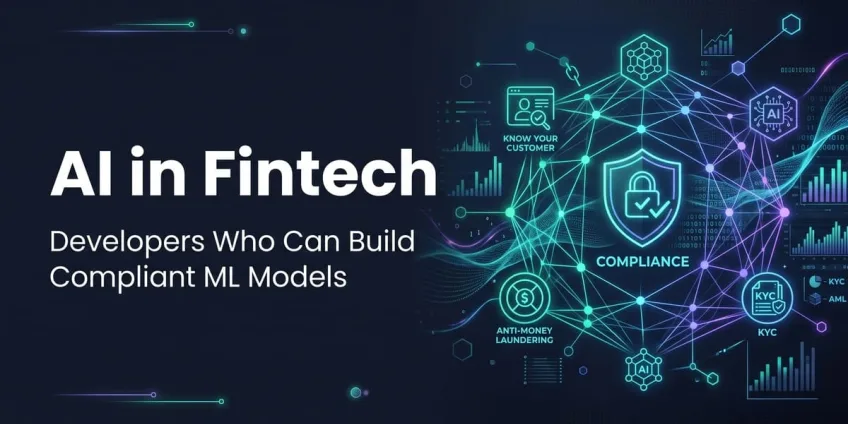
AI in Fintech: Where to Find Developers Who Can Build Compliant ML Models
Where to HirePublished on by Alex Korniienko • 11 min read read
- The Problem: Fintech Doesn't Have an AI Skills Gap - It Has a Compliance-Fluency Gap
- The Cost: What a Generic AI Hire Actually Costs a Fintech
- The Shift: Hire for Regulatory Fluency, Then Widen the Map
- The System: How to Vet a Compliance-Aware ML Engineer
- Proof: What This Looks Like in Practice
- The Vision: What Changes When You Hire This Way
- Frequently Asked Questions
- The Bottom Line
The talent fintechs actually need isn't a better model architect - it's an engineer who can defend every prediction in front of a regulator.
Finding developers who build compliant ML models means looking past general AI talent pools toward engineers with direct exposure to regulated environments - credit underwriting, fraud detection, or anti-money-laundering systems specifically. The fastest routes run through specialized vetting platforms, staff-augmentation firms with a financial-services track record, and talent hubs such as Central and Eastern Europe, where banking-sector ML experience is comparatively common. Qualification here comes down to one thing: the ability to document a model's reasoning well enough to survive a regulator's audit.
Most fintech leaders hire for the wrong half of this problem. They screen for machine learning skill first and hope compliance understanding arrives later, filtered through a compliance team acting as translator. It rarely works that way. A credit model that can't produce a specific, defensible reason for a denial creates more than an engineering headache - under the Equal Credit Opportunity Act and Regulation B, that gap becomes a liability the legal department inherits, usually discovered only after a denied applicant has already asked why.
What follows is the smaller, harder-to-source search behind that problem: not how to find another AI engineer, but how to find one who can build a compliant one.
The Problem: Fintech Doesn't Have an AI Skills Gap - It Has a Compliance-Fluency Gap
Fintech has no shortage of engineers who can build a gradient-boosted model or fine-tune a transformer. What it lacks is engineers who understand why that model needs a paper trail before it ever touches a customer.
Five areas concentrate almost all of the compliance complexity. Credit scoring and underwriting sit under the Equal Credit Opportunity Act, Regulation B, and the Fair Credit Reporting Act - rules that require specific, accurate reasons whenever an algorithm denies an application, something non-linear models struggle to produce without deliberate design work. Fraud detection systems carry their own fair-lending exposure: identity-verification tools that perform unevenly across skin tones, or behavioural triggers that correlate with protected characteristics, can turn a security feature into a discrimination claim. Algorithmic trading and asset management answer to market-conduct and risk-management rules that predate AI but weren't written with it in mind. Customer service automation raises UDAAP concerns the moment a chatbot denies a claim or freezes an account without a clear path to human review. And AML and sanctions-screening systems must, in the words of a February 2026 regulatory analysis from Venable LLP, "remain reasonably designed to detect suspicious activity" - a standard that's straightforward to state and genuinely difficult to prove for a black-box model.
Regulators are converging on the same expectation from several directions at once, according to a September 2025 regulatory analysis from Moody's. The Federal Reserve's SR 11-7 has governed model risk management in US banking for over a decade and now, in practice, extends to ML systems. Canada's OSFI Guideline E-23 broadens the definition of "model" to cover any algorithm that uses data to generate an output, with full implementation due by May 2027. Colorado's AI Act, effective June 30, 2026, classifies AI-driven credit and fraud decisions as "consequential," triggering mandatory impact assessments. The UK's Prudential Regulation Authority, the Reserve Bank of India, and the US National Institute of Standards and Technology have each published their own expectations for explainability and human oversight. None of these frameworks demands a specific algorithm. All of them demand a developer who can explain, in plain language, exactly what a model is doing and why.
The Cost: What a Generic AI Hire Actually Costs a Fintech
The direct cost shows up first in the calendar. A senior AI engineering search already runs 90 to 120 days against roughly 25 days for a typical software role - a three-to-five-times gap driven mostly by scarcity, not by employer pickiness. Narrow that search further to candidates who also understand model governance and validation, and the timeline stretches again, often past the point where a product roadmap can absorb the delay.
The indirect cost is worse, and it rarely shows up until later. A model built without documentation discipline doesn't fail during development. It fails during the first regulatory exam, the first disputed denial, or the first internal audit - at which point re-architecting the system costs far more than building it correctly the first time would have. Gartner's most recent survey of 183 finance leaders found that 59% were already using AI in their finance function as of mid-2025, up only slightly from 58% the year before - a plateau the survey's authors linked partly to unresolved governance and trust concerns, not a lack of appetite. Fintechs that keep hiring generalist ML talent and treating compliance as an afterthought are, in effect, choosing to pay this cost later, in a currency of legal exposure and rebuild time rather than salary.
There's a strategic cost too. Every month spent explaining a model to an examiner instead of shipping the next feature is a month a better-prepared competitor spends pulling ahead. In a market where 88% of organizations report using AI in some form, according to McKinsey's 2026 State of AI survey, differentiation increasingly comes not from having a model but from being able to prove, quickly and credibly, that the model is safe to keep running.
The Shift: Hire for Regulatory Fluency, Then Widen the Map
The instinct to hire locally, in San Jose or New York, made sense when the talent pool for advanced ML was genuinely concentrated there. It makes less sense now that the specific skill fintechs need - ML engineering plus regulatory literacy - is scarce everywhere, including in those hubs. Demand for AI engineers has outpaced supply by roughly 3.2 to 1 as of mid-2026, according to FutureProofing.dev's July 2026 analysis of job-posting and candidate data. Waiting for that ratio to improve in one zip code isn't a strategy.
The more workable shift is to decouple location from qualification and search where regulated-industry ML experience is comparatively dense. Central and Eastern Europe has spent two decades building outsourced and nearshore teams for Western European and UK banks, which means a meaningful share of its senior ML talent has already worked inside a model-governance process, not just inside a Jupyter notebook. A 2026 regional compensation guide from Nortal put expert-level ML and AI engineering pay in Poland and Bulgaria at roughly €8,000-€9,500 per month, with Ukrainian mid-to-senior specialists in a comparable €3,000-€7,900 range - a fraction of the $190,000-$260,000 senior-level band reported for the US market by salary-benchmarking site Optiveum in early 2026, even before accounting for the premium US compliance-fluent candidates typically command.
Latin America adds a third option, though the data here is thinner: hourly contracting rates in the region run roughly $50-90 for standard ML work, per Optiveum's 2026 country comparison, with fintech-specific banking exposure less consistently documented than in CEE. None of this makes distance a substitute for scrutiny. A developer sourced from a wider talent map still has to demonstrate that regulatory grounding directly - the location just widens the number of qualified people you're choosing from.
The System: How to Vet a Compliance-Aware ML Engineer
A resume won't tell you whether a candidate can defend a model to an examiner. A short, specific set of questions will. Ask a candidate to walk through how they'd generate an adverse-action reason from a non-linear credit model, not whether they've heard of SHAP or LIME - the tool name is easy to memorize, the reasoning is not. Ask what they'd document before a model goes live, and listen for independent validation and drift monitoring rather than just accuracy metrics. Ask about a time they had to explain a model's behavior to someone outside engineering - legal, a regulator, an auditor - and whether that person actually understood the answer.
The table below separates what a generalist ML hire typically brings from what a regulation-literate one adds on top of it.
| Capability | Generalist ML engineer | Compliance-fluent ML engineer |
| Model accuracy and architecture | Strong | Strong |
| Adverse-action / explainability output | Rarely built by default | Designed in from the start |
| Familiarity with SR 11-7 or equivalent MRM frameworks | Uncommon | Expected |
| Bias testing across protected classes | Ad hoc, if done at all | Part of standard validation |
| Documentation for audit/regulator review | Minimal | Built alongside the model |
| Prior work in a regulated industry | Not required | Direct experience preferred |
Weight the interview toward the middle four rows. Model accuracy is table stakes; every serious candidate will have it. The rows that actually predict whether a hire survives a regulatory exam are the ones about documentation, bias testing, and prior exposure to a governance process - and they're also the rows most hiring managers forget to ask about, because a standard technical interview doesn't surface them. This is the combination worth screening for specifically when sourcing pre-vetted AI engineers rather than pulling from a generic freelance pool.
Proof: What This Looks Like in Practice
Platforms built specifically to vet for this combination tend to filter harder than general-purpose talent marketplaces, and the numbers show it. Cortance runs a five-stage vetting process for vetted fintech developers in which 21% of applicants pass all five stages - roughly four in five don't make it through, which is closer to the point than a limitation. Around 600 developers currently hold active, signed contracts with Cortance rather than sitting in a registered-but-unverified profile, and a first shortlist typically arrives within 30 minutes during business hours, or by 11 am the next business day otherwise.
Rates on a platform like this tend to land around $30-60 an hour depending on seniority and stack, which sits well below the $190,000-plus annual US benchmark for senior ML talent even after accounting for full-time-equivalent hours - useful context for a CTO comparing a nearshore contract against a local full-time hire. The mechanism that matters more than the rate, though, is what the vetting stages actually check: not just whether a candidate can build a model, but whether they can explain one under scrutiny.
A second, independent data point worth watching: Second Talent's review of 2025 Bureau of Labour Statistics projections shows data-scientist roles growing 35% through 2035, more than three times the 4% average across all occupations. Supply isn't catching up to demand anytime soon, in fintech or elsewhere, which makes the sourcing strategy - not just the interview questions - part of the long-term answer.
| Region | Senior ML engineer, approximate annual pay | Comparable hourly contract rate |
| United States | $190,000-$260,000+ | $100-$250+ |
| Central & Eastern Europe (expert level) | €96,000-€114,000 | $40-$70 |
| Latin America | Not consistently reported | $50-$90 |
The Vision: What Changes When You Hire This Way
A credit model that ships with its adverse-action logic already built in doesn't need a scramble the week before an exam - the documentation already exists, because the person who built the model wrote it as part of building the model, not after. A fraud-detection system reviewed for demographic parity before launch doesn't generate a discrimination complaint six months in. An AML pipeline with a named owner who can walk an examiner through every flagged transaction doesn't turn a routine review into a multi-week remediation project.
None of this requires a bigger team or a slower roadmap. It requires one different hiring criterion, applied consistently, and a broader map of where to find the person who meets it.
Frequently Asked Questions
- What makes an AI model "compliant" in fintech? A compliant model produces decisions a human can explain and defend, keeps records of how it was built and validated, and gets tested for uneven impact across protected groups before and after launch. Compliance works best as a property built into the model from the design stage, not a feature bolted on afterwards.
- Which regulations affect AI and ML models in financial services? The specific set depends on the use case and jurisdiction, but the most common in the US include the Equal Credit Opportunity Act and Regulation B for lending, the Fair Credit Reporting Act for credit-scoring disclosures, and the Federal Reserve's SR 11-7 for model risk management. Colorado's AI Act, effective June 30, 2026, adds state-level requirements for consequential automated decisions.
- Where can fintech companies find ML engineers who understand financial regulation? Specialised vetting platforms and staff-augmentation firms with a financial-services track record are the fastest route, followed by talent hubs where banking-sector outsourcing has been common for years - Central and Eastern Europe in particular, given its long history serving Western European and UK banks.
- Is it safe to hire remote or offshore developers for regulated fintech AI work? Yes, provided the vetting process directly checks for regulatory fluency and the contracting structure addresses data residency and access controls. Location doesn't determine compliance competence - the individual developer's background and the platform's screening rigour do.
- What's the real difference between a generalist ML engineer and one who builds compliant models? A generalist optimises for accuracy and ships a working model. Someone who builds compliant models does the same work but adds explainability, bias testing, and audit documentation from the start, so the system can survive a regulator's review without a redesign.
- Does hiring for compliance fluency cost more than hiring a generalist ML engineer? Not necessarily in salary terms, but the calculation should include the cost of not hiring for it - remediation, delayed launches, and legal exposure when a model fails an audit. Regional sourcing, particularly from Central and Eastern Europe, can offset even a modest premium for the added expertise.
The Bottom Line
The fintech AI talent shortage has less to do with machine learning skill than with something rarer: engineers who can build compliant ML models and then stand behind them in front of someone whose job is to find the flaw. That combination is rare enough that widening the search - past the usual hubs, past generic AI job boards, toward platforms and regions built around vetting for exactly this - beats waiting for the local market to produce more of it.
Start the next fintech AI hire with one question before any technical screen: can this candidate document a model's decision well enough for someone outside engineering to trust it? Everything else on the list is easier to teach.
Related Articles

The Best Countries to Hire Remote Developers in 2026: Evidence, Risks, and Proven Value
Most companies pick a country based on rate cards. The ones that regret it picked the wrong factor first.
- #comparison
- #teamscaling
- #smarthiring
- #findadeveloper
- #teamextention
- #softwaredevelopment
- #talentprovider
- #upworkalternative
- #offshore
- #nearshore
Upwork & Fiverr Alternatives for Startups That Can't Afford a Bad Hire
Upwork has 18M freelancers. Finding a good one is your problem. For startups where one bad hire can derail a fundraise, that's the wrong model.
- #startup
- #platform
- #cooperation
- #findadeveloper
- #teamextention
- #Outstaffing
- #upwork
- #fiver
- #upworkalternative