OpenClaw AI Agent: How to Deploy, Configure, and Build Scalable Automation in 2026
Digital TransformationPublished on by Alex Korniienko • 11 min. read
- The Numbers Behind the Hype: Why This Growth Is Different
- How OpenClaw Actually Works: The Architecture That Matters
- OpenClaw Deployment: Docker Setup in Five Steps
- Step 1: Create the project directory and compose file
- Step 2: Create your .env file
- Step 3: Build and start the container
- Step 4: Access the interface
- Step 5: Connect a messaging channel
- Which Model Connect to OpenClaw: The 2026 Leaderboard
- How Many Skills and LLM Models You Can Combine - and Where the Real Limits Are
- LLM providers: simultaneous, no hard cap
- Skills: no hard limit - but a practical ceiling exists
- Multi-agent and Lobster: where the actual ceiling is
- OpenClaw Response Speed: What Determines Time to Result
- Simple queries: seconds
- Multi-step workflows: minutes
- Complex autonomous tasks: 10–60 minutes
- The heartbeat problem: a hidden cost driver
- Pricing by Setup Type: From $0 to $330 per Month
- What Problems OpenClaw Solves for Businesses - and Which Setups Work
- Email triage and communication management
- Automated reporting and KPI compilation
- Client and employee onboarding automation
- DevOps and engineering workflow automation
- Sales automation and lead management
- Top Skills to Install First: The ClawHub Priority List
- Security: What Goes Wrong and How to Prevent It
- What's Coming: NemoClaw and the Enterprise Roadmap
- What This Means for Teams Building on OpenClaw
- FAQ
- Conclusion
The fastest-growing open-source project in history is also a production deployment decision - here's the complete system view.
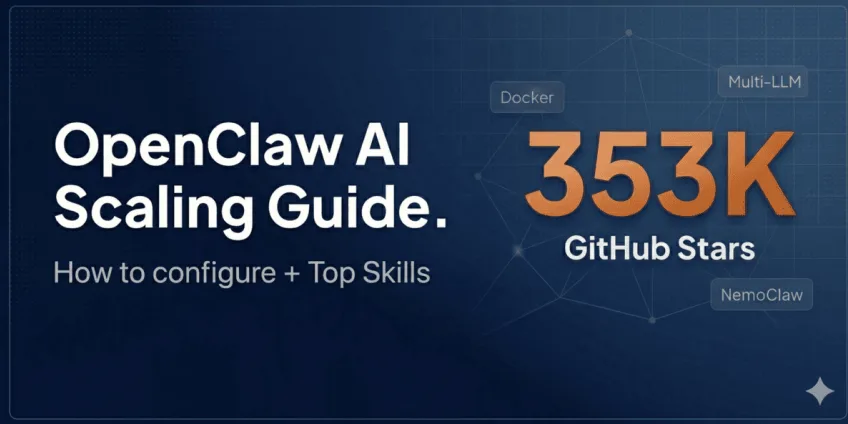
On March 3, 2026, OpenClaw crossed 250,829 GitHub stars, surpassing React's record that had stood unchallenged for over a decade. React took more than ten years to reach that milestone. OpenClaw did it in 60 days (star-history.com, March 2026). By April 2026, the number stood at 346,000 - still climbing, with 38 million monthly visitors and 3.2 million active users.
That growth is a signal worth taking seriously. Developers don't start a repository at that velocity because they're impressed by marketing. They star it because it solves a problem they've had for years: a locally-run, privacy-first AI agent that actually takes actions - manages files, calls APIs, writes code, operates messaging channels - rather than generating text about taking them.
OpenClaw is an open-source AI agent platform that connects large language models to your local environment, APIs, databases, and messaging channels through a skill-based architecture, enabling autonomous multi-step workflow automation without custom integration code. Deploying a working instance requires Docker, an LLM API key, and a messaging channel token; the process takes under 30 minutes. Practical business value comes from three decisions that follow deployment: which model powers the agent, which of ClawHub's 44,000+ skills you install, and how you configure multi-model routing to prevent costs from unexpectedly compounding.
This guide covers all of it - architecture, deployment, model selection with current leaderboard data, how many skills and models you can combine, business use cases with verified ROI figures, real pricing by setup type, the top skills worth installing first, and where the platform is heading.
The Numbers Behind the Hype: Why This Growth Is Different
Most viral open-source projects spike once and plateau. OpenClaw's growth curve has no precedent.
The project launched as "Clawdbot" in November 2025 - Peter Steinberger's weekend experiment in building an AI that could "actually do things." Anthropic filed a trademark complaint over the phonetic similarity to "Claude." The project briefly became "Moltbot" on January 27, 2026, then "OpenClaw" three days later. Neither name change slowed the momentum. Launch day generated 9,000 stars. Three days later: 60,000. Two weeks in: 190,000 - a faster accumulation than any project in GitHub's history at that point.
On February 14, Steinberger announced he was joining OpenAI to lead their agent efforts. The project moved to an independent 501(c)(3) foundation. OpenAI sponsors the foundation but does not control it - the MIT license and model-agnostic architecture remain intact. Both OpenAI and Meta had made acquisition offers before the deal closed.
| Date | Milestone |
| November 2025 | Published as Clawdbot - Peter Steinberger's weekend project |
| January 27, 2026 | Renamed Moltbot after Anthropic trademark complaint |
| January 29, 2026 | Renamed OpenClaw; goes viral - 9K stars on launch day |
| February 2026 | 100K stars; fastest repo growth in GitHub history |
| February 14, 2026 | Steinberger joins OpenAI; project moves to independent foundation |
| February 24, 2026 | 224K stars - surpasses Linux kernel (218K) |
| March 3, 2026 | 250,829 stars - surpasses React (243K); GitHub's most-starred software project |
| March 16, 2026 | NVIDIA announces NemoClaw at GTC 2026 in Jensen Huang's keynote |
| April 2026 | 346K stars; 38M monthly visitors; 3.2M active users; 44K+ ClawHub skills |
At GTC 2026 on March 16, Jensen Huang devoted a significant portion of his keynote not to chips but to OpenClaw. His framing was direct: "Mac and Windows are the operating systems for the personal computer. OpenClaw is the operating system for personal AI." He concluded with a mandate that has circulated widely in enterprise circles since: "Every company in the world today needs to have an OpenClaw strategy". When the CEO of the world's leading AI infrastructure company positions a framework alongside Linux and Kubernetes in historical importance, it stops being a developer curiosity and becomes a strategic planning item.
How OpenClaw Actually Works: The Architecture That Matters
Most agents are stateless. They answer a question and forget it. OpenClaw's design inverts this: the agent maintains a persistent workspace with structured memory files - MEMORY.md, SOUL.md, HEARTBEAT.md - stored locally at ~/.openclaw/workspace/. Every session builds on the last. The agent knows your project names, your communication preferences, and what you were working on yesterday.
The execution loop is deterministic:
- Input arrives via chat channel;
- The agent interprets the objective using the connected LLM;
- The agent decides whether a tool is required;
- Tool executes - API call, database query, shell command, or MCP call;
- Result returns to the agent;
- Agent evaluates: task complete, or continue?;
- Final output delivered.
The key architectural decision is where tools come from. OpenClaw supports two integration paths: native Skills installed from ClawHub, and MCP servers connected through the Model Context Protocol. Skills are pre-packaged instruction sets and API wrappers - install with one command, and the agent gains a new capability. MCP servers expose structured tools from any external service that implements the standard. As of February 2026, 500+ community-built MCP servers cover GitHub, Notion, Slack, Linear, Jira, Stripe, Shopify, and all major databases. MCPorter - OpenClaw's MCP bridge - supports simultaneous connections to an unlimited number of MCP servers.
OpenClaw Deployment: Docker Setup in Five Steps
Running OpenClaw without Docker on a personal or work machine is a security decision most practitioners advise against. The agent operates with system-level access, and an unconstrained instance on bare metal can reach personal files, system configurations, and credentials. Docker provides an isolation boundary that makes production use reasonable.
Step 1: Create the project directory and compose file
Create a folder for your OpenClaw files and add a compose.yaml:
yaml
services:
openclaw:
container_name: openclaw
image: ghcr.io/openclaw/openclaw:latest
ports:
- "18789:18789"
environment:
OPENAI_API_KEY: ${OPENAI_API_KEY}
ANTHROPIC_API_KEY: ${ANTHROPIC_API_KEY}
OPENROUTER_API_KEY: ${OPENROUTER_API_KEY}
command: ["node", "openclaw.mjs", "gateway",
"--allow-unconfigured", "--bind", "lan"]
restart: unless-stopped
YAML hierarchy is strict - spacing errors break the build silently.
Step 2: Create your .env file
In the same directory:
OPENAI_API_KEY=""
ANTHROPIC_API_KEY=""
OPENROUTER_API_KEY=""
Fill only the keys for providers you plan to use.
Step 3: Build and start the container
bash
docker compose up -d --build
First build takes 2–5 minutes. The container starts as a background service on completion.
Step 4: Access the interface
Navigate to http://localhost:18789. Run /models to list available providers; /model [name] to activate one. This is also where you configure channels, install skills, and review agent logs.
Step 5: Connect a messaging channel
Create a Telegram bot via BotFather, copy the token, and add it to your OpenClaw configuration through the interface. Discord, WhatsApp, Slack, Matrix, Signal, and iMessage via BlueBubbles follow the same pattern. OpenClaw supports 20+ messaging platforms.
Which Model Connect to OpenClaw: The 2026 Leaderboard
OpenClaw is model-agnostic. That flexibility makes model selection the most consequential configuration decision after deployment.
The Arena.ai Text Leaderboard - based on 5,754,368 human preference votes across 338 models, as of April 7, 2026 - provides the most current independent benchmark for general capability:
| Rank | Model | Score | Provider | Input / Output ($/M) | Context |
| 1 | claude-opus-4-6-thinking | 1503 | Anthropic | $5 / $25 | 1M |
| 2 | claude-opus-4-6 | 1497 | Anthropic | $5 / $25 | 1M |
| 3 | gemini-3.1-pro-preview | 1493 | $2 / $12 | 1M | |
| 4 | grok-4.20-beta1 | 1490 | xAI | N/A | N/A |
| 5 | gemini-3-pro | 1486 | $2 / $12 | 1M | |
| 6 | gpt-5.4-high | 1484 | OpenAI | $2.50 / $15 | 1.1M |
| 10 | gemini-3-flash | 1474 | $0.50 / $3 | 1M |
Two tiers apply in practice. Reasoning-heavy workflows - complex code generation, multi-step research synthesis, architectural decisions - warrant a top-five model. Claude Opus 4.6 or Gemini 3.1 Pro deliver the strongest output; the cost is material at scale but justified for high-stakes automation.
Routine automation - email triage, report generation, calendar management, Slack summaries - runs well on Gemini 3 Flash or mid-tier OpenRouter models at a fraction of the cost. Budget-sensitive deployments using Kimi, Mistral, and OpenRouter alternatives effectively cover more than 90% of typical use cases.
OpenClaw lets you switch the active model per session with /model, so running premium models for complex reasoning tasks and cheaper ones for routine automation within the same deployment is entirely practical.
How Many Skills and LLM Models You Can Combine - and Where the Real Limits Are
OpenClaw has one of the most flexible provider and tool combinations of any agent platform available today. But "unlimited flexibility" is a marketing phrase. The actual limits are specific, and understanding them before deployment saves time and money.
LLM providers: simultaneous, no hard cap
OpenClaw supports 12+ LLM providers out of the box - Anthropic, OpenAI, Google, xAI, OpenRouter, Ollama for local models, MiniMax, Kimi, Mistral, DeepSeek, GLM/Zhipu, and any OpenAI-compatible API as a custom provider. All can be connected simultaneously. In openclaw.json, each provider gets its own API key and alias. Switching between them is a /model [alias] command or automatic via routing config.
The "Brains & Muscles" architecture lets you assign different models to different task types within a single deployment:
| Agent role | Recommended model | Why |
| Primary (complex tasks) | Claude Opus 4.6 / Gemini 3.1 Pro | Best reasoning and tool-calling quality |
| Heartbeat (every 30 min) | Gemini 3 Flash / DeepSeek V3.2 | Simple keep-alive check - doesn't need flagship capability |
| Sub-agents (parallel work) | GLM-5-Turbo / Kimi K2.5 | Purpose-built for agent workflows, significantly lower cost |
| Local processing (sensitive data) | Llama 3.3 70B via Ollama | Data never leaves the machine |
| Fast queries (calendar, weather) | Gemini 3 Flash / GPT-4o mini | Lowest latency, lowest per-token cost |
This isn't theoretical. It's the standard optimization practice for production deployments. VelvetShark (2026) documented that multi-model routing cuts API costs by 50–80% without reducing output quality on the tasks that matter.
Skills: no hard limit - but a practical ceiling exists
There is no technical cap on how many ClawHub skills you can install simultaneously. MCPorter - OpenClaw's MCP bridge - supports connections to an unlimited number of MCP servers at once. In practice, a single deployment can carry dozens of active skills and multiple MCP servers without configuration errors.
The real constraint is the context window. Each installed skill adds its instruction set and tool schemas to the agent's system prompt. At high skill counts, the context saturates, and the model begins to ignore or confuse tools. Documented community practice: up to 15–20 active skills per agent before quality degrades noticeably. The solution is specialization - one agent handles DevOps skills, another manages CRM and communications, a third runs the content pipeline - with Lobster orchestrating between them.
Multi-agent and Lobster: where the actual ceiling is
Lobster - OpenClaw's built-in workflow engine - supports arbitrarily complex YAML pipelines with dozens of sub-agents, loops, conditions, and task delegation. The technical constraint: maxSpawnDepth defaults to 1, maximum 2. An agent at depth 2 cannot spawn further children. For complex deterministic pipelines - code → review → test - this limitation is resolved through Lobster workflow steps rather than sessions_spawn, a pattern that a community contributor formalized and contributed back as loop support for Lobster.
Flagship models (Claude 4.6, OpenAI GPT-5.x) can sustain autonomous execution on complex tasks for 30–60 minutes without human intervention. For mid-tier models - MiniMax M2.5, GLM-5, Kimi K2.5 - documented performance sits at 95%+ of flagship quality at roughly one-quarter of the per-token cost.
OpenClaw Response Speed: What Determines Time to Result
OpenClaw's speed depends on three variables: task type, the model selected, and whether the task runs reactively (in response to a message) or proactively (on a schedule).
Simple queries: seconds
A direct request via Telegram or Slack - "what's on my calendar tomorrow?" or "send a summary of the latest PR" - returns a result in 3–10 seconds on Gemini 3 Flash or Kimi K2.5. Latency is determined by the provider's API response time and a single tool call execution.
Multi-step workflows: minutes
Tasks involving 3–10 tool calls - email triage plus CRM update plus Slack summary - complete in 1–5 minutes. This is the task class where OpenClaw delivers its strongest ROI: one instruction replaces a chain of manual operations.
Complex autonomous tasks: 10–60 minutes
WildClawBench - a benchmark running inside a live OpenClaw environment with a real browser, filesystem, and email - shows that complex real-world tasks require 10 to 60+ tool calls. The highest overall score across all tested models was 0.52, meaning no frontier model passes all 60 tasks. That's a useful signal: genuinely ambiguous, multi-domain tasks from the real world remain challenging for current models.
Still, documented long-running autonomous sessions show flagship models sustaining complex work for 30–60 minutes without intervention. For production deployments, this means a single agent can complete a full cycle - data collection, analysis, report generation, distribution - within one scheduled run without any manual step.
The heartbeat problem: a hidden cost driver
Heartbeat is OpenClaw's background mechanism that fires an LLM request every 30 minutes by default to check for scheduled tasks. Each request consumes 8,000–15,000 input tokens. On flagship models (Opus 4.6 at $5/M input tokens), heartbeat alone costs $30–100/month before any actual agent work happens. The standard fix: route heartbeat to Gemini 3 Flash ($0.50/M) or DeepSeek V3.2 ($0.53/M). That single config change cuts monthly API spend by 40–60% with zero effect on agent output quality.
Pricing by Setup Type: From $0 to $330 per Month
OpenClaw is free software. But "free to download" and "free to run" are different claims. Three unavoidable cost pillars apply to every deployment: infrastructure (VPS or managed hosting), LLM API tokens, and maintenance time. Most pricing estimates count only the first.
| Setup | Infrastructure | LLM API / mo | Total / mo | Best for |
| Free - Oracle Cloud Free Tier + Gemini free tier | $0 (4 ARM vCPU, 24 GB RAM) | $0 | $0 | Testing, low-volume personal use |
| Ultra budget - Oracle Cloud + GPT-OSS-120B | $0 | $2–5 | $2–5 | Regular daily use; tool calling at o4-mini level |
| Personal daily - Hetzner CX22 + budget model | $4–7 | $10–20 (Gemini Flash or DeepSeek V3.2) | $17–27 | Personal assistant: email, calendar, web search |
| Active solo - Hetzner + Claude Sonnet 4.5 | $4–7 | $30–50 | $37–67 | Active daily automation, 5–15 tasks/day |
| 1-click managed - xCloud / RunMyClaw / Hostinger | $24–45 all-in | BYOK (separate) | $24–45 + API | Teams without DevOps - zero configuration |
| Power user (unoptimized) - Hetzner + Opus 4.6 | $4–7 | $200–320+ | Up to $330 | Intensive coding, complex autonomous workflows |
| Power user (optimized) - Hetzner + multi-model routing | $4–7 | $50–80 | $60–90 | Same workload; heartbeat on Flash, sub-agents on DeepSeek |
| Enterprise / NemoClaw - RTX workstation + NVIDIA Nemotron local | Hardware (one-time) or DGX Spark | $0 local inference | Hardware-based | Regulated industries, full data privacy, production security |
The heartbeat line is the most common source of bill shock. Default 30-minute heartbeat on Opus 4.6 costs $30–100/month by itself. One config change routes it to Gemini 3 Flash and eliminates 90% of that line item.
Managed hosting is cheaper for most teams. Self-hosting on Hetzner looks cheaper at the VPS invoice level. Add 4–8 hours of monthly maintenance at any realistic hourly rate and managed hosting at $30–45/month all-in becomes the lower total cost for anyone whose time is worth more than $15/hour.
Multi-model routing saves 50–80%. A documented case: a light user without routing optimization - $200/month in API costs. After configuring multi-model routing - $70/month. That's 65% savings from a 15-minute config change.
Chinese LLM providers offer the lowest per-token cost for agent workloads. Zhipu GLM-5-Turbo Lobster Package: Entry plan at $5.66/month for 35M tokens (~$0.16/M tokens). MiniMax M2.5 costs roughly four times less than GPT-5.x Codex while achieving 95%+ of flagship performance on standard agent tasks (36kr.com, 2026; cometapi.com, 2026). These are specifically optimized for OpenClaw's tool-calling patterns - not general-purpose chat models repurposed for agents.
What Problems OpenClaw Solves for Businesses - and Which Setups Work
OpenClaw's value for businesses isn't abstract. Enterprise adopters report specific, measurable outcomes across five workflow categories already running in production.
Email triage and communication management
Problem: Knowledge workers spend 2+ hours daily on email triage - sorting, prioritizing, drafting routine responses - work that consumes attention without requiring judgment.
What OpenClaw does: The agent reads incoming email via IMAP, classifies messages by urgency and topic, drafts responses for review, routes items to the relevant team member or CRM, and surfaces a prioritized summary via Telegram or Slack each morning.
Verified outcome: Early enterprise adopters report reducing email processing time from 2+ hours daily to under 25 minutes. Automated CRM note logging after sales calls saves 15–20 minutes per call.
Setup: Docker + IMAP skill + CRM skill (HubSpot or Salesforce) + Slack or Telegram channel. Draft-only mode until output quality is confirmed.
Automated reporting and KPI compilation
Problem: Weekly reporting requires pulling data from four to six disparate sources - CRM, analytics, ad platforms, project management - a process that takes 4–6 hours per cycle.
What OpenClaw does: A scheduled agent collects data from all connected sources, generates a formatted report with trend analysis, and delivers it via email and Slack at a configured time.
Verified outcome: Report generation reduced from 4–6 hours to 5 minutes in documented enterprise deployments, with consistent trend analysis that manual processes often omit.
Setup: Docker + Google Analytics MCP + CRM skill + Slack skill + Notion or Google Sheets for output. Scheduled trigger via Lobster workflow.
Client and employee onboarding automation
Problem: Onboarding involves five to eight sequential steps - folder creation, account provisioning, email sequences, calendar invites, CRM updates - each requiring a human to initiate.
What OpenClaw does: One message triggers the entire sequence: folder creation, email sending, CRM record creation, calendar invites, and access provisioning.
Verified outcome: Processes that previously took 3–4 hours of admin time compress to 15-minute automated sequences with zero manual errors. One landscaping company reduced lead response time from hours to minutes, reporting improved conversion rates through automated qualification and follow-up.
Setup: Docker + Gmail skill + CRM skill + Google Calendar MCP + Notion or Google Drive. Human approval checkpoint before CRM write is recommended for first deployments.
DevOps and engineering workflow automation
Problem: Dependency auditing, CI monitoring, codebase reviews, and infrastructure maintenance consume disproportionate senior engineer time when done manually.
What OpenClaw does: A scheduled agent scans dependency files, cross-references against vulnerability databases, prioritizes by severity, and reports findings. A separate agent monitors CI failures, analyzes logs, and can commit targeted fixes autonomously. Codebase reviews exceeding 5,000 lines - with refactoring suggestions and opened issues - are documented community deployments.
Verified outcome: Community benchmarks indicate 10–20 hours weekly time savings on repetitive engineering tasks, with some teams reporting full automation of dependency auditing and CI monitoring.
Setup: Docker + GitHub MCP + claude-code-skill + agent-audit-trail. NemoClaw strongly recommended before connecting to production repositories.
Sales automation and lead management
Problem: CRM hygiene, lead qualification, follow-up sequences, and proposal generation are time-sensitive but formulaic.
What OpenClaw does: The agent qualifies inbound leads, generates personalized outreach, logs all interactions to the CRM, and follows up automatically if no response arrives within a defined window.
Setup: Docker + HighLevel or HubSpot skill + Brave Search for prospect research + Notion for deal tracking + Telegram or WhatsApp for agent interaction.
Which setup fits which company stage:
| Company profile | Recommended entry point | Model tier | Key skills |
| Solo operator/freelancer | Single agent, Telegram, 3–5 skills | Gemini 3 Flash or OpenRouter | Email, calendar, web search |
| Small team (5–20 people) | One well-defined process first; expand from there | Claude Opus 4.6 for reasoning; Gemini Flash for routine | CRM, Slack, reporting |
| Agency / multi-client | Multi-agent per client function, governed workflows | Claude Opus 4.6 | CRM, GitHub, email, content pipeline |
| Enterprise / regulated | NemoClaw stack | Local NVIDIA Nemotron or Claude | NemoClaw policy-as-code required |
Top Skills to Install First: The ClawHub Priority List
ClawHub grew from 5,700 skills in early February to 44,000+ by April 2026 - over 65% of skills wrap MCP servers. The following categories cover the highest-value capabilities for most deployments, with a note on each that most tutorials omit.
Communication: Slack - sends, edits, pins, and reads messages via Clawdbot. Use mention-only mode in busy channels; unrestricted channel reading burns tokens rapidly and can surface sensitive context outside its intended scope. Gmail/IMAP - email drafting and triage. Start draft-only, promote to send after confirming output quality.
Developer workflow: GitHub MCP - repository management, issue tracking, PR review, CI/CD status. This is one of the most valuable integrations for engineering teams: one natural-language instruction can produce a bug report, search the relevant code, and create a tagged issue with full context. claude-code-skill - terminal and code execution via MCP. agent-audit-trail - tamper-evident, hash-chained action logging. Not optional for any production deployment.
Knowledge and research: openclaw-free-web-search - private search with self-hosted SearXNG and multi-source validation, with a trust score per result. chaos-mind - vector-indexed memory for agents managing large knowledge bases or needing to retrieve specific facts from months of accumulated context.
Productivity and file management: Fast.io MCP - 19 tools for file management, RAG-powered document search, and multi-agent coordination with 50GB free storage. Calendar management - Google or Apple, natural-language scheduling.
Security: Clawdbot Security Check - audits configuration for exposed credentials and overpermissioned skills before production use. Note: ClawHub underwent a major security cleanup in early 2026, removing 2,400+ suspicious packages after a documented supply chain incident. Install only officially sponsored or well-reviewed skills with transparent source code.
Security: What Goes Wrong and How to Prevent It
85% of enterprises are experimenting with AI agents. Only 5% have moved them to production. The gap isn't capability - it's the absence of audit trails, sandboxed execution, and policy-as-code controls that regulated industries require.
Four operational constraints that distinguish safe deployments from unsafe ones:
Dedicated accounts, not primary credentials. Create a secondary Google account with shared calendar access rather than connecting the agent to your primary account. The same applies to GitHub tokens - scope them to the specific repositories the agent needs, not the full organization.
Start with one channel and minimal skills. A Telegram channel with filesystem and email skills covers the majority of automation use cases. Add capabilities incrementally, with observation at each step.
Draft before send. For any skill that executes an outbound action - email send, Slack post, GitHub comment - configure it to produce a draft for human review before first live use. There have been documented cases of agents deleting entire email inboxes during automated cleanup workflows.
Docker in all cases. Local bare-metal deployments without containerization give the agent full access to the host system's credentials, configuration files, and personal data. There is no safe version of this for any serious deployment. Six CVEs were disclosed in early 2026, including a zero-click WebSocket hijacking vulnerability. Security researchers auditing accessible public instances found 63% had at least one critical misconfiguration.
What's Coming: NemoClaw and the Enterprise Roadmap
The gap between OpenClaw's community adoption and enterprise production deployment has been security. NVIDIA announced NemoClaw at GTC 2026 on March 16 - an enterprise security stack that installs on top of OpenClaw in a single command, adding the NVIDIA OpenShell runtime as a sandboxed execution environment (NVIDIA Newsroom, March 2026). NemoClaw is currently in early preview and described by NVIDIA as not production-ready.
What NemoClaw adds technically: Five stacked security layers between the OpenClaw agent and host infrastructure - sandboxed execution via OpenShell, network egress control via allowlist, minimal-privilege filesystem access, PII stripping via privacy router, and intent verification that blocks actions classified as credential access, persistence, or lateral movement. Every proposed agent action is intercepted before execution; all five checks must pass before the action runs.
A sample NemoClaw operator.yaml scopes filesystem access to specific directories, restricts network egress to an explicit allowlist, limits shell commands to approved tools, redacts PII fields before they reach external models, and blocks high-risk intent classes entirely. That's the level of control that makes a compliance conversation possible.
Hardware note: NemoClaw is optimized for NVIDIA RTX workstations and DGX systems running NVIDIA Nemotron models locally - enabling enterprise agents to operate on sensitive data without sending it to external APIs. The system is hardware-agnostic for non-NVIDIA hardware but loses the local inference advantage.
What's coming beyond NemoClaw: The OpenClaw Foundation roadmap includes a marketplace for Lobster workflow templates, native iOS and Android apps for agent management, and improved team-level permissions and audit logging. Cloud integrations and robotics deployments are expected by 2027, based on GTC 2026 demos and analyst reporting. Cisco independently announced DefenseClaw at RSAC 2026 - an open-source security framework that scans agent skills, verifies MCP servers, and inventories AI assets; it integrates with the NemoClaw stack for teams that need security coverage across both layers.
What This Means for Teams Building on OpenClaw
Configuring a personal OpenClaw deployment for email and calendar automation is a one-person project. Deploying it as part of a team's engineering or operations workflow - custom MCP servers, Lobster multi-agent pipelines, NemoClaw policy configuration for regulated data - requires engineers who understand agentic system design, MCP protocol implementation, and the failure modes that emerge when autonomous agents operate on production infrastructure.
The failure modes specific to autonomous agents in production - context saturation on large skill sets, tool call unreliability under load, prompt injection via connected MCP servers - require prior production agentic experience to anticipate before they appear on your deployment.
Pre-vetted AI engineers with production agentic system experience reduce ramp time from deployment to reliable output. For teams building custom LLM integrations on top of OpenClaw's architecture or extending it with internal tool connectivity, LLM developers who've shipped agentic systems in production understand the context window management, tool call reliability, and state persistence decisions that determine whether an autonomous agent performs consistently or behaves unpredictably.
FAQ
- What is OpenClaw? OpenClaw is an open-source AI agent platform that enables autonomous multi-step task execution - writing code, managing email, calling APIs, operating messaging channels - rather than generating text.
- How many LLM models and skills can OpenClaw use simultaneously? There is no hard technical limit on either. OpenClaw supports 12+ LLM providers connected simultaneously, each assigned to different task types via routing config - flagship models for complex reasoning, budget models for heartbeat and routine tasks. For skills, the practical ceiling is 15–20 active skills per individual agent before context window saturation degrades tool-calling accuracy. For larger configurations, the standard approach is specialized agents (DevOps agent, CRM agent, content agent) orchestrated by Lobster workflows, with each agent carrying only the skills relevant to its function.
- How do I install and deploy OpenClaw? Via Docker: create a compose.yaml pointing to ghcr.io/openclaw/openclaw:latest, add a .env file with your LLM API keys, run docker compose up -d --build, and access the interface at localhost:18789. Connect a messaging channel by adding a Telegram bot token or Discord credentials through the interface. The full process takes under 30 minutes.
- How fast does OpenClaw respond? Simple queries via Telegram return results in 3–10 seconds. Multi-step workflows involving 3–10 tool calls complete in 1–5 minutes. Complex autonomous tasks requiring 10–60+ tool calls - research synthesis, codebase reviews, multi-source reporting - take 10–60 minutes depending on model and task complexity. Flagship models (Claude 4.6, OpenAI GPT-5.x) sustain complex autonomous execution for up to 30–60 minutes without human intervention.
- How much OpenClaw cost to run per month? It depends entirely on infrastructure and model choices. The range spans from $0 (Oracle Cloud free tier + Gemini free tier) to $330/month (Hetzner VPS + Claude Opus 4.6 without routing optimization). The most common production setup for active personal or small team use runs $37–67/month. With multi-model routing - heartbeat and sub-agents on Gemini Flash or DeepSeek at $0.50–0.53/M tokens - the same workload costs $60–90/month. Managed hosting options (RunMyClaw, xCloud, Hostinger) run $24–45/month all-in, excluding your BYOK API costs.
- What is NemoClaw and when will it be production-ready? NemoClaw is NVIDIA's enterprise security stack for OpenClaw, announced at GTC 2026 on March 16. It adds five security layers via the NVIDIA OpenShell runtime: sandboxed execution, network egress allowlisting, minimal-privilege filesystem access, PII stripping, and intent classification. Currently in early preview - not production-ready. NVIDIA targets production readiness and cloud/robotics integrations for 2027.
- How many skills does OpenClaw support? ClawHub hosted 44,000+ community-built skills as of April 2026, up from 5,700 in early February - growth of roughly 8x in ten weeks (openclawvps.io, April 2026). Over 65% of skills wrap MCP servers. Additionally, OpenClaw connects to 500+ independent MCP servers. Note: ClawHub underwent a major security cleanup in early 2026, removing 2,400+ suspicious packages. Install only officially sponsored or well-reviewed skills in production.
- What kind of engineer do I need to deploy OpenClaw for a team? Personal deployments require Docker familiarity and basic terminal usage. Team deployments integrating OpenClaw with internal systems - custom MCP servers, multi-agent Lobster pipelines, NemoClaw policy configuration - require engineers with agentic system design experience, MCP protocol knowledge, and prior exposure to the failure modes of autonomous agents in production. These failure modes (context saturation at high skill counts, tool call unreliability under load, prompt injection via connected MCP servers) are not visible in controlled setups and require prior production agentic experience to anticipate.
Conclusion
OpenClaw is the most significant open-source infrastructure release of 2026. Its GitHub trajectory - from zero to GitHub's most-starred software project in 60 days, surpassing React, Linux, and every other non-aggregator project in the platform's history - is a developer vote on what the next era of software infrastructure looks like.
For businesses, the practical question is which workflows are worth automating and which setup profile fits your current stage. Email triage, automated reporting, onboarding sequences, and DevOps monitoring all have verified production outcomes. The platform supports unlimited simultaneous LLM providers, up to 15–20 active skills per agent before context degrades, and multi-agent pipelines of arbitrary complexity via Lobster - with real costs that range from $0 to $330/month depending on model choices and whether you've configured routing. Most teams land between $37 and $90/month once they've optimized heartbeat and sub-agent routing.
NemoClaw, NVIDIA's enterprise security layer, is in early preview and positions OpenClaw for regulated-industry deployment when it reaches production readiness. Every company, as Jensen Huang put it at GTC 2026, now needs an OpenClaw strategy.
Related Articles
Legacy ecommerce modernization: strategy, roadmap & risk
Most legacy platforms don't collapse in one incident. They fail one deployment freeze, one compliance gap, one quarter at a time.
Read article
Marketing Analysis Tools for Business: A Complete Guide 2026
Most marketing decisions are made on assumptions. Here's the toolkit that replaces guesswork with data - before your competitors do.
Read article
Technical GEO: How to Build a Website That AI Search Systems Can Actually Index
Your React SPA sends AI crawlers a blank page - making all GEO content investment invisible. Here's the full technical implementation for CTOs.
Read article