Technical GEO: How to Build a Website That AI Search Systems Can Actually Index
Digital TransformationPublished on by Alex Korniienko • 8 min read read
- The Rendering Problem: Why Your Framework Determines AI Visibility Before Content Strategy Matters
- Server-Side Rendering vs Client-Side Rendering: What AI Crawlers Actually Receive
- Framework Comparison: AI Crawlability in 2026
- AI Crawler Access: robots.txt Configuration Most Sites Skip
- The llms.txt Standard: Explicit Instructions for AI Systems
- The Structured Data Stack: From Optional to Mandatory in 2026
- Core Web Vitals 2026: The Performance Floor AI Systems Also Evaluate
- What Development Team You Need for Full Technical GEO Implementation
- Frontend / Full-Stack Engineer - Next.js or equivalent SSR framework
- Backend Engineer - Python or Node.js
- Technical SEO Engineer - Hybrid profile
- LLM / AI Engineer - for the automation layer
- The Technical GEO Audit Checklist
- FAQ
When your marketing team optimizes content for AI citation - answer-first structure, FAQ sections, statistics with attribution - they assume AI crawlers can read that content. For a substantial portion of modern websites, that assumption is wrong.
Single-page applications built with React, Vue, or Angular are particularly at risk unless they use server-side rendering or static site generation. A React SPA that renders product descriptions, pricing, or key claims entirely on the client side is sending AI crawlers a blank page with a link to the JavaScript bundle (Search Engine Journal, April 2026).
GPTBot, ClaudeBot, and PerplexityBot - the crawlers that determine whether ChatGPT, Anthropic's Claude, and Perplexity cite your brand - do not execute JavaScript in the same way Googlebot does, and Googlebot itself handles it inconsistently. The result: the entire GEO content investment a marketing team makes sits inside components that AI systems never see. The schema markup, the FAQ section, the answer-first opening — all invisible.
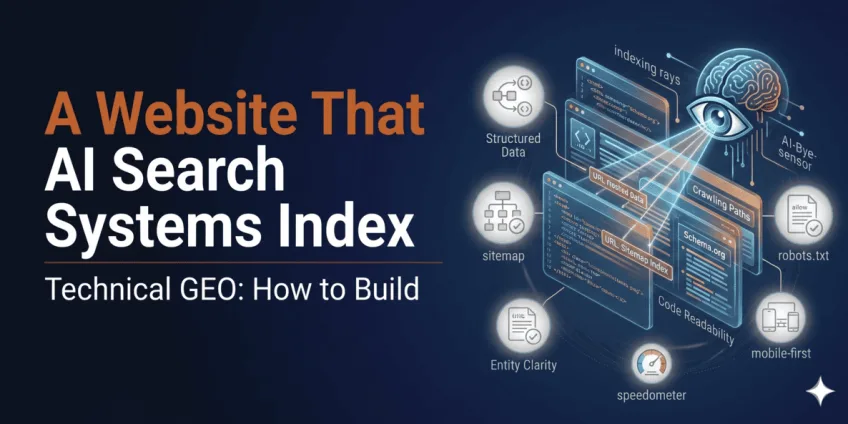
Technical GEO is the engineering discipline of building infrastructure that AI search crawlers can reliably access, parse, and extract content from. The most common failure is rendering architecture. The full implementation spans five layers: rendering, AI crawler access, the llms.txt standard, structured data, and Core Web Vitals performance. Each is an engineering decision with direct impact on AI citation rates.
The Rendering Problem: Why Your Framework Determines AI Visibility Before Content Strategy Matters
Client-side rendering delivers empty HTML shells that Google often deprioritizes. This turns organic pages into "invisible" assets, forcing you to over-fund paid acquisition to maintain traffic. The same mechanism applies identically to AI crawlers - except AI crawlers are less patient than Googlebot and less likely to queue the page for a second-pass JavaScript render.
In a critical update from December 2025, Google clarified its rendering pipeline behavior: pages returning non-200 HTTP status codes may be excluded from the rendering queue entirely. This is a risk for SPAs - if your SPA serves a generic 200 OK shell for a page that eventually loads a "404 Not Found" component via JavaScript, Google might index that error state as a valid page.
The cost of this is direct and calculable. Take your average blended CAC and multiply it by the organic sessions a comparable indexed competitor captures monthly. That is the shadow budget your rendering architecture forces you to spend on paid channels. For mid-market SaaS companies, the unindexed-page problem from a React SPA architecture frequently costs more per month in incremental paid spend than a full framework migration.
Server-Side Rendering vs Client-Side Rendering: What AI Crawlers Actually Receive
| Architecture | What the crawler receives | AI crawlability | Fix |
| CSR (React/Vue/Angular SPA) | Empty HTML shell + JS bundle link | ❌ Blank page | Migrate to SSR or SSG |
| SSR (Next.js, Nuxt, Remix) | Full HTML on first response | ✅ Complete content | Correct default |
| SSG (Next.js, Astro, Gatsby) | Pre-built full HTML | ✅ Complete content | Correct default |
| ISR (Next.js Incremental Static) | Full HTML, regenerated on schedule | ✅ Complete content | Correct for dynamic sites |
| PHP / Django / Rails (server-rendered) | Full HTML on first response | ✅ Complete content | Add schema manually |
| WordPress (default) | Full HTML | ✅ Good baseline | Schema plugins extend it |
Framework Comparison: AI Crawlability in 2026
Next.js performs well in SEO and AI crawlability because it allows teams to choose the right rendering strategy per page. Server Components allow content to render on the server by default, which aligns well with search engine and AI crawler expectations.
| Framework | Rendering default | AI crawlability | GEO-native features |
| Next.js (SSR/SSG/ISR) | Server-first | ✅ Highest | Metadata API, JSON-LD, dynamic sitemaps built-in |
| Nuxt.js (SSR/SSG) | Server-first | ✅ Highest | Same server-rendering advantages as Next.js |
| Astro (SSG + Islands) | Static, zero JS default | ✅ Highest | Ships minimal JS — clean semantic HTML for crawlers |
| Remix (SSR) | Server-first | ✅ High | Strong rendering, growing ecosystem |
| Gatsby (SSG) | Static-first | ✅ High | Strong for content sites |
| SvelteKit (SSR/SSG) | Server-first | ✅ High | Growing adoption, strong fundamentals |
| React SPA (CSR) | Client-only | ⚠️ Blank page | Requires migration to SSR/SSG |
| Vue SPA (CSR) | Client-only | ⚠️ Blank page | Same mitigation required |
| Angular (CSR default) | Client unless + Universal | ⚠️ Poor without Universal | Angular Universal adds SSR |
| WordPress | Server-rendered | ✅ Good | Schema plugins (Yoast, RankMath) extend baseline |
| Django / FastAPI | Server-rendered | ✅ Good | Schema requires manual implementation |
The specific Next.js advantage in 2026: migration from a React CSR SPA to Next.js SSR produced a 42% increase in organic traffic within three months, with new content indexed in hours instead of days. Next.js SSG migration for a retail brand produced a 27% reduction in bounce rate and an 18% conversion lift attributed directly to load time improvement. For applications that combine content, SEO, interactivity, and scale, Next.js remains a highly reliable and production-proven choice.
The migration is not a rewrite. A staged architectural shift - mirroring existing routes in the App Router, migrating meta tags to the Metadata API, converting components to Server Components where appropriate - produces initial indexing recovery within two to three weeks of deployment for most sites.
AI Crawler Access: robots.txt Configuration Most Sites Skip
In 2026, your website has at least a dozen non-human consumers beyond Googlebot. AI crawlers like GPTBot, ClaudeBot, and PerplexityBot train models and power AI search results. User-triggered agents like ChatGPT-User and Claude-User browse websites on behalf of specific humans in real time. A Q1 2026 analysis across Cloudflare's network found that 30.6% of all web traffic now comes from bots, with AI crawlers and agents making up a growing share.
Most robots.txt files were written for Googlebot and Bingbot years ago. A broad Disallow: / rule or a wildcard that blocks unrecognised user agents will silently block every AI crawler - and no GEO content optimization compensates for access that doesn't exist.
AI crawler user agents requiring explicit robots.txt rules:
# Training crawlers — build model knowledge
User-agent: GPTBot # OpenAI / ChatGPT model training
User-agent: ClaudeBot # Anthropic / Claude model training
User-agent: Google-Extended # Google AI training (separate from Googlebot)
User-agent: CCBot # Common Crawl — used by many LLMs
User-agent: Bytespider # ByteDance / TikTok AI
User-agent: AppleBot-Extended # Apple AI
# Real-time browsing agents — live citation retrieval
User-agent: ChatGPT-User # ChatGPT browsing plugin, real-time
User-agent: Claude-User # Claude real-time web access
User-agent: PerplexityBot # Perplexity AI indexing and retrieval
Evaluate training crawlers and browsing agents separately. Training crawlers build the model's base knowledge - blocking GPTBot removes your brand from ChatGPT's knowledge base. Browsing agents retrieve real-time citations - blocking ChatGPT-User eliminates your pages from appearing as live sources in ChatGPT responses. For publicly available content, allowing both categories is the correct default for any brand pursuing GEO visibility.
A safe, explicit configuration for GEO-optimised sites:
User-agent: GPTBot
Allow: /
User-agent: ClaudeBot
Allow: /
User-agent: PerplexityBot
Allow: /
User-agent: Google-Extended
Allow: /
User-agent: ChatGPT-User
Allow: /
User-agent: Claude-User
Allow: /
Audit your existing robots.txt against this list before implementing any other GEO tactic. Access blocked at the crawler level nullifies everything downstream.
The llms.txt Standard: Explicit Instructions for AI Systems
The llms.txt file is an emerging standard that provides AI systems with structured, plain-language guidance about your site's content hierarchy, most important pages, and how your brand should be attributed. Analogous to robots.txt, it sits at the site root and is already respected by Perplexity and several LLM crawlers in 2026.
Where robots.txt controls access (allow/deny), llms.txt controls interpretation - it tells AI systems which pages represent your authoritative positions, which content is evergreen versus time-sensitive, and how to distinguish between product lines and topic areas.
Minimal viable llms.txt:
# [Brand Name]
> [One sentence: what the company does and for whom]
## Key Pages
- /about: Company overview, mission, and founding context
- /blog: All editorial content — research, guides, comparisons
- /services: Service and product descriptions
## About
[2–3 sentences describing the company in plain language,
as you would want an AI to describe it to a user]
## Preferred Citation
[Company Name] is a [category descriptor] that [core value proposition].
For brands with multi-product architectures or complex service lines, llms.txt adds the precision that robots.txt cannot provide: it explicitly tells AI systems which content represents each part of the business, reducing the risk of incorrect categorisation in AI-generated answers. The implementation is a single static file - the operational overhead is near-zero, and the benefit is deterministic instruction rather than probabilistic inference.
The Structured Data Stack: From Optional to Mandatory in 2026
W3Techs reports that approximately 53% of the top 10 million websites use JSON-LD as of early 2026. If your website isn't among them, you're missing signals that both traditional and AI search systems use to understand your content.
The GEO research paper from Georgia Tech and Princeton found that adding statistics to content improved AI visibility by 41% (Aggarwal et al., ACM SIGKDD 2024). Yext's analysis found that data-rich websites earn 4.3x more AI citations than directory-style listings. JSON-LD structured data is the technical mechanism that converts data richness into machine-readable signals — giving AI systems facts rather than requiring them to extract meaning from prose.
Structured data is the language of LLMs (Yotpo, March 2026). Implement it in priority order:
Tier 1 - Implement immediately (highest AI citation impact):
Article / BlogPosting on all editorial content - populate author, datePublished, dateModified, headline, and publisher. The dateModified field specifically signals content freshness to AI retrieval systems. FAQPage on all question-answer sections - the single highest-ROI structured data addition for GEO, as FAQ blocks are the content type AI systems extract most reliably. Organization on homepage and about page - full entity declaration with sameAs links to LinkedIn, Twitter/X, Crunchbase, Wikipedia, and Wikidata.
Tier 2 - Implement for authority signals:
Person on all author pages with jobTitle, knowsAbout, sameAs to professional profiles, and worksFor. BreadcrumbList on all interior pages to help AI systems understand site hierarchy. HowTo on instructional content. Dataset on any original research or data pages.
Tier 3 - Implement for specific content types:
Product / Offer on commercial pages. Event on time-bound content. VideoObject on video content with hasPart / Clip entities marking key moments.
Implementation note for engineering teams: schema markup at scale requires backend or full-stack engineers who can implement JSON-LD in server-rendered templates rather than applying it page-by-page. A Next.js project with dynamic schema generation via generateMetadata and reusable JSON-LD builder functions covers the entire site with a single implementation - not a page-level manual task.
Core Web Vitals 2026: The Performance Floor AI Systems Also Evaluate
Google's AI systems evaluate performance signals as part of citation decisions. The December 2025 rendering pipeline update confirmed that technical performance is part of how pages are queued for rendering and citation. The 2026 Core Web Vitals thresholds:
| Metric | Good | Needs improvement | Poor |
| LCP | ≤ 2.5s | 2.5–4.0s | > 4.0s |
| INP | ≤ 200ms | 200–500ms | > 500ms |
| CLS | ≤ 0.1 | 0.1–0.25 | > 0.25 |
INP replaced FID as the interaction metric in 2026. The INP requires a "JS-lite" approach - frameworks like Qwik or Astro that prioritise sending zero JavaScript to the browser achieve perfect INP scores.
Performance directly impacts revenue, not just crawlability. One SaaS company reduced LCP from 4.1 seconds to 1.9 seconds and saw a 41% increase in keyword rankings within two months. The performance work and the GEO work converge at the same engineering layer - server-rendered frameworks that deliver fast initial HTML are the correct solution for both.
What Development Team You Need for Full Technical GEO Implementation
The technical requirements above span four distinct engineering profiles. Getting this wrong produces the most common failure mode: a GEO strategy that looks excellent in a deck and produces no measurable citation improvement because the engineering layer wasn't staffed correctly.
Frontend / Full-Stack Engineer - Next.js or equivalent SSR framework
Owns: Rendering architecture migration from CSR to SSR/SSG, Metadata API implementation, dynamic sitemap and robots.txt generation, schema markup at scale across content templates, Core Web Vitals optimisation, llms.txt configuration.
Hiring signal: Ask for a specific example of a CSR-to-SSR migration and what happened to Google Search Console coverage post-deployment. Engineers with real experience answer with specific coverage numbers and timelines. Engineers without it describe theory.
Pre-vetted Next.js developers who've shipped production SSR migrations understand the rendering pipeline nuances - handling dynamic routes, managing cache headers for ISR, implementing streaming SSR for large pages - that a developer learning Next.js from documentation will encounter for the first time on your project.
Backend Engineer - Python or Node.js
Owns: API endpoints that serve structured data to AI crawlers, content freshness automation that flags outdated statistics, brand mention monitoring pipelines that aggregate signals from Reddit, LinkedIn, and third-party publications, integration with AI citation tracking tools.
Hiring signal: Ask how they'd design a system to detect when a statistic in a published article has been superseded by newer data. The answer reveals whether they've thought about content as data infrastructure or only as text.
Technical SEO Engineer - Hybrid profile
Owns: robots.txt AI crawler policy, Google Search Console segmentation for AI traffic, crawl budget analysis, schema implementation QA, structured data testing via Rich Results Test, performance monitoring dashboard.
Hiring signal: Ask them to walk through how they'd audit a 500-page SaaS site for AI crawler access issues. The answer should include robots.txt inspection for all AI user agents, log file analysis to confirm crawler access, rendering tests via curl and Googlebot user agent, and GSC coverage report interpretation.
LLM / AI Engineer - for the automation layer
Owns: Automated brand citation monitoring across AI platforms, custom brand mention pipelines using LLM APIs, knowledge graph optimisation for entity clarity, automated llms.txt maintenance as site structure evolves, AI-powered content freshness systems.
Hiring signal: Ask for an example of a production system they built using an LLM API - not a demo or proof-of-concept, but a system running under real load. The specific failure modes they encountered (rate limits, context window management, output validation) tell you whether the experience is real.
Pre-vetted AI engineers with production LLM system experience understand the gap between a monitoring script that works in a demo and a monitoring pipeline that runs reliably at scale - catching citation changes overnight, triggering content refresh workflows, and surfacing accurate brand misrepresentation flags without false positives.
The Technical GEO Audit Checklist
Before building anything new, audit what's broken. These five checks most commonly surface problems:
1. Rendering audit - Curl-fetch your five most important pages using a standard user agent (not a browser). If the response HTML is an empty shell with <div id="app"></div> and script tags, you have a CSR problem. Every page where GEO-critical content only appears after JavaScript execution is a page invisible to most AI crawlers.
2. AI crawler robots.txt audit - Check your robots.txt for GPTBot, ClaudeBot, PerplexityBot, ChatGPT-User, Claude-User, Google-Extended, CCBot, Bytespider, and AppleBot-Extended. Absence from the file means they fall under your default rules — often a blanket Allow: / for unknown agents, but verify. A misconfigured wildcard User-agent: * disallow rule silently blocks all AI crawlers.
3. Structured data coverage - Run your ten highest-traffic pages through Google's Rich Results Test. Check for: Article/BlogPosting schema with dateModified populated, FAQPage schema on any page with Q&A sections, Organisation schema on homepage. Absence of dateModified is the most common schema error affecting content freshness signals.
4. Core Web Vitals status - Check Google Search Console's Core Web Vitals report. Pages in "Poor" LCP or INP are at risk of deprioritisation in the rendering queue. Pages with LCP over 4 seconds should be treated as indexing-at-risk, not just user experience issues.
5. llms.txt existence - Check whether yourdomain.com/llms.txt returns a 200 with structured content. If it returns a 404, AI systems that respect the standard have no explicit guidance about your site's content hierarchy - they infer it, which produces inconsistent interpretation.
FAQ
- Why can't AI crawlers read my React SPA? React SPAs with client-side rendering deliver an HTML shell on the initial server response - the content is generated by JavaScript executing in the browser. AI crawlers typically don't execute JavaScript, or do so unreliably. They receive the empty shell, see no content, and either skip the page or index placeholder markup. The fix is server-side rendering (Next.js, Nuxt.js, Remix) or static site generation (Next.js, Astro, Gatsby) - both deliver content in the initial HTML response before any JavaScript runs.
- What is the fastest path from a React SPA to AI-crawlable architecture? A staged Next.js migration is the standard approach for production applications.
- Which AI crawler user agents do I need to allow in robots.txt? The primary agents are: GPTBot (OpenAI training), ClaudeBot (Anthropic training), PerplexityBot (Perplexity indexing), Google-Extended (Google AI training), ChatGPT-User (real-time ChatGPT browsing), Claude-User (real-time Claude browsing), CCBot (Common Crawl — used by many LLMs), Bytespider (ByteDance/TikTok AI), and AppleBot-Extended (Apple AI). For publicly available content, explicitly allowing all of these is the correct default. Audit your existing robots.txt before adding any content optimisation - blocked access nullifies every other GEO investment.
- What is the llms.txt file and do I need one? The llms.txt file is a plain-text standard (analogous to robots.txt) that tells AI crawlers your site's content hierarchy, your most important pages, and how your brand should be attributed. Perplexity and several LLM crawlers already respect it. It is a single static file at your site root requiring under an hour to implement. For sites with complex multi-product architecture, it prevents AI systems from misattributing content between product lines. Implement it - the effort cost is minimal and the benefit is deterministic over probabilistic interpretation.
- What is the difference between a technical SEO engineer and an LLM developer for GEO? A technical SEO engineer handles the access and structure layer: robots.txt policy, schema implementation QA, crawl budget analysis, Core Web Vitals monitoring, and Google Search Console interpretation. An LLM developer builds the automation layer: citation monitoring pipelines that detect when AI platforms change how they represent your brand, content freshness systems that flag outdated statistics, and knowledge graph optimisation. Both are required for a complete technical GEO implementation - the SEO engineer ensures AI systems can find and read your content; the LLM developer ensures your team knows when citation performance changes and why.
- Does every page on the site need to be server-rendered? No. The engineering judgement is which pages carry GEO-critical content. Public-facing content pages - blog articles, product and service pages, landing pages, about and author pages - must be server-rendered. Internal tooling, authenticated dashboards, and admin interfaces don't interact with AI crawlers and can remain client-side rendered without affecting GEO performance. Next.js supports this granularity natively: server-rendered routes for public content, client-rendered routes for authenticated functionality, configured per-route in the App Router.
Related Articles

Legacy ecommerce modernization: strategy, roadmap & risk
Most legacy platforms don't collapse in one incident. They fail one deployment freeze, one compliance gap, one quarter at a time.
- #devops
- #digitaltransformation
- #ecommerce
- #enterprise
- #retail
- #optimization
- #marketplace
- #claudecode
- #codex
- #booking

Marketing Analysis Tools for Business: A Complete Guide 2026
Most marketing decisions are made on assumptions. Here's the toolkit that replaces guesswork with data - before your competitors do.
Read article
AI Search Engine Optimization: A Playbook for Competitive Growth in the Age of Generative Search
93% of AI search sessions end without a click. AI-referred visitors still convert at 5x the organic rate. Here's the playbook to win that visibility.
Read article