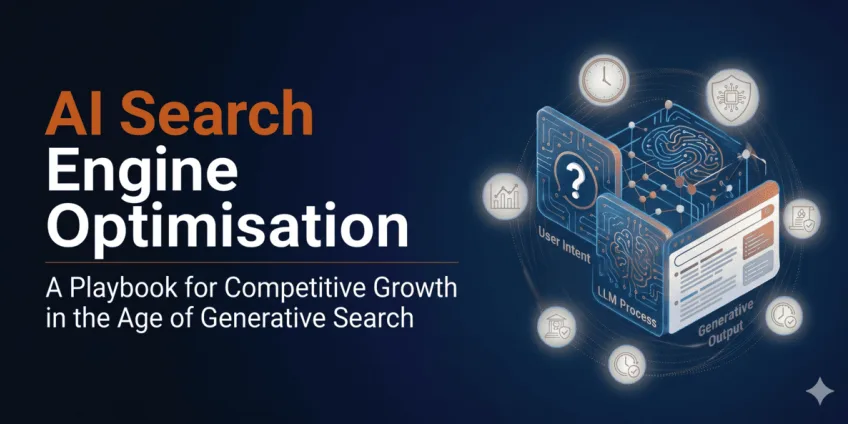
AI Search Engine Optimization: A Playbook for Competitive Growth in the Age of Generative Search
Digital TransformationPublished on by Iryna Seleman • 10 min read read
- Why Traditional SEO Is No Longer Sufficient on Its Own
- The Three-Model Framework: SEO, AEO, and GEO
- Where Users Are Now: The Six AI Search Platforms and What Each Rewards
- The Six Content and Authority Levers That Drive AI Citation
- Answer-First Content Structure
- Original Data and Statistics
- Third-Party Brand Mentions at Scale
- Entity Clarity
- Continuous Freshness
- Author Authority
- The New Visibility Metrics: What to Track Instead of (Just) Rankings
- The Three-Month Operating Model
- Month 1 - Audit
- Month 2 - Build
- Month 3 - Govern
- FAQ
In Q1 2026, 25.11% of all Google searches trigger an AI Overview - up 57% from Q4 2025, based on Conductor's analysis of 21.9 million searches. Healthcare queries trigger AI Overviews in 48.75% of cases. Technology sits at 30%. Gartner projects that traditional search volume will drop 25% by 2026 and that 50% of all searches will involve an AI assistant by 2028.
None of this means SEO is over. It means there is now a second visibility layer - and the two layers reward fundamentally different behaviours.
In traditional search, you rank for a keyword, and a user sees your link. They click, or they don't. In AI search, there is no list of links. There is one synthesized answer, potentially citing three to eight sources. Either you are one of those sources, or you are invisible.
AI search engine optimization - GEO (Generative Engine Optimization) or AEO (Answer Engine Optimization) - is the practice of structuring content and brand presence so AI-powered platforms cite your brand when users ask questions. AI referral traffic converts at 2x the rate of traditional organic search while requiring only one-third the sessions, making it the highest-efficiency acquisition channel available. One B2B SaaS portfolio of 42 websites saw AI-driven sessions increase 240% while traditional organic clicks dropped 18%, with AI traffic converting at 14.2% versus 2.8% for organic - a five-fold advantage. The GEO market is valued at $848 million in 2025 and projected to reach $33.7 billion by 2034 at a 50.5% CAGR. 98% of CMOs are already investing in AEO in 2026.
The question is no longer whether AI search optimization matters. It's whether your team has the operating model to capture it before competitors do.
Why Traditional SEO Is No Longer Sufficient on Its Own
The click-through rate data tells the story directly. The presence of an AI Overview correlates with a 34.5% lower average CTR for the top-ranking page. Users looking for a quick answer no longer scroll to the ranked listings - which means a page ranking #1 can lose more than a third of its traffic to an AI Overview that answers the question directly.
60% of searches are now completed without users clicking through to other websites. Around 93% of AI search sessions end without a visit to a website. Those numbers don't signal the death of the website - they signal the birth of a new visibility metric: citation frequency in AI-generated answers.
AI search is redistributing authority the same way the printing press once did. Before, brands controlled visibility through media spend and rankings. Now, AI controls visibility through citation and trust. The brands that understand this will lead.
The brands moving resources accordingly are using EMARKETER's 2026 budget framework: 40% to core SEO, 25% to digital PR, 20% to data and reporting, 10% to training, and 5% to experimentation. Core SEO remains the foundation - but the 25% digital PR allocation is the GEO investment. Third-party mentions, not just on-page optimization, determine AI citation frequency. The budget reflects that reality.
GEO is not a replacement for SEO. Brands that excel at GEO in 2026 are typically the same brands with strong traditional SEO foundations. The optimization principles overlap significantly, but GEO adds specific requirements around content structure, citation-friendliness, and data richness that SEO alone does not address.
The Three-Model Framework: SEO, AEO, and GEO
Understanding what each model optimizes for is the prerequisite to a coherent strategy - because deploying them in the wrong combination wastes budget and produces conflicting signals.
| Model | Optimizes for | Primary metric | Platform |
| SEO | Ranking in search results for clicks | Organic traffic, keyword positions | Google, Bing, DuckDuckGo |
| AEO | Appearing as the direct answer (zero-click, voice) | Position Zero, featured snippet capture | Google AI Overviews, voice assistants |
| GEO | Being cited in AI-generated conversational answers | Citation frequency, AI share of voice | ChatGPT, Perplexity, Gemini, Claude |
EMARKETER's principal analyst draws a clearer line: "SEO is about ranking pages for clicks, while GEO is about being selected as a source in synthesized answers".
The practical strategy: these are not competing investments but complementary layers. SEO builds the authority and technical foundation. AEO extracts zero-click value from that foundation. GEO extends brand visibility into AI conversations where no click will occur - but where purchasing intent is formed and brand preference is established before the user ever visits a website.
Where Users Are Now: The Six AI Search Platforms and What Each Rewards
Platform-by-platform understanding matters because AI systems don't all pull from the same sources or reward the same signals. A strategy that works on Google AI Overviews does not automatically translate to ChatGPT, and a brand invisible to Perplexity is invisible to a specific high-intent research audience.
Google AI Overviews and AI Mode reach 1.5 billion monthly users. 76.1% of URLs cited in AI Overviews also rank in the top 10 of Google search results, making traditional ranking the strongest correlation signal for this platform. Invest in page-one ranking and structured content - that is the clearest path to Overviews inclusion.
ChatGPT has 900 million weekly active users globally and drives 87.4% of all AI referral traffic. Its citation rate is just 0.7% - ChatGPT rarely links to sources but absorbs knowledge into responses. The lever here is not on-page content. YouTube mentions and branded web mentions are the top factors correlating with AI brand visibility in ChatGPT, AI Mode, and AI Overviews. Building brand presence on Reddit, YouTube, LinkedIn, and high-authority publications is what gets absorbed into ChatGPT's knowledge base.
Perplexity has a 13.8% citation rate - the highest of any platform - with lower total traffic volume than ChatGPT but significantly higher per-citation intent. It functions as a research tool for complex queries. For B2B brands, Perplexity citations frequently precede high-value purchase decisions.
Gemini integrates tightly with Google's broader ecosystem, meaning Google Search Console signals - impressions, CTR, query data - provide indirect indicators of Gemini inclusion. Its reward signals align closely with AI Overviews: answer-first structure, schema markup, and factual density.
Claude and Microsoft Copilot draw from crawled web content with similar structural preferences: clean semantic HTML, explicit attribution, and consistent entity presentation across domains.
The competitive window is currently uneven across platforms. Platform fragmentation will increase - AI search will not consolidate into a single dominant platform the way traditional search consolidated around Google. Multi-platform GEO strategies will be essential, and brands will need to monitor and optimize across an expanding ecosystem of AI surfaces. Brands building citation presence on two or three platforms now will face a significantly more crowded landscape in twelve months.
The Six Content and Authority Levers That Drive AI Citation
Academic research from Georgia Tech, Princeton, and IIT Delhi - the foundational GEO paper published at ACM SIGKDD 2024 - demonstrated that targeted optimization boosts AI visibility by 30–40%. The levers that move the needle most in 2026 are not mysterious. They are specific, executable, and accessible to any marketing team willing to treat them as a distinct work stream.
Answer-First Content Structure
AI systems that use real-time retrieval evaluate a page's relevance primarily on its opening content. The first 200 words of any article should directly and completely answer the primary query - not build up to the answer. Write the summary first. Build the depth below it. An AI system extracting a citation from your page should be able to use the first two paragraphs as a standalone answer without needing the surrounding context.
Original Data and Statistics
AI systems prefer to cite sources that provide facts others don't. The GEO research paper found that adding statistics to content improved AI visibility by 41%. Yext's analysis found that data-rich websites earn 4.3x more AI citations than directory-style listings. Every article should contain at least one data point with explicit attribution - a survey result, an industry benchmark, an internal analysis - that a reader can verify independently.
Third-Party Brand Mentions at Scale
Distributing content to a wide range of publications can increase AI citations by up to 325% compared to only publishing the content on your own site. This is the GEO equivalent of link building - but the goal is a mention, not a hyperlink. Press coverage, contributed data to industry reports, guest articles on authoritative domains, podcast appearances with published transcripts, and active presence in community platforms all feed the brand mention signals that LLMs absorb as trust signals.
Reddit alone has 100 million daily active users generating conversations about brands. Find where your audience discusses your category, contribute genuinely, and build a presence that AI systems recognize as authentic signal rather than promotional noise.
Entity Clarity
AI systems reason about entities - brands, people, products - and their relationships. A brand that appears consistently across all digital properties with the same name, domain, and description builds stronger entity recognition. Maintain consistency in Name, Address, and Phone across all platforms. Use structured data on your About and homepage to make entity relationships explicit. Ensure your Wikipedia or Wikidata presence is accurate and updated - LLMs draw on these structured knowledge sources directly.
Continuous Freshness
40–60% of cited sources in AI responses rotate monthly, meaning GEO requires continuous monitoring and content freshness, not one-time optimization. AI retrieval systems weight recent content for time-sensitive queries - articles with visible "Last Updated" signals, current statistics, and fresh examples outperform evergreen content for fast-moving topics. Set a quarterly content refresh schedule for your highest-performing articles. Add "What changed in [current year]" sections to perennial content. Treat your existing content library as a living asset, not an archive.
Author Authority
In 2026, author authority is becoming the most scrutinized signal for both rankings and AI citations as algorithms get better at distinguishing real expertise from generic content. Every author bio should be rich with relevant credentials. Dedicated author pages should showcase expertise comprehensively - professional credentials, social profiles, certifications, and a clear explanation of why the person is uniquely qualified to write on the topic. Conference talks, podcast appearances, industry awards, and mentions in credible media build the web of confirming signals that AI systems evaluate when deciding whether to cite a source.
The New Visibility Metrics: What to Track Instead of (Just) Rankings
The absence of standard tooling for GEO measurement is the most cited implementation barrier. But the data is available - it requires a combination of tools and a measurement model that treats AI visibility as a distinct channel.
AI citation share: How often does your brand appear in AI-generated answers for your key topics? Manual citation audits - querying your 20 most valuable prompts across ChatGPT, Perplexity, Google AI Mode, and Gemini, documented monthly - provide the baseline. List 10–15 questions your ideal customer would ask an AI engine, run each query, note whether your brand is mentioned, and document which competitors appear instead. Repeat monthly, because AI-generated answers shift as models update.
AI referral traffic and conversion rate: Tag traffic from AI platforms (chat.openai.com, perplexity.ai, gemini.google.com, claude.ai) in GA4 and track sessions, conversion rate, and revenue per session separately from organic. AI-referred visitors spend 68% more time on websites than traditional search visitors - that behavioral signal reflects higher intent from users arriving after an AI pre-qualified your brand as relevant.
Branded search volume trend: When AI citations increase brand awareness without generating direct clicks, the signal shows up as growth in branded search queries. Users who encounter your brand in an AI answer and convert later through direct navigation or branded search are attributed to other channels - tracking branded search volume trend captures this indirect effect.
AI Overview impression data: Available in Google Search Console under the Search Appearance filter. Track impressions and CTR from AI Overviews separately from standard blue-link results. Organic CTR in AI Overviews recovered from 1.3% in December 2025 to 2.4% in February 2026 - a trend worth monitoring per vertical.
In a zero-click search world, organic click-through rate is only part of the story. The metrics that matter now are AI citation share, brand mention share, and answer presence rate - on which of your top queries does your brand appear as the cited source? Dedicated GEO tracking platforms now average $337/month and automate the manual citation audit process.
The Three-Month Operating Model
Early movers in GEO are building citation moats that competitors will struggle to overcome. Emerging patterns suggest AI platforms develop source preference bias, favouring domains that consistently provide reliable information - initial citation wins compound into long-term competitive advantages. The competitive window is real and measurable: 54% of US marketers plan to implement GEO within 3–6 months. The brands that move first in the next quarter face a materially less crowded citation landscape than brands that move in six months.
Month 1 - Audit
Run a full AI visibility audit before changing any content. Query your 20 most valuable search prompts across ChatGPT, Perplexity, Google AI Mode, and Google AI Overviews. Document where your brand appears, where competitors appear instead, and where AI systems misrepresent your positioning. Identify your top ten existing articles with high organic traffic that lack answer-first structure and FAQ schema - these are the fastest citation wins available. Set up GA4 segmentation for AI referral traffic. Establish the citation frequency baseline you will measure against.
Month 2 - Build
Publish the first structured content cluster targeting your highest-value prompts. Each piece: answer-first opening that functions as a standalone extract in the first 200 words, at least one original or explicitly attributed data point, FAQ section covering the natural follow-up questions your audience asks AI systems, and structured schema markup. Begin third-party distribution for your best existing content - target publications where your audience already researches and where LLMs actively pull citations. Start building or increasing Reddit, LinkedIn, and YouTube presence in the topic areas central to your product positioning.
Month 3 - Govern
Create the operating model that sustains this work: an executive scorecard with AI citation frequency and AI referral conversion as standing KPIs, a content refresh calendar for your top 20 pages, a process for identifying and correcting AI misrepresentations of your brand across platforms, and a standardized AI-first content brief template for all new editorial output. The output of Month 3 is a repeatable system - not a completed project. Month three is for governance: define ownership for misinformation correction, standardize an AI-first content brief template, and ensure the output is "we now have an operating model" rather than "we experimented with AI SEO".
At scale, this operating model requires automation: citation-monitoring pipelines that flag when brand representation changes across platforms, content-freshness systems that detect when statistics become outdated, and distribution-tracking systems that connect third-party publication performance to downstream AI citation rates. Pre-vetted AI engineers and LLM developers who've built production AI monitoring systems reduce the gap between a strategy on a slide deck and an operating model running in production.
The technical implementation — rendering architecture, structured data at scale, AI crawler configuration - is covered in depth in the companion technical guide: Technical GEO: How to Build a Website That AI Search Systems Can Actually Index.
FAQ
- What is the difference between SEO, AEO, and GEO? SEO (Search Engine Optimization) optimizes for keyword rankings and click-through traffic from traditional search results. AEO (Answer Engine Optimization) optimizes for appearing as a direct answer in zero-click results, AI Overviews, and voice search. GEO (Generative Engine Optimization) optimizes for being cited or mentioned in AI-generated conversational answers from platforms like ChatGPT, Perplexity, and Gemini. All three are complementary - GEO and AEO build on strong SEO foundations rather than replacing them.
- How much does being cited in AI search actually affect traffic and conversions? AI referral traffic currently accounts for 1.08% of total web traffic across ten industries, with IT and technology at 2.8%. The volume is small but quality is exceptional: AI-referred visitors convert at 2–5x the rate of traditional organic visitors, spend 68% more time on websites, and arrive with pre-established brand credibility from the AI's endorsement. A B2B SaaS portfolio of 42 websites recorded AI traffic converting at 14.2% versus 2.8% for organic - a five-fold advantage.
- Which AI platform should be prioritized first? For most brands, Google AI Overviews first — 25.11% of all Google searches trigger them, and the citation correlation with traditional ranking makes it the most predictable platform to optimize for. ChatGPT second - it drives 87.4% of AI referral traffic by volume. Perplexity third for B2B and high-intent research queries - it has the highest citation rate (13.8%) of any platform. Prioritization should follow where your audience is already searching, which varies significantly by industry.
- How quickly does GEO optimization produce results? Georgia Tech and Princeton's research showed a 30–40% increase in AI visibility through targeted optimisation. In practice, 63% of websites using AI-first content structures experienced improved AI search visibility within three months. Structural changes — such as answer-first content and FAQ sections - deliver quicker results than authority-building efforts (like third-party mentions and digital PR), which tend to compound over 6–12 months. Freshness optimisation yields near-immediate results, as 40–60% of AI citations rotate monthly.
- What content types get mentioned most often in AI search results? Blog content is the #1 page type cited in AI Overviews according to Conductor's 2026 benchmarks. Within blog content, articles with structured comparison data, specific statistics with named sources, transparent methodology, and FAQ sections get cited most frequently. Product and service pages rank lower in citation frequency. For ChatGPT specifically, YouTube mentions and branded web mentions on third-party domains are the top citation correlation signals.
Related Articles
Legacy ecommerce modernization: strategy, roadmap & risk
Most legacy platforms don't collapse in one incident. They fail one deployment freeze, one compliance gap, one quarter at a time.
- #devops
- #digitaltransformation
- #ecommerce
- #enterprise
- #retail
- #optimization
- #marketplace
- #claudecode
- #codex
- #booking
Marketing Analysis Tools for Business: A Complete Guide 2026
Most marketing decisions are made on assumptions. Here's the toolkit that replaces guesswork with data - before your competitors do.
Read article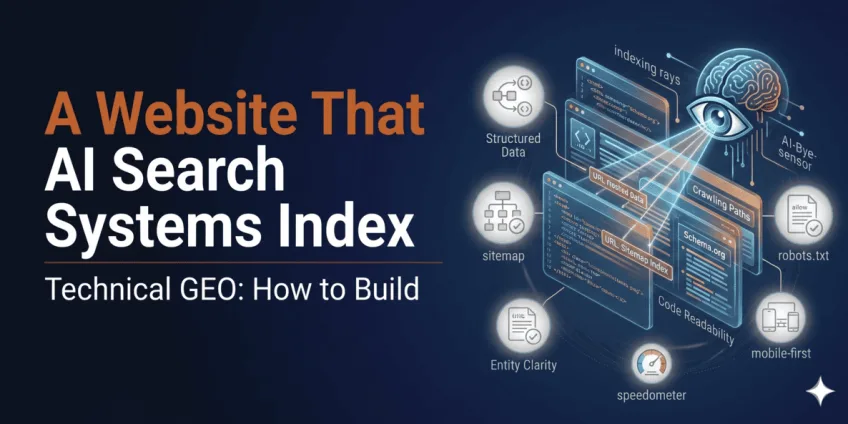
Technical GEO: How to Build a Website That AI Search Systems Can Actually Index
Your React SPA sends AI crawlers a blank page - making all GEO content investment invisible. Here's the full technical implementation for CTOs.
Read article