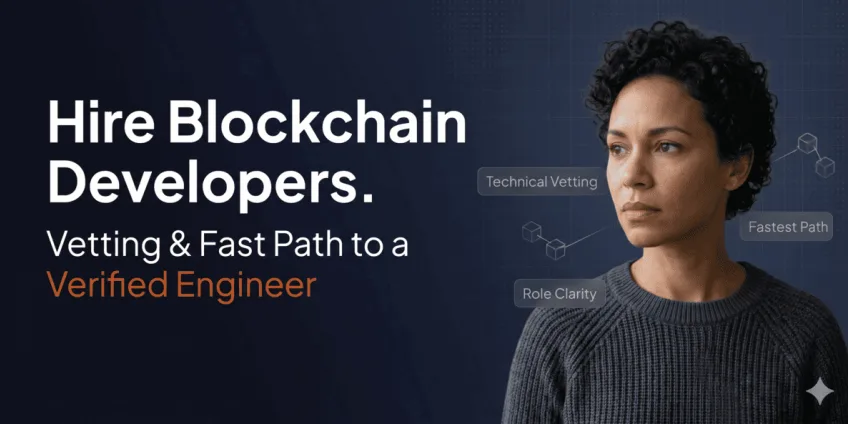
How to Hire a Blockchain Developer: Technical Vetting, Role Clarity, and the Fastest Path to a Verified Engineer
How to HirePublished on by Iryna Seleman • 8 min. read read
- The Four Blockchain Roles - and Why Conflating Them Costs You
- Smart Contract Developer
- dApp Developer
- Protocol Developer
- Blockchain System Architect
- The Skills That Actually Separate Production Engineers from Bootcamp Graduates
- Solidity Depth: Two Levels That Look the Same on a CV
- Security Pattern Knowledge
- Tooling and Development Environment
- The Interview Process That Surfaces Depth Without Requiring Domain Expertise
- What a Realistic Hiring Timeline Looks Like
- Where to Find Verified Blockchain Engineers
- FAQ
- Conclusion
The gap between a blockchain developer and someone who can play one in an interview is wider than in almost any other engineering discipline.
Senior blockchain developers are genuinely scarce. Electric Capital's Developer Report (2025) estimates roughly 23,000 active Web3 developers globally - an ecosystem that has grown more slowly than the on-chain project pipeline it's supposed to serve. That scarcity drives up salaries, extends search timelines, and compresses the candidate pool before vetting even starts.
Scarcity isn't the hardest part. The harder problem is verification. Blockchain is a field where a candidate can build a resume that looks compelling from two Solidity courses, several forked GitHub repositories, and a portfolio of token contracts that were never deployed to mainnet. That profile is indistinguishable from someone who spent three years building and auditing DeFi protocols under real economic risk - until something in production goes wrong.
Hiring a blockchain developer requires a different approach than standard engineering roles because the gap between stated familiarity and actual production competence is invisible on a resume. Before sourcing candidates, define which blockchain discipline you need - smart contract developer, dApp engineer, or protocol specialist - since the skills overlap far less than the titles suggest. Evaluate on Solidity depth, gas optimization reasoning, security pattern knowledge, and whether candidates can describe a real vulnerability they encountered. For most teams, the fastest path to a verified hire is a pre-contracted pool of blockchain engineers who passed technical evaluation before your search began.
The Four Blockchain Roles - and Why Conflating Them Costs You
Most job postings ask for a "blockchain developer" and leave the scope undefined. That ambiguity produces the wrong candidates and weeks of misaligned interviews.
Smart Contract Developer
The most commonly needed profile. Smart contract developers write, test, and deploy self-executing contracts - primarily in Solidity for Ethereum and EVM-compatible chains, or Rust for Solana. The work is high-stakes by nature: once a contract deploys to mainnet, bugs cannot be patched in the traditional sense. Exploits are irreversible. The difference between a competent Solidity engineer and a mediocre one isn't visible in code review - it shows when the code encounters an adversarial environment.
This role is most subject to resume inflation. Solidity is syntactically accessible, and a developer with JavaScript experience can begin writing contracts within days. Producing secure, gas-optimized, production-grade smart contracts takes significantly longer to learn, and the indicators of that depth don't appear on a LinkedIn profile.
Btw, if you are looking for a full-cycle Smart Contract development team, Stubbs.pro could help you with that.
dApp Developer
Decentralized application developers build the frontend and middleware layer that connects users to on-chain contracts. The stack combines standard web engineering - React, TypeScript, Node.js - with Web3-specific libraries: ethers.js, web3.js, and wallet integration via MetaMask or WalletConnect. dApp developers don't necessarily write smart contracts, but they need to understand contract interfaces, event listening, and transaction error handling well enough to build against them reliably.
This profile is easier to source than a pure smart contract engineer. Vetting methodology sits closer to standard full-stack hiring with a Web3 overlay rather than a deep Solidity assessment.
Protocol Developer
Protocol engineers work at the consensus and network layer - modifying or building blockchain infrastructure itself rather than deploying applications on top of it. This is the most specialized profile in the category, typically requiring deep systems programming in C++, Go, or Rust alongside expertise in consensus mechanisms, P2P networking, and cryptographic primitives. Most product companies don't need this profile. Mistaking it for a smart contract role leads to either overpaying for a generalist or undervaluing a specialist.
Blockchain System Architect
Architects design the infrastructure layer: which chain to build on, how to structure contract interactions, how to manage upgradability, and how the system handles scale and security. At an early-stage company, a senior smart contract developer typically absorbs this function. At scale, it becomes a distinct role. Hiring for it prematurely adds overhead without output.
[Visual needed: role taxonomy diagram - 4 profiles mapped by technical depth vs. product proximity]
The Skills That Actually Separate Production Engineers from Bootcamp Graduates
Every blockchain job description lists Solidity, smart contracts, and Ethereum. Those are table stakes. The skills that distinguish candidates require active probing rather than profile scanning.
Solidity Depth: Two Levels That Look the Same on a CV
Solidity fluency exists at two levels. The first is syntactic: types, modifiers, inheritance, events, basic contract structure. Most candidates with six months of exposure reach this level. The second is semantic: understanding how the EVM executes instructions, how storage layout affects gas costs, how to prevent reentrancy without sacrificing composability, and when to drop into assembly.
A candidate at the first level writes contracts that function correctly in a test environment. A candidate at the second level writes contracts that hold under adversarial conditions with real funds at stake.
In an interview, ask for a specific gas optimization decision the candidate made in production and why they made it. Ask them to explain the checks-effects-interactions pattern and name a contract where they've seen it violated. The specificity - or absence of it - in the answers tells you which level you're dealing with before you see a single line of code.
Security Pattern Knowledge
Smart contract security isn't a checklist - it's a discipline built from understanding the attack surface of decentralized execution. The engineers worth hiring think adversarially by instinct: they know what reentrancy looks like, understand integer overflow behavior, can discuss front-running and MEV exposure, and have used static analysis tools like Slither or MythX in a real project. Still, the most reliable signal isn't whether they can name vulnerabilities. It's whether they've caught one before deployment. Ask for it directly.
Tooling and Development Environment
Production blockchain engineers work with a defined stack: Hardhat or Foundry for local development and testing, OpenZeppelin for audited contract libraries, ethers.js or web3.js for frontend integration. Candidates who haven't used at least two of these in a production context are likely working from tutorials. The presence of Foundry in particular - a newer, faster testing framework gaining rapid adoption - is a signal of current, active practice rather than historical familiarity.
The Interview Process That Surfaces Depth Without Requiring Domain Expertise
Standard technical interviews fail in blockchain hiring because evaluating the answers requires specialized knowledge. The framework below is designed to surface depth through the specificity of responses, reducing the dependency on a blockchain-expert interviewer.
Round 1 - Live contract writing. Give the candidate a bounded prompt: a basic ERC-20 token with a mint function restricted to a specific address. Ask them to write it without external tools. Evaluate whether they reach for OpenZeppelin patterns or reinvent primitive security mechanisms; whether they add events, handle edge cases, and consider upgradeability unprompted.
Round 2 - Vulnerability identification. Present a contract with a deliberate reentrancy flaw in a withdrawal function. Ask them to identify the issue, explain how an attacker would exploit it, and rewrite the affected code. Correct answers are specific about the exploit mechanism and propose a fix that addresses the root cause rather than masking it.
Round 3 - Production experience probe. Ask the candidate to describe the most technically complex smart contract they deployed to mainnet - not testnet - and what they would do differently. Engineers with genuine production experience answer this question with specific trade-offs, technical constraints, and decisions made under time-and-cost pressure. Engineers with primarily educational experience answer in generalities.
Round 4 - System design. Describe a product scenario - a token-gated membership contract with upgrade requirements - and ask them to design the contract architecture. Evaluate whether they raise proxy patterns, access control concerns, and gas implications unprompted. The quality of what they raise without being asked is more predictive than any answer to a direct question.
What a Realistic Hiring Timeline Looks Like
Building the search from scratch through standard recruiting: role definition (1–2 days), posting across channels (1 day), application review and screening (1–2 weeks), four technical rounds (1–2 weeks), offer and negotiation (1 week), onboarding (1 week). Total: six to ten weeks, assuming no fallouts at offer stage and a steady application flow.
That timeline assumes a well-defined role, consistent candidate volume, and an interviewer with enough blockchain domain knowledge to evaluate answers. Most early-stage engineering teams have at most one of the three.
A pre-vetted pool compresses the first three phases into hours. Candidates have already passed a multi-stage technical evaluation before your request exists. The interview rounds you run confirm fit rather than establish baseline competence. Offer and onboarding: one week. Total from request to start: five to ten business days.
For a team that has already lost a sprint cycle to an open blockchain role, that compression is measured in product output - not just calendar time.
Where to Find Verified Blockchain Engineers
Most channels for sourcing blockchain developers optimize for volume rather than verification. Job boards return applicants who self-selected on keyword match. Freelance marketplaces return profiles where the only vetting mechanism is prior client ratings - which say nothing about whether a candidate has written secure production contracts or merely functional-looking ones.
For teams without an internal blockchain-capable interviewer, this creates a genuine bottleneck: running the four-round process above requires someone who can evaluate whether the answers are actually correct. Building that internal evaluator just to make one hire is an expensive solution to a sourcing problem.
Pre-vetted matching platforms that run blockchain-specific technical evaluation before contracts are issued address both sides. Engineers arrive having passed a technical screen conducted by domain specialists - not a profile filter. The interview round your team runs is confirmation, not discovery.
Cortance's blockchain developers passed five evaluation stages before being contracted, including live technical assessment and security-pattern verification, and only 21% of applicants cleared all stages. The first matching experts arrives within 30 minutes of a request, because the verification work happened before your search began. And that`s type of providers you as a business should cooperate with.
FAQ
What skills should a blockchain developer have in 2026? Core requirements include Solidity proficiency for EVM-chain work or Rust for Solana, understanding of smart contract security patterns, experience with Hardhat or Foundry for development and testing, and familiarity with Web3 integration libraries such as ethers.js. Beyond the technical stack, strong blockchain engineers demonstrate security-first reasoning by instinct - they think about adversarial conditions and production failure modes, not just functional correctness.
What is the difference between a smart contract developer and a blockchain developer? "Blockchain developer" covers several distinct specializations. A smart contract developer specifically writes and deploys self-executing contracts on a blockchain platform - the most commonly needed profile for product companies. A blockchain developer may also encompass protocol engineers who build network infrastructure, dApp developers building the user-facing application layer, or architects designing the overall on-chain system. Define which you need before sourcing, or you will spend weeks interviewing candidates for the wrong role.
How to evaluate a blockchain developer without deep Solidity knowledge yourself? Structure evaluation around demonstrable proof rather than stated familiarity. Ask candidates to identify a vulnerability in a provided contract sample, describe a gas optimization decision from their own production work, and explain what they would do differently on their last mainnet deployment. Correct, specific answers are recognizable without domain expertise - as are vague, generic ones. For teams without a blockchain-capable interviewer, pre-vetted experts providers with specialist screeners removes the dependency entirely.
What are the biggest mistakes companies make when hiring blockchain developers? Three patterns recur:
- hiring based on stated Solidity familiarity rather than proven production security skills.
- confusing blockchain roles—hiring a smart contract engineer when a dApp developer is needed, or vice versa.
- conducting a generic software engineering interview that fails to explore blockchain-specific failure modes, only to discover capability gaps after the engineer is already working on production contracts where errors cannot be undone.
Should I hire a full-time blockchain developer or use a contractor? For exploratory builds or time-bounded projects, a senior contractor with production smart contract experience often makes more sense than a full-time hire - the scope may not justify permanent headcount, and contract flexibility accommodates changing requirements. For products where smart contract work is ongoing and central to the roadmap, a full-time placement offers continuity and institutional knowledge that contract rotations cannot match. In both cases, the rigorous vetting process should be identical - the deployment environment remains the same regardless of employment structure.
What programming languages does a blockchain developer need to know? Solidity is the primary language for Ethereum and EVM-compatible chains - Polygon, Arbitrum, BNB Chain, and most Layer 2 networks. Rust is required for Solana development. Go is used in Hyperledger Fabric and some Ethereum client implementations. Most smart contract engineers also work with JavaScript or TypeScript for testing environments and dApp integration. The language priority depends on which chain your product is built on - clarify this before posting a role.
Conclusion
Hiring a blockchain developer is a specific technical challenge that standard engineering recruitment wasn't designed for. Resume signals are unreliable, the interview process requires domain knowledge most teams don't have internally, and the cost of a wrong hire isn't measured in delayed features - it's measured in vulnerable contracts deployed to an immutable ledger.
Getting it right starts with role clarity: define which blockchain discipline you need before sourcing a single candidate. Build evaluation around security reasoning and production experience rather than syntax familiarity. And if the internal capacity to run that process doesn't exist, the fastest path to a verified engineer is one who was evaluated by specialists before your search began.
Related Articles

Types of Salesforce Developers and How AI Is Reshaping Each Role
Five Salesforce roles, five different jobs. Hire the wrong one and the cost shows up months later.
Read article
How to Hire a QA Engineer with Real Accessibility Testing Skills
Most QA engineers have heard of WCAG. Few can tell you what it doesn't catch - and that gap is exactly where accessibility bugs survive to production
Read article
How to Hire Cloud Engineers Without Losing Weeks to a Process Built for a Different Era
Six weeks to hire one cloud engineer. That's not unusual - it's the industry average. The fix isn't moving faster through the same funnel.
Read article