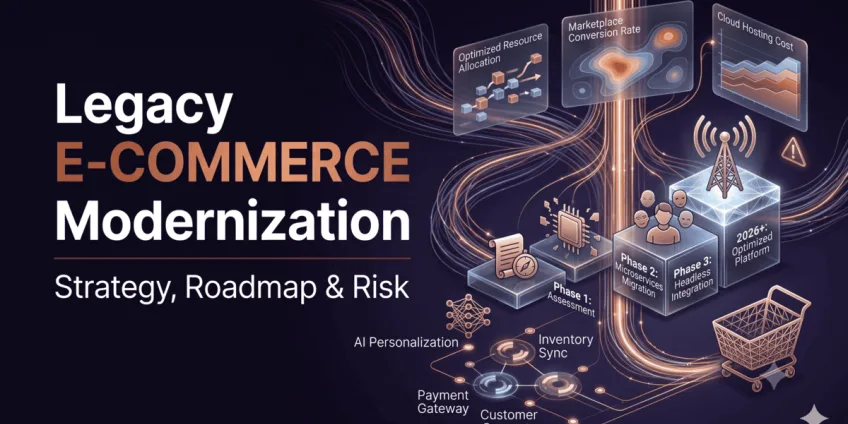
Legacy ecommerce modernization: strategy, roadmap & risk
Digital TransformationPublished on by Alex Korniienko • 10 min read read
- Where a legacy platform turns into an operating risk
- The cost of standing still, in numbers a board will recognize
- The shift: from a rewrite project to a governed program
- The system: a five-gate roadmap for legacy ecommerce modernization
- What the data says about where programs actually fail
- What a modernized operating model looks like a year later
- The one decision to make before you fund this
- FAQ
- Where to start this quarter
A governance-first framework for operations leaders who need predictable delivery more than a new tech stack.
$5,600 a minute. That's the Gartner benchmark most incident-management teams still use to price unplanned downtime, and it hasn't gotten cheaper with age. For an operations leader running a legacy commerce platform, that number isn't abstract. It's the deployment window nobody wants to own, the PCI scan that turns up a compensating control nobody approved, and the release that slips because checkout still depends on a report nobody documented.
Legacy ecommerce modernization is the structured process of replacing an aging commerce platform's architecture, data flows, and compliance controls without disrupting live revenue. The programs that succeed run in phased, gated stages - rehosting or refactoring first, then replatforming or rebuilding - with defined exit criteria for data integrity, uptime, and PCI-DSS scope at every stage. The programs that fail skip the gates and call it moving fast.
This guide is written for the operations leader who owns that tradeoff: not the platform comparison, but the governance structure that keeps a live store solvent while the ground underneath it changes.
Where a legacy platform turns into an operating risk
A commerce platform doesn't fail on a single date. It degrades on a schedule, and that schedule is visible when operations leadership tracks the right signals rather than waiting for an incident to force the conversation.
Deploy cadence is the earliest tell. A healthy commerce platform ships multiple releases a week. Teams running aging Magento 2 or on-premise monoliths past year three of the install commonly fall below four production releases a month, and that number keeps dropping as the codebase accumulates undocumented dependencies (Agile Analytics, summarizing Accelerate's State of DevOps research, 2024). Once release velocity stalls, every roadmap commitment made to the business becomes a promise the platform can't keep on schedule.
Compliance scope fragments next, often without anyone deciding it should. A typical legacy monolith touches cardholder data across eight to twelve system components, and each component must pass quarterly vulnerability scans. When a platform vendor stops issuing security patches - and Magento 1 has had none since June 30, 2020 - maintaining a clean PCI-DSS scope requires custom compensating controls that auditors assess one at a time. That is audit overhead an operations team absorbs every quarter, whether or not a breach ever happens.
Incident rate is the signal that finally reaches the board. If P1 and P2 incidents have risen for two consecutive quarters, the platform is generating failure faster than the team can stabilize it. That trend line, more than any single outage, is what should trigger a modernization conversation before the board asks why nobody started sooner.
None of these signals require a security incident to matter. Trending the wrong way for two quarters is enough on its own.
The cost of standing still, in numbers a board will recognize
The financial case for legacy ecommerce modernization rests on a handful of cost lines, and none of them show up as a single item in the budget most executives review.
Maintenance drag quietly takes the biggest share. Legacy-heavy organizations allocate 60-80% of their IT budget to keeping existing systems running, against a 30-40% maintenance share in a healthy technology environment. On a ten-person engineering team, that ratio leaves roughly three people advancing anything the business actually asked for this quarter.
Downtime exposure compounds on every deployment, not only during named incidents. Gartner's frequently cited benchmark still anchors most incident-cost models at $5,600 a minute in lost revenue and productivity, a figure that has only grown as commerce has shifted further online. A legacy platform with a shrinking maintenance window and no rollback plan carries that exposure on every release, not just during a headline outage.
Performance-driven revenue loss is the quietest of the group, because nothing crosses an alarming threshold on any single day. Google, fifty-five, and Deloitte Digital's "Milliseconds Make Millions" study, based on 30 million mobile sessions across 37 retail, travel, and luxury brands, found that a 0.1-second improvement in load speed lifted retail conversion rates by 8.4% and average order value by 9.2%. Run that relationship in reverse on a platform with degrading response times, and the erosion is real, even without a single dramatic metric to point to.
A fourth risk only appears if modernization itself gets rushed: search visibility. Search Engine Journal's analysis of 892 domain migrations found an average recovery time of 523 days to regain pre-migration organic traffic, with 17% of sites never fully recovering even after 1,000 days. Well-planned migrations with validated redirect maps recovered in 30 to 60 days in the same dataset. The gap between those two outcomes comes down to whether the program treated SEO equity as a phase-exit criterion or an afterthought.
The shift: from a rewrite project to a governed program
Most modernization efforts that miss their timeline were scoped as a project with an end date, not a program with governance built into every phase. That distinction matters more than the choice of destination platform.
A rewrite project treats modernization as one large initiative that succeeds or fails at a single go-live. A governed program breaks the same work into phases, each with a hard exit criterion: a signed-off dependency graph before design starts, a validated redirect map before any DNS change, zero data-reconciliation failures across three consecutive dry runs before the first customer-facing cutover. The platform choice - rehost, refactor, replatform, or rebuild - still matters. But it stops being the variable that determines whether legacy ecommerce modernization programs stay on schedule or drift.
This reframe is what lets an operations leader sponsor the work with confidence. A rewrite project asks the business to trust a big-bang outcome months out with no visibility in between. A governed program produces evidence at every gate, long before launch, that the risk is being managed rather than deferred.
The system: a five-gate roadmap for legacy ecommerce modernization
A phased roadmap assigns each stage of the work a hard gate rather than a soft deadline. The structure below holds up across retail and B2B commerce migrations regardless of destination platform.
- Assess (weeks 1-4). Map every integration, data flow, and PCI-DSS scope boundary. Exit criterion: a dependency graph signed off by security, engineering, and commercial stakeholders together, not passed between departments in sequence.
- Design (weeks 3-6). Select the target architecture and the approach - rehost, refactor, replatform, or rebuild. Draft a 301 redirect map for every canonical URL before any code ships. Exit criterion: architecture decisions documented and the redirect map complete.
- Pilot (weeks 5-10). Migrate one bounded domain - catalog, checkout, or account - against a production clone. Exit criterion: zero data-reconciliation failures across three consecutive dry runs.
- Migrate (weeks 8-24). Expand domain by domain, gating each go-live behind a canary release to a small traffic slice before full promotion. Sequence the most complex domain, usually pricing or contract logic in B2B, early rather than last.
- Stabilize (weeks 20-28). Freeze feature releases for four weeks post-cutover. Track response time, conversion rate, and organic visibility daily. Exit criterion: all three within 5% of pre-migration baselines for 14 consecutive days.
Choosing the right approach at the Design gate is a risk decision as much as a technical one:
| Approach | Downtime tolerance needed | Governance load | Typical timeline |
| Rehost | Low | Light | 4-8 weeks |
| Refactor | Medium | Moderate | 2-4 months |
| Replatform | Medium to high | Moderate to heavy | 3-9 months |
| Rebuild | High | Heaviest | 6-18 months |
Once the dependency graph shows more than three or four tightly coupled subsystems, the sequencing question becomes strangler fig versus big-bang - and this is where most governance failures start:
| Factor | Strangler fig migration | Big-bang cutover |
| Legacy system stays live during migration | Yes, module by module | No, single cutover event |
| Rollback granularity | Per module | Entire deployment |
| Best fit | Complex, tightly coupled dependency graphs | Fewer than 20 integrations, stable catalog |
| Main operational risk | Parallel-system cognitive load if decommission date slips | Concentrated blast radius at go-live |
Feature flag infrastructure is a prerequisite for the strangler fig path, not an optional add-on. Without it, there's no way to route a canary release to a small slice of traffic before a new checkout flow reaches every customer, which means every rollback becomes an all-or-nothing decision instead of a targeted one.
What the data says about where programs actually fail
Three failure modes end more modernization programs than platform selection ever does: data corruption after cutover, PCI-DSS scope expansion instead of contraction, and organic traffic collapse from an unvalidated redirect map.
Data integrity holds up when every migration job is idempotent - meaning it produces the same end state whether it runs once or gets re-run after a partial failure. Reconciliation checksums against order totals, SKU counts, and customer records, run on every incremental batch rather than only at final cutover, catch collision and duplication errors while they're still cheap to fix.
PCI-DSS scope tends to expand, not shrink, when teams cut over hard and audit afterward. Running the legacy and new environments in parallel, with traffic switchable in minutes through blue-green deployment, lets a team validate the new environment's compliance scope against the PCI Security Standards Council's SAQ and ROC requirements before the old stack is decommissioned. Compliance costs for a PCI Level 2 merchant processing 1-6 million transactions a year already run $10,000-$25,000 annually under a clean scop. Scope creep from a rushed cutover multiplies that overhead well past the original estimate.
Staffing is the risk operations leaders underestimate most. A phased roadmap assumes the team has DevOps capacity to build canary releases and blue-green pipelines, and backend engineers who can write idempotent migration jobs, at the exact moment the legacy team is also holding the existing platform together. That capacity gap is usually where a well-designed roadmap starts slipping its own gates. Programs that hit this wall mid-migration typically have two options: pull engineers off the legacy platform, which recreates the maintenance-drag problem from the cost section above, or bring in specialists scoped to the phases that need them.
What a modernized operating model looks like a year later
Twelve months after a well-governed program stabilizes, the artifacts an operations leader reviews change shape. A quarterly board update shows PCI-DSS scope shrinking rather than expanding, because compensating controls were retired along with the legacy components that required them. Deploy frequency climbs back into multiple releases a week, and a feature request that used to take two sprints now ships behind a flag in days, tested on a small cohort before full rollout.
The maintenance-to-innovation ratio flips, too. Teams that complete a MACH-oriented modernization report meeting or exceeding ROI expectations at a 9-in-10 rate, and 61% expect a fully composable architecture in place by the end of 2026. That isn't a technology outcome. It's an operating model where the roadmap the business asks for and the roadmap the platform can support are one and the same.
The one decision to make before you fund this
Before approving a modernization budget, ask for two artifacts: the dependency graph and the exit criteria for phase one. If either is missing, the roadmap isn't ready to fund, no matter how compelling the destination platform pitch sounds.
A dependency graph without exit criteria is a technical diagram with no governance. Exit criteria without a dependency graph are a checklist with no understanding of what could break. Together, they're the difference between a modernization program the operations team can actually steer and one that only reports progress in retrospect, after a phase has already gone wrong.
FAQ
- How long does legacy ecommerce modernization typically take? Most programs run 4 to 12 months depending on catalog size, integration count, and chosen approach. A rehost can land in 4-8 weeks; a full rebuild toward composable, MACH-based architecture typically takes 6-18 months. B2B platforms with complex pricing engines or ERP dependencies tend to land at the longer end of that range.
- What does legacy ecommerce modernization cost? Focused re-architecture work starts around $150,000, while a full platform swap with data migration and third-party integrations can exceed $1 million. Smaller replatforming scopes often run $15,000-$150,000 depending on revenue tier and integration complexity. Teams should model three-year total cost, not just the migration invoice, since maintenance drag and downtime exposure compound annually.
- How much organic traffic is at risk during an ecommerce platform migration? Analysis of 892 domain migrations found an average recovery time of 523 days, with 17% never fully recovering even after 1,000 days. The same dataset showed well-executed migrations, backed by a validated redirect map, recovering in 30 to 60 days. The gap is almost entirely a planning outcome, not a platform outcome.
- How to protect PCI-DSS compliance during a platform migration? Run the legacy and new environments in parallel using blue-green deployment, so traffic can be switched in minutes and the new environment's compliance scope can be validated before the old stack is decommissioned. Teams that cut over hard and audit afterward routinely find their cardholder data environment scope expanded rather than shrank, triggering a full reassessment mid-launch.
- What's the biggest operational risk in a B2B legacy ecommerce migration? Data migration integrity is the primary failure point, as contract pricing, account hierarchies, and order history must be transferred without corruption. ERP integration dependencies are typically the longest-lead technical item, because B2B systems often carry undocumented custom fields that break standard connectors during cutover.
Where to start this quarter
Legacy ecommerce modernization succeeds or fails on governance, not on the destination platform. The signals are visible before an incident forces the conversation: deploy cadence trending down, compliance scope fragmenting, and a feature backlog that keeps slipping past its estimate. The financial case, tens of percentage points of IT budget lost to maintenance drag, downtime exposure priced in thousands per minute, and revenue quietly eroding with every added hundred milliseconds of load time, rarely needs embellishing once it's modeled honestly.
Start with the dependency graph. Everything else on the roadmap depends on what it shows.
Related Articles

Marketing Analysis Tools for Business: A Complete Guide 2026
Most marketing decisions are made on assumptions. Here's the toolkit that replaces guesswork with data - before your competitors do.
Read article
Technical GEO: How to Build a Website That AI Search Systems Can Actually Index
Your React SPA sends AI crawlers a blank page - making all GEO content investment invisible. Here's the full technical implementation for CTOs.
Read article
AI Search Engine Optimization: A Playbook for Competitive Growth in the Age of Generative Search
93% of AI search sessions end without a click. AI-referred visitors still convert at 5x the organic rate. Here's the playbook to win that visibility.
Read article